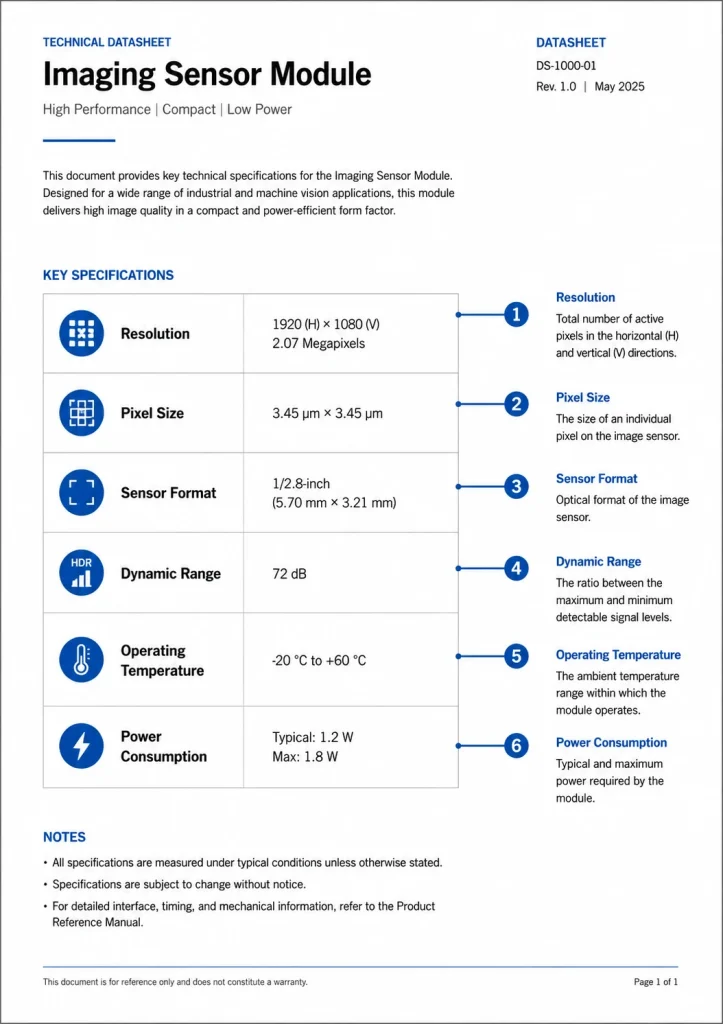
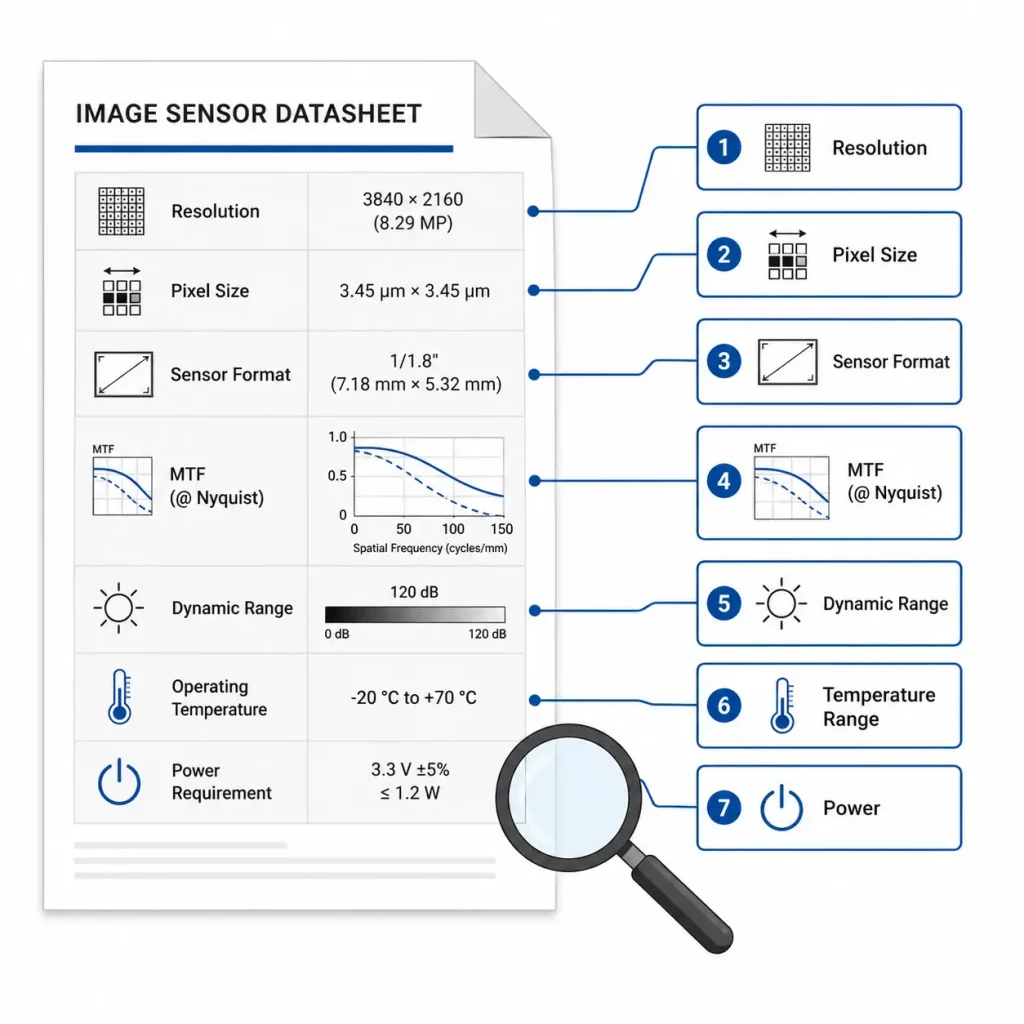
A camera module datasheet packs resolution, pixel size, sensor format, dynamic range, MTF, sensitivity, and operating environment into a single dense page — and misreading any one of these seven parameters in isolation is the most common cause of selecting the wrong module for a project. This guide decodes each spec in plain language, shows how they interact with each other, and gives you a repeatable framework for comparing datasheets from different manufacturers on equal terms.
Key Takeaways
- Resolution alone is meaningless without pixel size — a 48MP sensor with tiny pixels can underperform a 5MP sensor with large pixels in low light.
- Sensor format (1/3", 1/2.8", 1/1.8", etc.) determines lens compatibility and field of view — it is not interchangeable with resolution.
- MTF (Modulation Transfer Function) tells you how sharp the image actually is at a given spatial frequency — two sensors with identical resolution can have very different real-world sharpness.
- Dynamic range and SNR matter more than resolution for any application with variable or harsh lighting.
- Always read typical vs. min/max values — a "typical" spec on the datasheet is not a guarantee across every unit you receive.
Spec 1 — Resolution & Pixel Count
Resolution is the first number every camera module datasheet leads with, expressed as horizontal × vertical pixel count (e.g., 1920×1080) or total megapixels (1920×1080 ≈ 2.07MP). It tells you how finely the sensor divides the image into discrete picture elements — nothing more. A higher resolution number does not automatically mean a sharper, brighter, or more accurate image; it only means more individual sample points across the same physical sensor area or a larger sensor area at the same pixel density.
For machine vision and measurement applications, resolution should be derived backward from your required spatial accuracy: divide your field of view by the smallest feature you need to resolve, then add a safety margin of 2-3x (the "Nyquist" consideration — you typically need at least 2 pixels across the smallest feature to reliably detect it, and more in practice for robust algorithms).
Spec 2 — Pixel Size & the Resolution/Sensitivity Trade-off
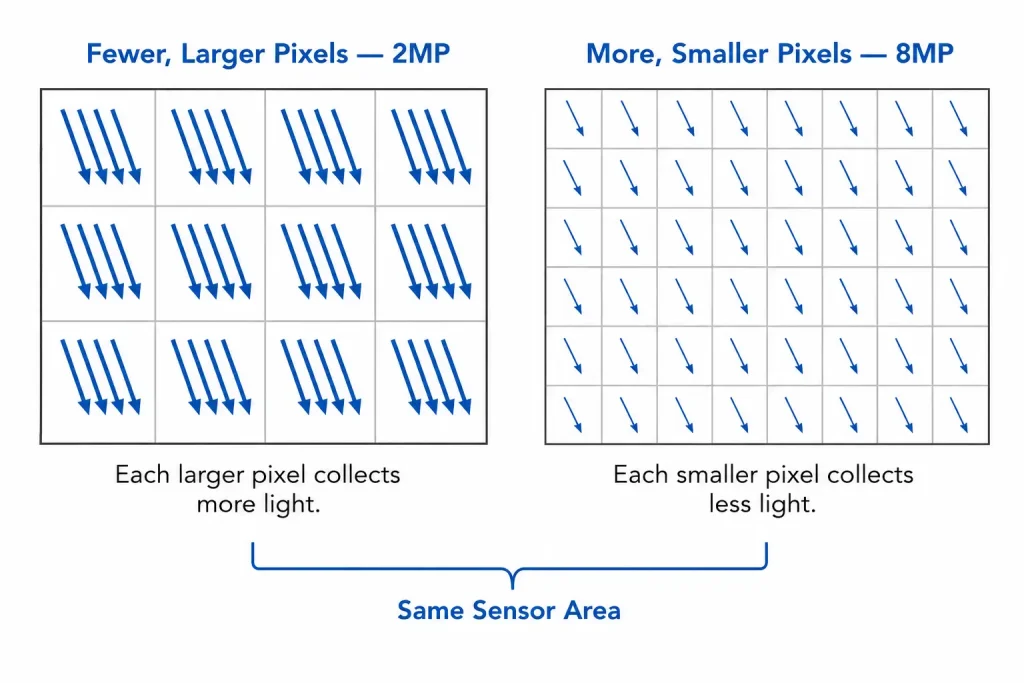
Pixel size, listed in micrometers (µm), is the physical dimension of each individual photodiode on the sensor. This single number explains why two sensors with identical resolution can perform completely differently in real-world conditions. A larger pixel collects more photons per unit of exposure time, directly improving low-light sensitivity and full-well capacity (the maximum charge a pixel can hold before saturating) — which in turn improves dynamic range.
This creates a fundamental engineering trade-off on any fixed sensor format: cramming in more megapixels means shrinking each individual pixel, which reduces per-pixel light-gathering area. A 1/2.8" sensor at 2MP typically uses pixels around 2.9µm; pushing the same physical sensor area to 8MP shrinks pixels to roughly 1.4-1.55µm. The 8MP sensor resolves finer detail in good light, but the 2MP sensor will usually outperform it in low light and high-contrast scenes — neither is universally "better."
Factory Perspective — When More Megapixels Made the Image Worse: "A customer building an outdoor parking access terminal initially specified an 8MP sensor, reasoning that higher resolution would improve their license plate recognition (LPR) algorithm's accuracy at greater distances. When we ran their actual deployment scenario — a camera mounted 4 meters from the vehicle, operating from dawn through dusk including direct low-angle sun exposure at certain times of day — the 8MP module's small 1.45µm pixels saturated and clipped highlights under direct sun, washing out exactly the plate characters their algorithm needed. We re-tested with a 2MP sensor using 2.9µm pixels at the same optical format: the larger pixels' higher full-well capacity preserved detail in the bright plate region instead of clipping it, and the LPR algorithm's read rate improved from 81% to 96% in their field test — despite using a quarter of the resolution. We now run a standard 'worst-case lighting' test for any outdoor LPR or access control inquiry before recommending a sensor, specifically because the megapixel-equals-better assumption is the single most common spec mistake we see from first-time customers." — Smeiker Sensor Engineering Team
Spec 3 — Sensor Format & Field of View
Sensor format (1/4", 1/3", 1/2.8", 1/1.8", 1", etc.) is a legacy naming convention inherited from vidicon tube cameras that predates CCD and CMOS sensors entirely — the number does not directly equal the sensor's physical diagonal in inches, but it is a standardized reference every lens and sensor manufacturer uses consistently. Larger format numbers mean a physically larger sensor area, which generally allows larger pixels (better sensitivity) at any given resolution, but also requires a larger, more expensive lens with a larger image circle to cover the full sensor area.
Critically, sensor format and resolution are independent specs that must both be checked against your lens choice — a lens with a 1/3" image circle will vignette (darken at the corners) or fail to cover a 1/2" sensor, regardless of resolution. M12 lenses typically serve sensor formats up to approximately 1/1.6"; larger formats with global shutter architectures generally require C-mount or CS-mount lenses.
Spec 4 — MTF: Why Resolution Numbers Can Mislead
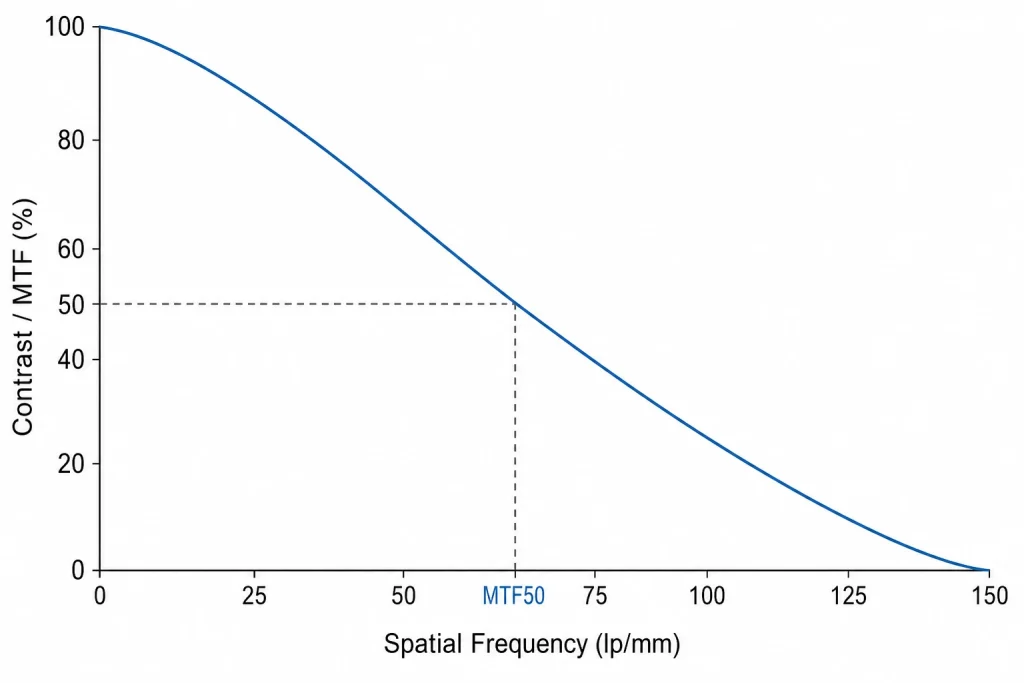
Modulation Transfer Function (MTF) is the spec most frequently omitted from budget camera module datasheets — and the one that explains why two sensors with the same pixel count can produce visibly different image sharpness. As Edmund Optics explains, MTF accounts for the roll-off in contrast that occurs at high spatial frequencies due to pixel crosstalk and finite fill factor — meaning a sensor doesn't deliver 100% contrast simply because its pixel pitch theoretically supports a given resolution.
MTF is typically expressed as a percentage of contrast retained at a given spatial frequency (line pairs per millimeter, lp/mm), often summarized as "MTF50" — the frequency at which contrast drops to 50% of its peak value. Basler's guidance on matching lens and sensor MTF gives a direct formula: pixel size (µm) = 1000 ÷ (2 × lens MTF in lp/mm). A lens rated at 50 lp/mm pairs well with a 10µm pixel; a lens rated at 100 lp/mm is needed to fully exploit a 5µm pixel. Pairing a high-resolution, small-pixel sensor with a lens whose MTF can't keep up wastes the sensor's resolution entirely — the bottleneck simply moves from the sensor to the lens.
When comparing camera module datasheets, request the MTF curve (or at minimum the MTF50 value) for the specific lens+sensor combination, not just the sensor's theoretical resolution — this is especially critical for any quality inspection or measurement application where perceived sharpness directly affects algorithm accuracy.
Spec 5 — Dynamic Range & Signal-to-Noise Ratio (SNR)
Dynamic range, usually expressed in decibels (dB), is the ratio between the brightest and darkest signal levels a sensor can capture simultaneously in a single exposure without clipping highlights or losing shadow detail in noise. A sensor with 60dB dynamic range can capture a scene with roughly 1000:1 brightness ratio between the brightest and darkest usable detail; a sensor rated at 120dB (typically achieved via HDR techniques like dual-exposure or dual-conversion-gain) can handle a 1,000,000:1 ratio — relevant for scenes with both deep shadow and direct sunlight in the same frame, such as a vehicle entering a tunnel or a backlit doorway.
Signal-to-Noise Ratio (SNR) describes how much of the sensor's output signal is genuine image information versus electronic noise, also in dB. SNR and dynamic range are related but distinct: a sensor can have wide dynamic range while still suffering from poor SNR in shadow regions, producing a "noisy" but not "clipped" image. For low-light applications (NIR face recognition, nighttime surveillance), prioritize SNR specs at your actual operating illuminance — datasheet SNR is typically quoted at a specific lux level, and performance at lower light is usually worse than the headline number suggests.
Spec 6 — Operating Environment & Power Consumption
Every camera module datasheet lists an operating temperature range — often −20°C to 70°C for industrial-grade modules, or 0°C to 50°C for consumer-grade. This range covers the full module assembly (sensor, ISP, regulators, PCB), not just the sensor die — and exceeding it can cause performance degradation (increased noise, color shift) well before outright failure. Datasheets for outdoor or harsh-environment applications should also specify humidity and altitude limits, since condensation and reduced convective cooling at altitude both affect long-term reliability.
Power consumption is listed in milliwatts (mW) or as supply voltage + current draw, typically broken into active (streaming) and standby modes. For battery-powered or thermally-constrained designs (drones, handheld devices, fanless enclosures), the active power figure directly impacts both battery life and the thermal budget your enclosure design must dissipate — a module drawing 800mW continuously generates meaningfully more heat than one drawing 200mW, which matters disproportionately in sealed IP-rated enclosures with no active cooling.
Spec 7 — Typical vs. Min/Max Values
Many camera module datasheet parameters list three values: minimum, typical, and maximum. The "typical" value represents expected performance under normal conditions and across a normal production distribution — it is not a guaranteed value for every single unit you receive. For specs where variation matters to your application (power consumption near a thermal limit, dynamic range near a minimum scene requirement), check whether the datasheet's min/max range is tight or wide; a wide spread signals more unit-to-unit variation in production, which may require additional incoming inspection on your end.
Footnotes and appendices in camera module datasheets frequently contain conditions under which the headline spec applies — for example, an SNR figure quoted "at 1000 lux, 1/30s exposure" tells you almost nothing about performance at 50 lux. Always read footnoted test conditions before comparing the same-named spec across two different manufacturers' datasheets, since the test conditions are rarely identical.
| Spec | What It Tells You | What to Watch For |
|---|---|---|
| Resolution | Pixel count, not image quality | Derive from required spatial accuracy, not marketing appeal |
| Pixel Size | Light-gathering ability per pixel | Smaller pixels = less low-light sensitivity at fixed format |
| Sensor Format | Physical sensor size, lens compatibility | Must match lens image circle — independent of resolution |
| MTF | Real-world sharpness at given spatial frequency | Sensor and lens MTF must be matched, not just resolution |
| Dynamic Range / SNR | Highlight/shadow capture range, noise level | Check the lux level the spec was measured at |
| Operating Environment | Temperature, humidity, altitude limits | Applies to full assembly, not just sensor die |
| Typical vs Min/Max | Expected vs guaranteed performance range | Check footnotes for test conditions before comparing across vendors |
How to Use a Camera Module Datasheet Before You Request Samples
Reading a camera module datasheet well means working through the seven specs above in the order your application actually requires them — not the order the datasheet lists them. Start with your real-world constraint (required spatial accuracy, lighting environment, ambient temperature range), then check each spec against that constraint rather than scanning for the "best" number on each line. A datasheet comparison built this way will frequently disqualify the highest-resolution option in favor of a lower-resolution module that actually meets your dynamic range or low-light requirement.
Once you've shortlisted 2-3 candidate modules using this framework, the next step is requesting actual samples rather than relying on datasheet numbers alone — datasheet specs describe the sensor's theoretical capability, while a real sample reveals how the ISP tuning, lens pairing, and assembly quality perform together in your specific environment.
Project Case — Datasheet-Driven Shortlisting: "A mid-sized industrial automation integrator in Germany came to us with three competing camera module datasheets from different suppliers, all claiming '5MP, suitable for inspection.' None of the three datasheets specified MTF, and only one specified dynamic range — and that one was measured at 1000 lux, while their inspection station's actual lighting was closer to 300 lux with significant glare from a nearby window. We worked through the framework in this guide with their engineering team: derived the actual resolution requirement from their smallest defect size (0.3mm at a 200mm field of view, requiring roughly 1300 pixels horizontal minimum — well under 5MP), then prioritized dynamic range and SNR testing at their real 300-lux condition over headline resolution. We supplied two candidate samples — a 2MP and a 3MP module, both with larger pixels than the original 5MP options under consideration — for side-by-side testing on their actual line. The 3MP module's measured SNR at 300 lux beat all three original 5MP candidates' datasheet claims (none of which had been verified at that illuminance), and the customer proceeded to a 2,000-unit annual order. The lesson they took away: a complete datasheet with MTF and condition-specific dynamic range data is worth more than a higher megapixel number with incomplete specs." — Smeiker Applications Engineering Team
Frequently Asked Questions
What are the most important specs on a camera module datasheet?
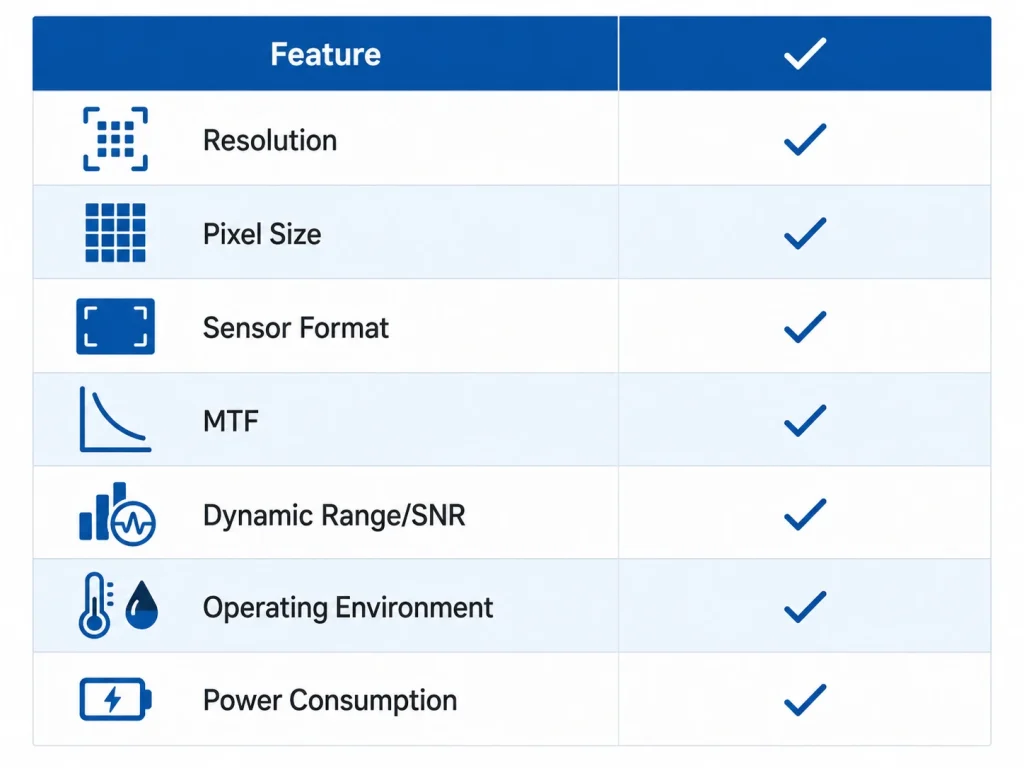
Resolution, pixel size, sensor format, MTF, dynamic range/SNR, operating environment, and power consumption are the seven specs that matter most. No single spec tells the full story — resolution and pixel size must be read together, and sensor format must match your lens choice independently of resolution.
Why does a higher resolution camera module sometimes perform worse?
On a fixed sensor format, more megapixels means smaller individual pixels, which reduces per-pixel light-gathering area and full-well capacity. This degrades low-light sensitivity and dynamic range — so a higher-resolution sensor can underperform a lower-resolution one in challenging lighting, even though it resolves finer detail in good light.
What is MTF on a camera module datasheet?
MTF (Modulation Transfer Function) measures how much image contrast is retained at a given spatial frequency, accounting for real-world losses from pixel crosstalk and lens limitations. MTF50 — the frequency at which contrast drops to half its peak — is a common summary value. It reveals real sharpness that a pixel-count spec alone cannot show.
How do I compare camera module datasheets from different manufacturers?
Check the footnoted test conditions for every spec before comparing — dynamic range, SNR, and low-light sensitivity figures are only comparable if measured under the same illuminance and exposure settings. A spec quoted at 1000 lux from one manufacturer cannot be directly compared to a spec quoted at 50 lux from another.
Should I trust datasheet specs without testing a sample?
Use the datasheet to shortlist 2-3 candidates, but always request and test physical samples before committing to production. Datasheet specs describe sensor theoretical capability; real performance depends on ISP tuning, lens pairing, and assembly quality, which only a physical sample under your actual operating conditions can verify.
Can Smeiker help interpret a camera module datasheet for my application?
Yes. Our applications engineering team routinely reviews datasheets from any manufacturer alongside a customer's actual operating conditions to identify gaps or misleading specs before a sourcing decision is made. Contact us with your application details and any datasheets you're comparing.
Need Help Interpreting a Camera Module Datasheet?
Send us your application requirements — or a datasheet you're already comparing — and Smeiker's applications engineering team will help you identify the specs that actually matter for your project.
Get a Free Quote →