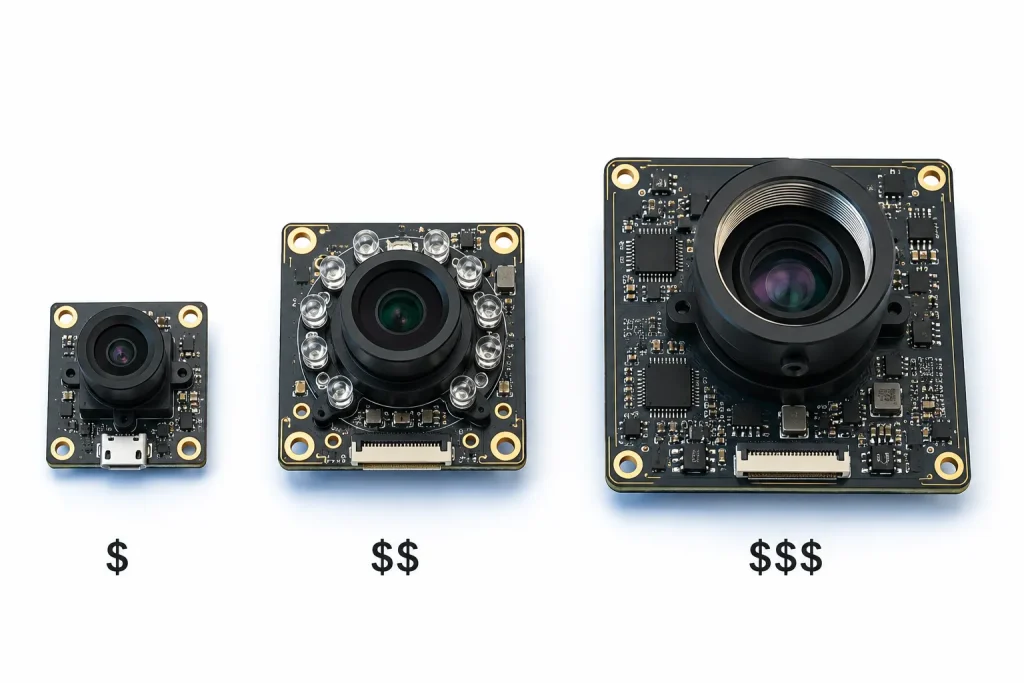
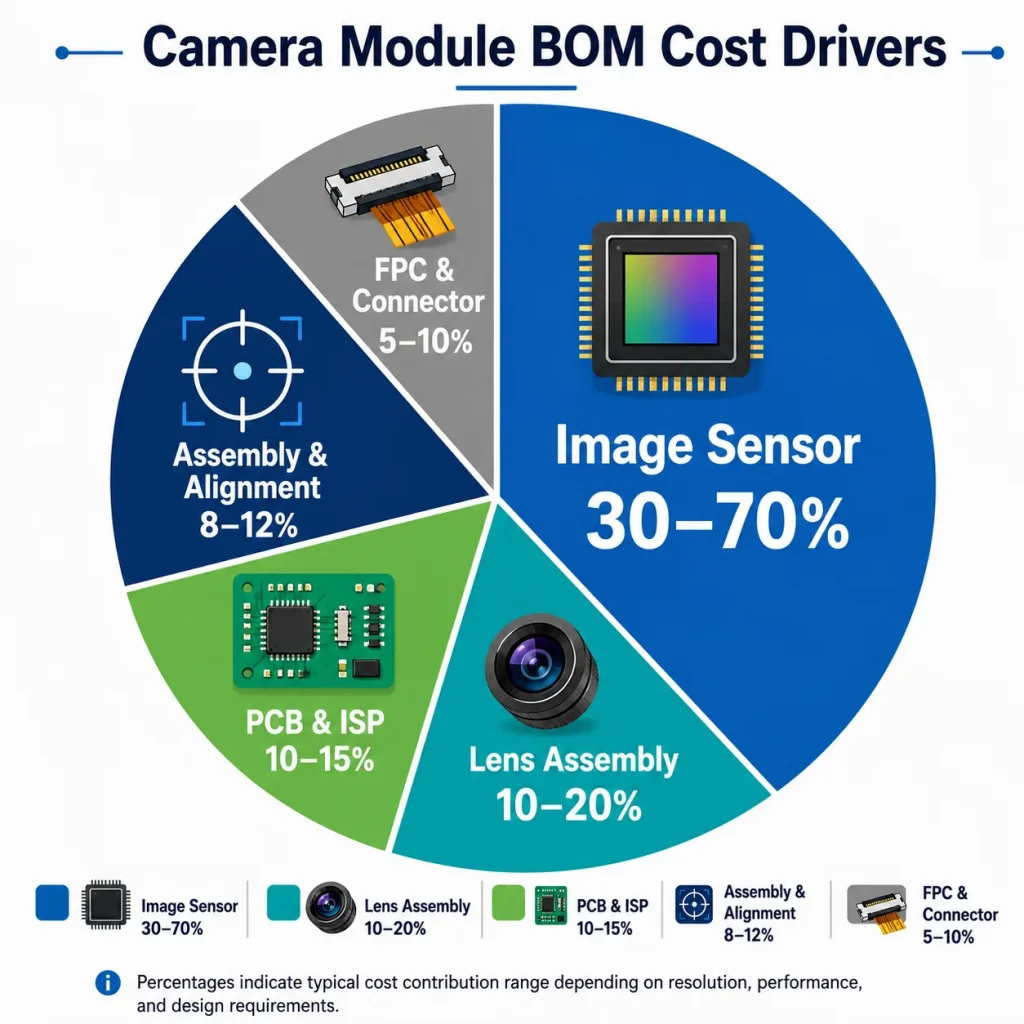
Short answer: Camera module pricing ranges from under $5 for a simple 1MP DVP module to over $150 for a global shutter industrial module with active alignment — with the image sensor alone accounting for 30–70% of the total unit cost depending on resolution and sensor family. The remaining cost is split across lens assembly, PCB, ISP processing, FPC connector, and assembly labor. Getting a quote that accurately reflects your real unit cost requires an itemized BOM-level breakdown, not a single bundled number — because that bundled number hides the variables that will change the price when you modify a spec or scale volume.
The global camera module market was valued at $43.49 billion in 2024 and is projected to reach $102 billion by 2035, spanning everything from sub-$2 consumer modules to specialized medical and automotive modules costing hundreds of dollars per unit. That 50x price spread for what is nominally "the same component category" exists because five independent variables each drive cost in a different direction, and suppliers rarely explain which ones dominate your quote until you ask.
This guide breaks down camera module pricing by BOM line item, explains the non-obvious cost drivers that most quotes don't surface (NRE, active alignment premium, ISP tuning labor, sensor grade vs reject binning), and gives you a practical framework for requesting a quote that lets you compare different suppliers — and different module configurations — on equal terms. Whether you're evaluating your first ODM module at 500 units or negotiating a long-term supply agreement at 50,000 units per year, the same five cost variables determine your unit price.
Key Takeaways
- The image sensor is the largest BOM cost driver — typically 30–70% of total unit cost — and sensor family (Sony Pregius vs Starvis, OmniVision, onsemi) drives as much price difference as resolution.
- Active Alignment (AA) assembly adds $3–8/unit over fixed-jig methods for modules above 5MP; it is not a premium optional feature but a requirement for sharpness consistency at high resolution.
- NRE (Non-Recurring Engineering) cost for ODM customization typically runs $500–$5,000; full OEM $5,000–$50,000+. NRE is usually amortized into unit price over the first production run at agreed MOQ.
- Volume is the most powerful lever: moving from 500 to 5,000 units/year typically reduces unit cost by 20–35%, mostly from sensor and lens procurement discounts.
- Always request an itemized quote — a bundled single price per unit makes it impossible to understand which line item changes when you modify a spec, switch sensors, or scale volume.
Camera Module Pricing: What Each BOM Line Item Actually Costs
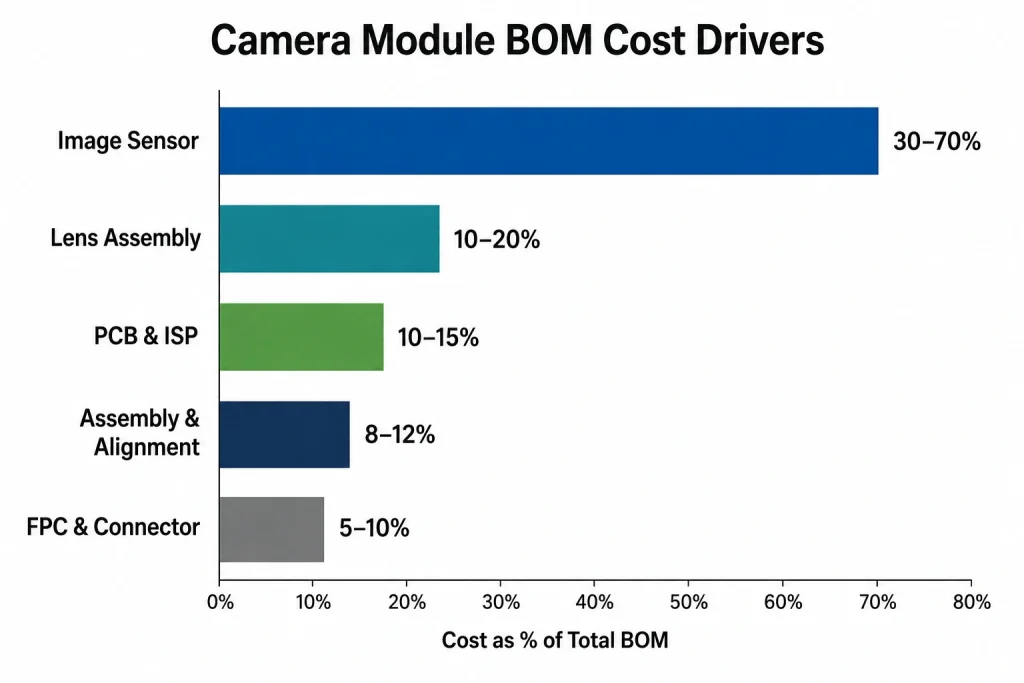
Image Sensor: 30–70% of Total Unit Cost
The CMOS image sensor is almost always the single largest cost line in any camera module, typically representing 30–70% of total unit cost across common B2B module configurations. As industry engineering analysis documents, the delta between a $5 module and a $150 module exists almost entirely in the grade and generation of these sensor components.
Within a given pixel resolution, sensor family drives far more price variation than most buyers expect:
- Sony Starvis / Starvis 2 (rolling shutter, BSI): IMX415 (8MP), IMX678 (8MP Starvis 2) — premium positioning due to market-leading low-light performance; command a 30–60% price premium over equivalent-resolution OmniVision sensors.
- Sony Pregius / Pregius S (global shutter): IMX296 (1.6MP), IMX265 (3.1MP) — global shutter architecture adds significant cost over rolling shutter at the same resolution; Pregius sensors typically cost 40–80% more than a Starvis equivalent at matching pixel count.
- OmniVision (rolling shutter): OV9782, OV4689, OV2710 — cost-optimized sensors at each resolution tier; typically 20–50% less expensive than Sony equivalents, with slightly lower SNR and dynamic range in most scenarios.
- Sensor grade / binning: sensor manufacturers produce wafers with varying yield distributions — "Grade A" sensors meet the full spec, lower grades may have marginal dead pixels or noise floor specs. Some suppliers quote lower-priced modules built on lower-grade bins; always specify Grade A in your purchase agreement if image consistency matters.
Understanding camera module pricing starts with understanding sensor economics: the manufacturer who quotes you the lowest single number may be using a different sensor grade, a competing sensor family with lower sensitivity, or a sensor approaching end-of-life that they're clearing inventory on. An itemized quote exposes this immediately; a bundled price conceals it entirely.
Lens Assembly: 10–20% of Total Unit Cost
The lens assembly cost is driven by three independent variables: element count, material (plastic vs glass), and mount type. Budget M12 plastic lenses with 3–4 elements for standard FOV applications cost under $1; glass-hybrid industrial lenses with 6–7 elements, wide FOV, and IR-coating for outdoor deployment cost $8–15 each. The choice matters disproportionately at resolutions above 5MP, where a cheap lens limits what the sensor can deliver — you're paying for a high-resolution sensor but getting the image quality of a lower-resolution system because the lens is the sharpness bottleneck.
Factory Perspective — The Hidden Lens Upgrade Cost: "A customer sourcing 5MP MIPI modules for an outdoor traffic monitoring system initially chose the lowest-cost lens option in our configurator — a 4-element plastic M12 at $0.85/unit. In lab testing at room temperature, image sharpness was acceptable. But when we ran temperature cycling between −20°C and 70°C (their enclosure specification), the plastic lens barrel's thermal expansion caused a measurable focus shift of roughly 12 µm — equivalent to moving the focal plane by about 0.4 mm — at the cold extreme. This produced consistently soft images during winter night operation. Replacing the lens with a glass-core 5-element variant at $3.20/unit (a $2.35/unit increase) eliminated the thermal focus drift entirely. On a 3,000-unit annual order, the upgrade cost $7,050/year more — versus the alternative cost of field returns, which their project manager estimated at $180–$220 per unit replacement call. The lesson: lens material specification isn't a premium option; it's a reliability decision that must be made against the product's actual operating environment." — Smeiker Optical Engineering Team
PCB, ISP, Assembly Process & FPC: The Remaining 30–50% of Unit Cost
PCB & ISP: 10–15%
PCB cost is driven by board size, layer count, and material requirements. A standard 4-layer FR4 PCB for a compact 25×25mm MIPI module costs $0.15–$0.60 in volume; a custom-shaped or multi-layer design increases this. If the camera module includes an onboard ISP (Image Signal Processor) — common in USB modules where the ISP handles the RAW-to-JPEG conversion before the USB controller — the ISP chip adds $1.50–$8 per unit depending on capability. MIPI modules destined for host SoCs with onboard ISPs don't need a separate ISP chip in the module, which reduces BOM cost but requires the host's ISP to be tuned for your specific sensor.
Assembly & Active Alignment: 8–12%
Assembly labor is the cost line that most suppliers quote narrowly — but the method of lens assembly dramatically affects this figure and the associated quality outcome. Fixed-jig assembly (lens placed by mechanical jig, bonded in position) costs roughly $0.40–$1.20/unit in labor at volume. Active Alignment (AA) assembly — where the lens is adjusted on a 6-axis motorized stage while monitoring live image sharpness before bonding — costs $2.50–$5.00/unit more in labor but eliminates micron-level misalignment as a yield-loss source. For modules below 3MP or in cost-sensitive consumer applications, fixed-jig is acceptable. For any module above 5MP, or any application where corner sharpness uniformity matters, AA is the correct choice and its cost premium should be treated as a reliability requirement, not an optional upgrade. Our camera module quality control guide covers why AA alignment directly reduces field-return rates.
FPC Connector & Cable: 5–10%
FPC (Flexible Printed Circuit) connector cost scales with pin count, pitch, and cable length. A standard 15-pin 0.5mm pitch FPC connector adds $0.08–$0.20/unit; a custom 30-pin assembly with a 200mm cable can reach $0.80–$1.50/unit. Cable length customization — one of the most common ODM requests — adds $0.15–$0.60/unit in material cost depending on length increment. Specify your exact required cable length in your RFQ rather than accepting a supplier's standard length; this is a cost you should control, not discover as a surprise in a revised quote.
NRE, MOQ & Volume: The Non-BOM Cost Drivers
Camera module pricing has two distinct structures: recurring unit cost (the BOM-driven cost that repeats with every unit ordered) and non-recurring engineering (NRE) cost that is paid once per design. Understanding the difference between them — and how NRE gets amortized into quoted unit prices — is what makes two "identical" quotes from different suppliers actually incomparable if only the unit price is considered.
NRE: What It Covers and Typical Ranges
As defined in our OEM vs ODM guide, NRE covers the engineering work done once to configure or design a camera module for your specific requirements. For ODM customization, this typically includes PCB profile modification, lens selection and AA calibration setup, ISP register tuning for your lighting environment, and FPC connector customization. For full OEM, it also includes PCB schematic, layout, and DFM review.
| NRE Type | What It Covers | Typical NRE Range | Sample Lead Time |
|---|---|---|---|
| Standard ODM (minor customization) | Lens swap, ISP tuning, FPC length | $500 – $2,000 | 4 – 8 weeks |
| Extended ODM (PCB form factor change) | Custom PCB shape, connector pinout, NIR LED ring integration | $2,000 – $5,000 | 8 – 12 weeks |
| Full OEM (client-designed PCB) | PCB schematic + layout, DFM review, full ISP calibration | $5,000 – $50,000+ | 12 – 20 weeks |
Volume: The Most Powerful Price Lever
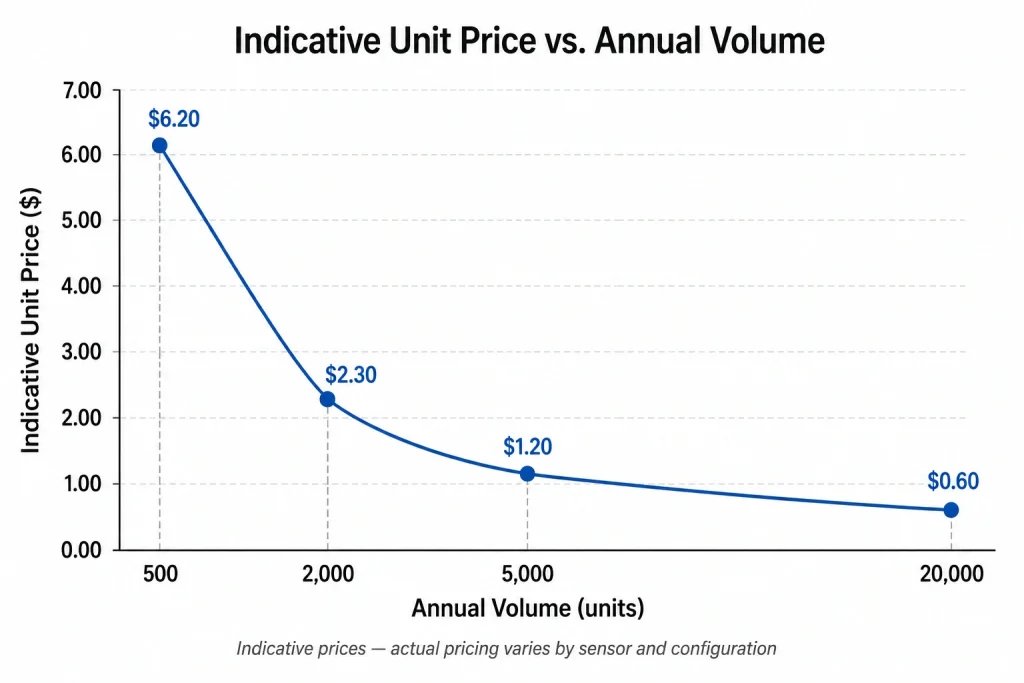
Volume affects camera module pricing through two mechanisms: supplier procurement discounts on sensors and lenses at higher quantities, and fixed overhead amortization across more units. The relationship is not linear — the largest price drops occur when crossing key volume thresholds that unlock next-tier sensor pricing from the sensor manufacturer. A representative price progression for a 2MP USB module with Sony OV9782 sensor and standard M12 lens at Smeiker's current pricing tiers:
| Annual Volume | Unit Price (indicative) | Unit Price vs 500/yr |
|---|---|---|
| 500 units/year | ~$18.50 | Baseline |
| 2,000 units/year | ~$15.20 | −18% |
| 5,000 units/year | ~$12.80 | −31% |
| 20,000 units/year | ~$10.40 | −44% |
Note: Prices above are indicative examples for illustration and will vary by sensor availability, lens selection, and customization requirements. Request a current quote for your specific configuration.
If your initial volume is genuinely at 500 units but you expect to scale to 5,000 within 18–24 months, share that roadmap with your supplier at the RFQ stage — some manufacturers will offer a reduced NRE in exchange for a volume commitment, effectively reducing your total cost of entry in exchange for a supply agreement they can plan against.
How to Request a Camera Module Quote That Gets Compared Fairly
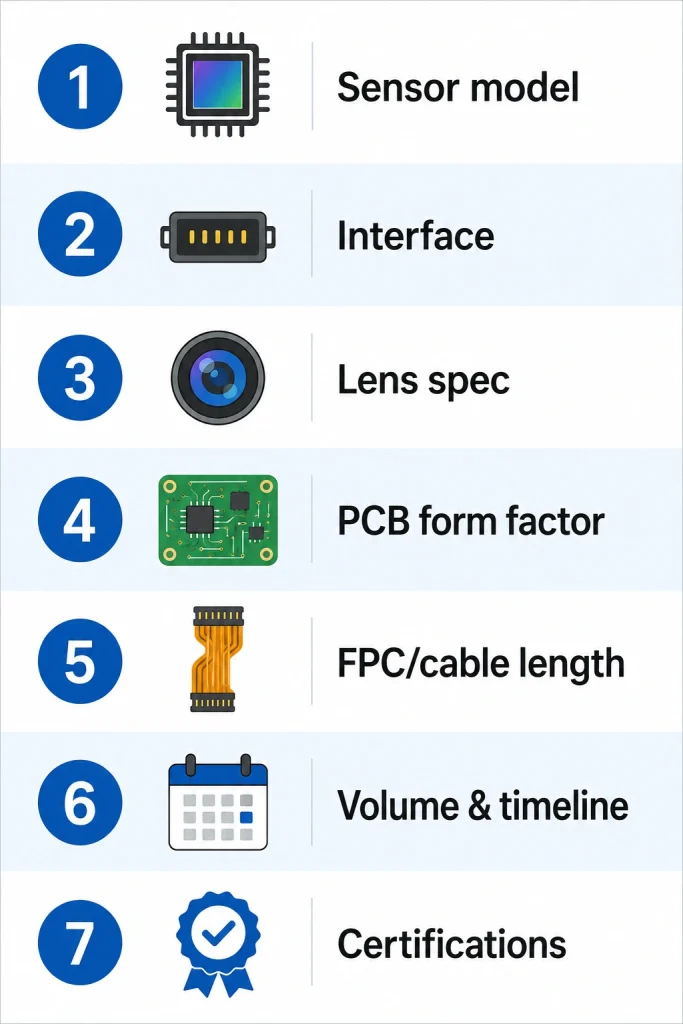
Most suppliers will respond to a vague RFQ ("need a 2MP USB camera module, ~500 units") with a bundled unit price that is impossible to compare against quotes from other suppliers — because the sensor grade, lens element count, ISP, FPC length, NRE treatment, and MOQ assumptions embedded in that price are all invisible. The following information, provided upfront in your RFQ, converts your enquiry from a transaction into a technical document that forces apples-to-apples responses:
- Sensor specification: name the exact sensor model (e.g., OmniVision OV9782), or specify minimum pixel size, shutter type (global/rolling), and required NIR sensitivity if a specific model isn't yet defined.
- Interface: USB (specify 2.0 or 3.0, UVC required or not), MIPI (specify lane count and host SoC), or DVP.
- Lens specification: FOV, M12 or CS mount, fixed focus or autofocus, focal length, material (plastic or glass core), IR-cut filter configuration.
- PCB form factor: target PCB dimensions or maximum envelope, any cutout/shape requirements, connector location preference.
- FPC/cable length: exact length in mm, connector pitch (0.5mm or 1.0mm), pin count requirements.
- Volume and timeline: initial order quantity, annual volume forecast for years 1 and 2, required delivery date for first samples.
- Certifications needed: CE, FCC, RoHS — and which markets the finished product will be sold into.
Request the response in the same itemized structure — sensor, lens, PCB+ISP, assembly, FPC, NRE (shown separately, not amortized into unit price without disclosure), and any tooling costs. A professional camera module manufacturer will respond in this format without resistance; a trading company reselling another factory's product often cannot, because they don't have visibility into the BOM themselves.
Project Case — How an Itemized Quote Revealed a Sensor Grade Issue: "A European AGV manufacturer had been receiving quotes for a 4MP global shutter MIPI module from three suppliers. Two quoted within $0.80 of each other per unit; the third was $4.20 lower. When we responded with a fully itemized BOM breakdown, our applications team immediately noticed that the low-cost quote's sensor line item was priced approximately $3.50 below the spot market rate for Grade A Sony IMX252 — which implied either a different sensor grade or a different sensor entirely. We recommended the customer request samples from all three suppliers and run a controlled dead-pixel and uniformity test across 10 units from each. The low-cost supplier's samples showed an average dead pixel count of 3.2 per unit versus 0.1 per unit from the other two suppliers — statistically consistent with a lower sensor bin grade. The customer chose our quote at the mid-range price; they estimated the cost of re-testing and replacing returned units in the field would have exceeded the apparent $4.20/unit savings within the first two quarters of production. The bill of materials level of transparency is the difference between a price comparison and a quality comparison." — Smeiker Technical Sales Engineering Team
For a current itemized quote on any Smeiker module configuration, contact our engineering team with the specification points above — we respond within 48 hours with a fully itemized breakdown, not a single bundled number.
Frequently Asked Questions
What is the typical camera module pricing for a 2MP USB module?
Camera module pricing for a standard 2MP USB (UVC-compliant) module with OmniVision OV2710 or OV9782 sensor, fixed M12 lens, and standard 15-pin FPC typically ranges from $12–$22 at 500–1,000 units. Sony sensor variants (IMX415 etc.) carry a 30–50% premium at the same volume. Pricing decreases meaningfully at 5,000+ units annually.
Why do camera module quotes from different suppliers vary so much?
Quote variation usually reflects differences in sensor grade, sensor family (Sony vs OmniVision vs onsemi), lens material and element count, assembly method (active alignment vs fixed jig), and whether NRE is disclosed separately or silently amortized into unit price. Requesting an itemized BOM-level quote from each supplier makes these differences visible and comparable.
How much does NRE cost for a custom camera module?
NRE for standard ODM customization (lens swap, ISP tuning, FPC length) typically runs $500–$2,000 with 4–8 week sample lead time. Extended ODM with custom PCB form factor runs $2,000–$5,000, 8–12 weeks. Full OEM with client-designed PCB is $5,000–$50,000+, 12–20 weeks. NRE can often be credited against the first production order; confirm this in your supply agreement.
How does volume affect camera module price?
Volume is the most powerful pricing lever after sensor family selection. Moving from 500 to 5,000 units/year typically reduces unit cost by 25–35%, driven primarily by sensor and lens procurement discounts. The largest drops occur at key volume thresholds (typically 1,000, 5,000, and 20,000 units) that unlock next-tier sensor pricing from the manufacturer.
Is Active Alignment worth the extra cost in a camera module?
For modules above 5MP or any application where corner sharpness uniformity matters (machine vision, face recognition, inspection), active alignment is not optional — it is the production method that prevents micron-level misalignment from reaching your product. The $3–8/unit premium is significantly lower than field-return costs if a batch with misaligned lenses escapes into production.
How long does it take to get a camera module quote from Smeiker?
An itemized quote for a standard ODM configuration is typically returned within 24–48 hours of receiving a complete specification (sensor, interface, lens, PCB envelope, FPC, volume, and certification requirements). Complex or full OEM configurations requiring DFM review may take 3–5 business days for a complete pricing response.
Get an Itemized Camera Module Quote Within 48 Hours
Share your sensor, interface, lens, PCB, volume, and certification requirements. Smeiker returns a fully itemized BOM-level quote — sensor, lens, PCB, assembly, FPC, and NRE shown separately — so you can compare it accurately against other options.
Request a Quote →