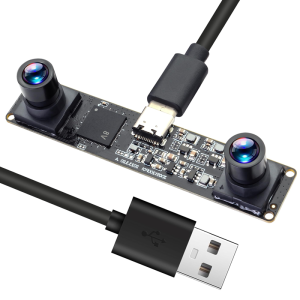
The color binocular camera module and RGB+IR binocular camera module have significant differences in technical principles and application scenarios, mainly reflected in imaging methods, applicable environments, and functional focus. The main application differences between the two are as follows:
1. Imaging principle and functional differences
Color binocular camera module
Using two RGB cameras, depth information is calculated through binocular stereo vision algorithm, mainly used for 3D reconstruction, visual navigation, obstacle avoidance and other scenes.
Dependent on ambient light, it performs well under sufficient illumination, but its performance decreases in low light or all black environments.
Typical applications: Mobile robots (such as service robots, unmanned vehicles) AR/VR、 Environmental perception in autonomous driving.
RGB+IR binocular camera module
Composed of an RGB camera and an infrared (IR) camera, it has both visible light and infrared imaging capabilities.
IR cameras can work in low or no light environments and are suitable for scenarios such as live detection, nighttime monitoring, and facial recognition anti-counterfeiting.
Due to the fact that infrared light is not affected by visible light interference, it can effectively resist fake face attacks such as photos and screens, and is suitable for fields with high security requirements such as security, financial payments, etc
3. Typical application scenarios
Color binocular camera module
Mobile robots (such as MYNT EYE S Color, used for SLAM and obstacle avoidance).
Autonomous driving (environmental perception, lane detection).
AR/VR (spatial positioning, gesture interaction).
RGB+IR binocular camera module
Financial payment/access control system (live detection to prevent photo/video attacks).
Intelligent security (night monitoring, infrared thermal imaging).
Vehicle monitoring (driver status monitoring, such as fatigue detection).
4. Technological development trends
Color binocular modules are developing towards higher resolution and lower latency, combined with IMU (Inertial Measurement Unit) to improve SLAM accuracy.
RGB+IR modules tend towards multispectral fusion (such as RGB+IR+ToF) to enhance their all-weather environmental adaptability.
Color binocular modules are more suitable for scenes that require high-precision 3D environment perception, such as robots and autonomous driving. RGB+IR binocular modules are more suitable for scenarios with high requirements for live detection and anti-interference ability, such as security authentication and low light monitoring.