
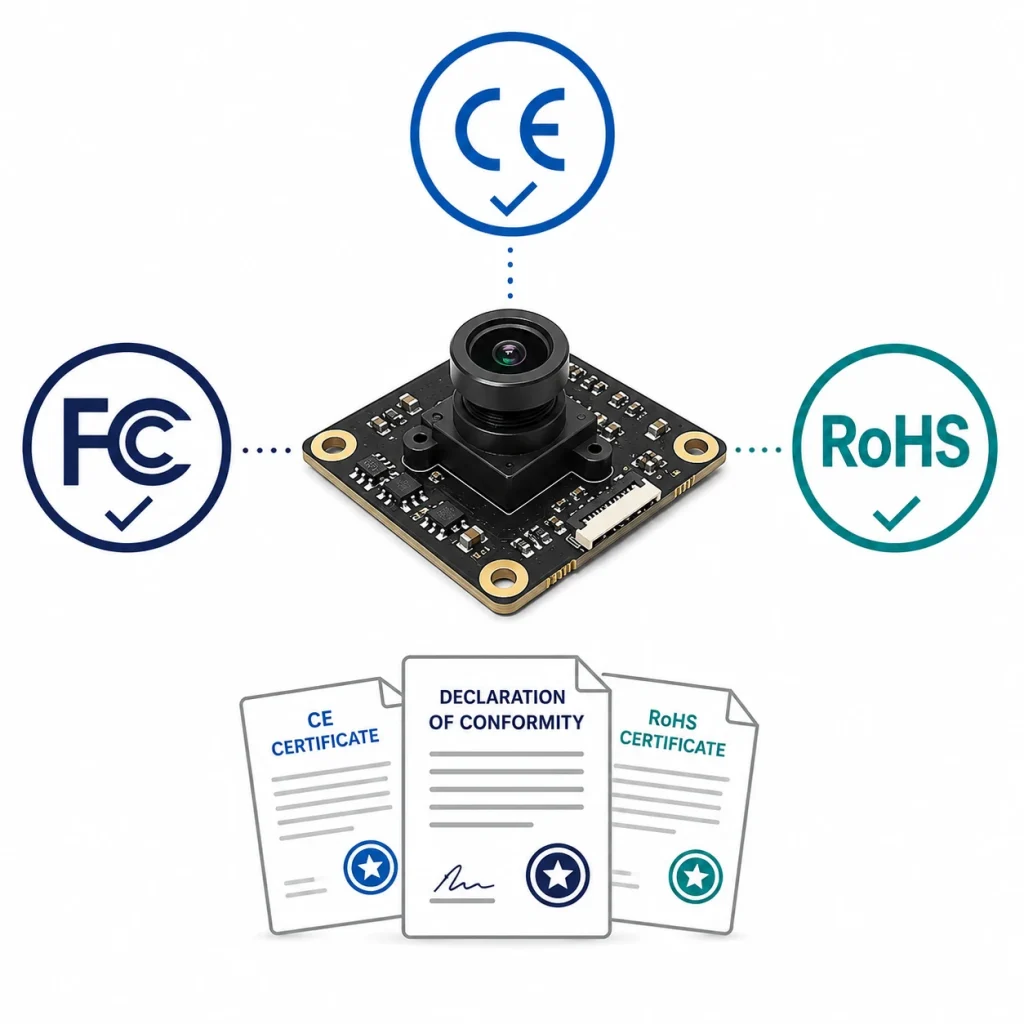
Camera module certifications — CE, FCC, and RoHS — determine whether the modules you source can legally support your finished product's market entry. Modules sold into the EU require CE marking and RoHS compliance; modules sold into the US require FCC compliance for any unintentional radiator (which includes virtually all digital camera modules, even without wireless radios). For OEM buyers, the critical distinction is this: a camera module's certification documentation supports — but does not replace — your own final product's certification. Understanding what each camera module certification actually covers, and what documentation you need to request, prevents costly compliance gaps discovered late in your product's certification process.
Key Takeaways
- CE marking is mandatory for any product entering the EU/EEA market and covers EMC, safety (LVD), and RoHS — a camera module itself is a component, but its EMC characteristics directly affect your final product's CE compliance.
- FCC compliance applies to "unintentional radiators" under Part 15 Subpart B — this includes camera modules with digital clocks/oscillators, even without wireless connectivity. Your final product needs its own FCC authorization regardless of module-level testing.
- RoHS 3 (Directive 2015/863/EU) restricts 10 substances; as of July 22, 2024, industrial monitoring and control instruments — including many machine vision camera modules — lost their previous RoHS exemption.
- A module-level "RoHS compliant" claim means the component itself meets substance restrictions — it does not certify your finished product, but it is required documentation you must collect from every component supplier.
- Smeiker provides full compliance documentation packages — material declarations, RoHS test reports, and CE Declaration of Conformity for our camera modules — to support your OEM certification process.
Camera Module Certifications: CE Marking Explained
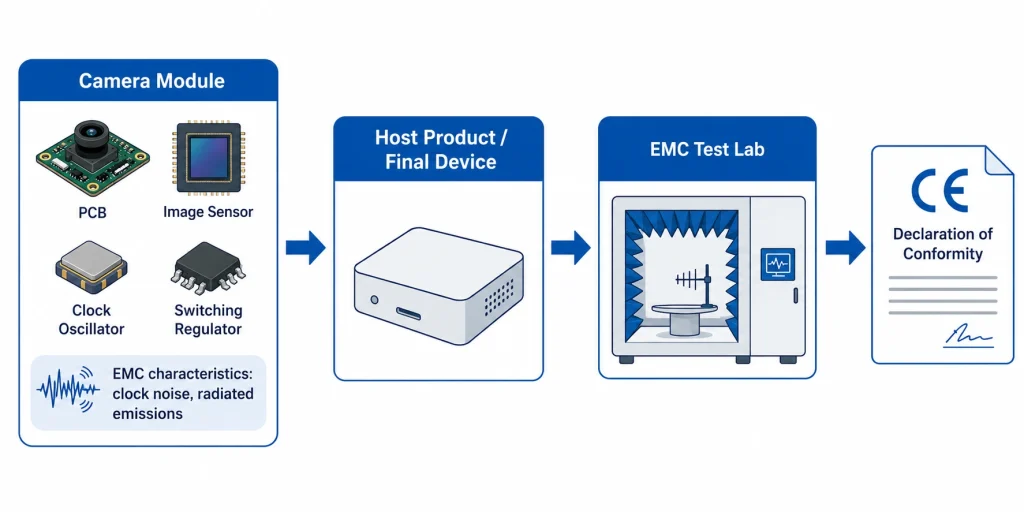
CE marking is a mandatory conformity mark for products sold within the European Economic Area (EEA). For electronic products like camera modules, CE marking is not a single test — it is a declaration that the product complies with all applicable EU directives, most commonly the EMC Directive (2014/30/EU) and, where relevant, the Low Voltage Directive (2014/35/EU) and RoHS Directive (2011/65/EU as amended by 2015/863/EU).
CE marking works on a self-declaration basis — the manufacturer (or the responsible party placing the product on the EU market) tests the product against harmonized standards, compiles a Technical Construction File, and signs a Declaration of Conformity (DoC). There is no central "CE certificate" issued by an EU authority for most electronic products; the CE mark is the manufacturer's own legal declaration, backed by test evidence.
What This Means for a Camera Module Specifically
A bare camera module — a PCB with a sensor, lens, and FPC connector, intended for integration into another product — is technically a component, not an end product, and is not independently CE-marked in the traditional sense. However, the module's EMC characteristics (clock frequencies, switching regulator noise, radiated emissions from the FPC/PCB) directly contribute to your final product's EMC test results. A camera module with poorly filtered switching regulators or unshielded high-speed MIPI/USB traces can cause your finished product to fail EMC testing even if every other component is clean.
For OEM buyers, the practical question is not "is this module CE marked?" but rather: "has this module been characterized for EMC performance, and can the supplier provide test data or a reference design that has passed CE EMC testing in a similar host enclosure?" Reputable camera module suppliers can provide reference EMC test reports from prior customer integrations, which significantly de-risks your own CE testing.
FCC Compliance: Unintentional Radiators and Why Camera Modules Are Included
Many OEM buyers assume FCC compliance only applies to products with wireless radios (Wi-Fi, Bluetooth, cellular). This is incorrect. Under 47 CFR Part 15 Subpart B, any digital device that uses a clock signal above 9 kHz — which includes every camera module with a pixel clock, MIPI/USB serializer, or microcontroller — is classified as an "unintentional radiator" and is subject to FCC emissions limits.
Module-Level vs Product-Level FCC Authorization
For products containing wireless transmitters, the FCC offers Modular Approval — a radio module can receive its own FCC ID under a Grant of Equipment Authorization, which can then be referenced by host product manufacturers. However, as CEL's FCC certification guide emphasizes, a pre-certified module's approval helps but does not fully exempt the final product from FCC testing — the module's prior approval doesn't replace verifying the final device's compliance, since the host's enclosure design, antenna configuration, and additional components can alter overall emission characteristics.
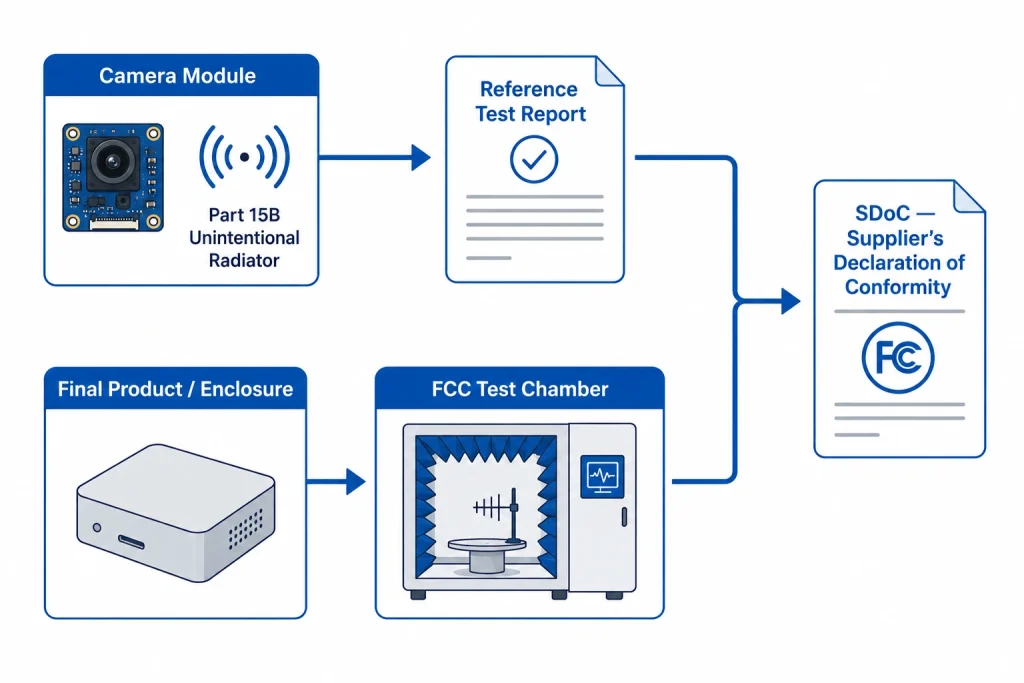
Camera modules typically do not contain wireless transmitters (the camera itself transmits image data over wired MIPI/USB, not RF) — so Modular Approval generally does not apply to camera modules themselves. Instead, camera modules fall under Part 15 Subpart B (unintentional radiators), and most products use the Supplier's Declaration of Conformity (SDoC) pathway — self-testing against FCC Part 15B limits, without filing with the FCC, but with test records retained for 2 years.
What This Means for Your Final Product
- Your finished product — kiosk, AGV, drone, access control terminal — containing a camera module needs its own FCC Part 15B testing and SDoC, regardless of any module-level claims.
- A camera module supplier's "FCC compliant" claim, if accurate, typically means: the module was tested in a reference host configuration and met Part 15B radiated/conducted emissions limits in that configuration. This is useful reference data — but your final enclosure, PCB layout, and additional components change the emissions profile.
- Request from your camera module supplier: the reference test report (showing test setup, frequency range, and measured emissions vs. limits), and any layout/shielding recommendations that contributed to passing results — these recommendations are directly actionable for your own PCB design.
RoHS & REACH: What's Actually in Your Camera Module
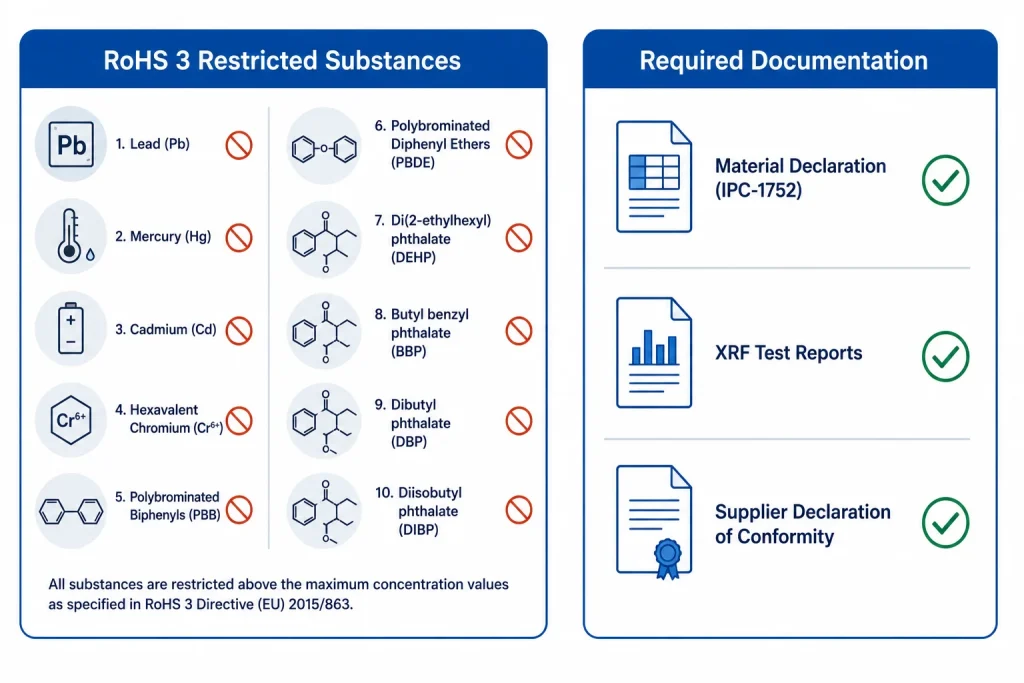
RoHS (Restriction of Hazardous Substances, Directive 2011/65/EU, updated by RoHS 3 / 2015/863/EU) restricts 10 substances in electrical and electronic equipment sold in the EU: lead, mercury, cadmium, hexavalent chromium, PBB, PBDE, and four phthalates (DEHP, BBP, DBP, DIBP) added under RoHS 3. REACH (Registration, Evaluation, Authorisation and Restriction of Chemicals) is a separate, broader EU regulation covering over 230 Substances of Very High Concern (SVHCs) across all articles — not just electronics — including packaging, cables, and adhesives.
The 2024 RoHS Exemption Change That Affects Industrial Camera Modules
A critical regulatory change for B2B camera module buyers: as of July 22, 2024, industrial monitoring and control instruments lost their previous RoHS exemption. Previously, "Category 9" industrial monitoring and control equipment had extended exemptions for certain substances (notably leaded solder in specific high-reliability applications). Camera modules destined for industrial machine vision, factory automation, and similar Category 9 applications must now meet the same substance restrictions as consumer electronics — meaning lead-free solder, RoHS-compliant components throughout the BOM, and updated material declarations from every component supplier.
What "RoHS Compliant" Documentation Should Include
- Material Declaration: A document listing each component in the module's BOM with its RoHS compliance status, typically in IPC-1752 or similar format.
- Third-party test reports: For critical components (solder, PCB substrate, connector plating), XRF (X-ray fluorescence) test reports from accredited labs confirming substance levels below RoHS thresholds.
- Supplier Declaration of Conformity: A signed statement from the camera module manufacturer declaring RoHS 3 compliance for the specific part number and revision you are purchasing.
Factory Perspective — RoHS 3 Exemption Change Impact: "When the Category 9 RoHS exemption for industrial monitoring and control equipment expired in July 2024, we audited our entire camera module BOM for components that had previously relied on that exemption. We found two issues: a specific high-temperature solder alloy used on one global shutter module's lens bonding process contained lead above the new threshold, and a connector plating supplier's gold-flash process used a cadmium-based undercoat on one connector series. We requalified the lens bonding process with a lead-free high-temp solder alternative — validated through 200 thermal cycles (-40°C to 85°C) with no bond failures — and switched the connector to a nickel-underplate gold-flash alternative from a different supplier, verified via XRF testing showing cadmium below 100 ppm (RoHS limit). We updated material declarations for all affected SKUs and notified the small number of customers whose existing approved BOMs referenced the old connector part number, providing a pin-compatible replacement with updated documentation. This kind of regulatory change tracking is now a standing quarterly review item for our compliance team — because a single overlooked component can invalidate a customer's entire product certification." — Smeiker Compliance & Quality Engineering Team
How to Verify a Supplier's Certification Claims
Verifying camera module certifications before placing a purchase order — rather than after your own product enters testing — is the single highest-leverage compliance step an OEM buyer can take.
A common and serious risk in B2B camera module sourcing is suppliers claiming "CE, FCC, RoHS compliant" without underlying documentation. As industry compliance guidance notes, these marks are legal gateways, not optional badges — a device missing valid documentation cannot legally support your product's market entry, and discovering this during your own certification process can cost weeks of schedule and tens of thousands of dollars in redesign.
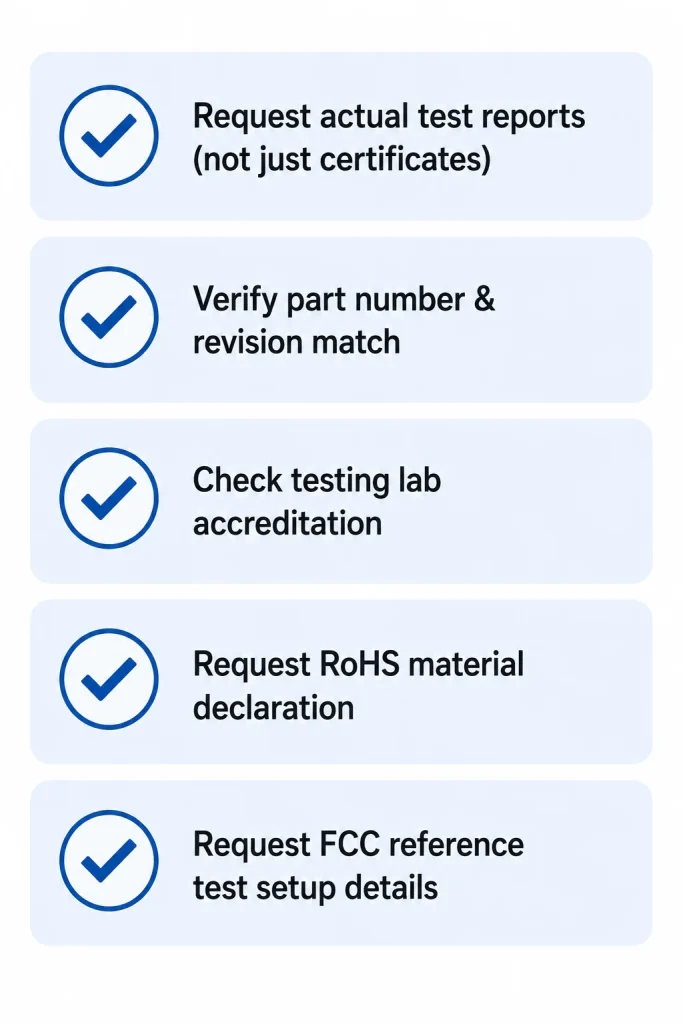
Verification Checklist for OEM Buyers
- Request the actual test report, not just a certificate summary. A genuine RoHS or EMC test report shows the testing lab name, accreditation number, test date, specific part number/revision tested, test methodology (standard reference), and measured results vs. limits. A one-page "certificate" with no underlying data is insufficient.
- Verify the part number and revision match what you're purchasing. Compliance documentation is specific to a part number and hardware/firmware revision. A supplier may have valid documentation for "Module X Rev A" while shipping you "Module X Rev B" with a different BOM — verify the revision matches.
- Check the testing lab's accreditation. Reputable labs (TÜV Rheinland, Bureau Veritas, SGS, Intertek, and accredited regional labs) are verifiable via their accreditation body registries. A test report from an unaccredited or unverifiable lab carries no legal weight.
- For RoHS, request the material declaration in addition to the test report. The material declaration covers the full BOM; the test report typically covers spot-check verification of specific high-risk components (solder, plating, plastics).
- For FCC, request the reference test setup details. If a module passed Part 15B testing in a reference enclosure, ask what that enclosure was, what shielding/grounding was used, and whether the test report includes a measurement plot (not just a pass/fail statement).
Project Case — Compliance Documentation Gap Discovered at DVT: "A North American smart kiosk manufacturer came to us mid-program after their existing camera module supplier's RoHS documentation failed verification during the customer's own product CE certification process. The original supplier had provided a one-page document titled 'RoHS Certificate' with no test data, accreditation reference, or part-number traceability — the customer's compliance consultant flagged it as insufficient. With their CE certification deadline three weeks away and a contractual penalty clause for delay, the customer needed a drop-in replacement module with verifiable documentation fast. We supplied our equivalent USB camera module (OmniVision OV9782-based) with a complete documentation package: IPC-1752 material declaration covering all 47 BOM line items, third-party XRF test reports from a TÜV-accredited lab covering solder, PCB substrate, and connector plating, and a signed Supplier Declaration of Conformity referencing the specific part number and PCB revision. The module was pin- and software-compatible with the original supplier's part, requiring zero firmware changes. The customer's compliance consultant approved the documentation within 48 hours, and the customer's CE certification proceeded on schedule. We now provide this documentation package as standard with every camera module shipment, specifically because this kind of late-stage discovery is common and costly for our customers." — Smeiker Compliance Documentation Team
Other Camera Module Certifications & Smeiker's Documentation Packagee
While CE, FCC, and RoHS dominate compliance discussions for products sold into the EU and US, other markets impose their own requirements that camera module buyers exporting globally should be aware of:
- UKCA (UK Conformity Assessed): Replaced CE marking for Great Britain post-Brexit, with similar scope but UK-designated standards and a UK-based responsible person requirement.
- RCM (Regulatory Compliance Mark): Australia/New Zealand's combined mark for EMC, safety, and telecommunications — commonly required alongside CE/FCC for products sold in those markets.
- CCC (China Compulsory Certification): China's mandatory certification scheme for products in the "Catalogue of Mandatory Product Certification" — relevant if your finished product (not typically the camera module component itself) falls within scope and is sold domestically in China.
Smeiker's Compliance Documentation Package
For every camera module shipped, Smeiker provides a standard compliance documentation package supporting your OEM certification process:
- RoHS 3 Material Declaration (IPC-1752 format) covering the full BOM, updated for the 2024 Category 9 exemption changes
- Third-party XRF test reports for solder, PCB substrate, and connector plating from accredited testing labs
- Reference EMC test data from prior customer integrations to support your own CE/FCC pre-compliance planning
- Supplier's Declaration of Conformity referencing your specific part number and PCB revision
This documentation is part of our standard OEM/ODM customization package and is provided proactively — not only on request — because compliance gaps discovered during your certification process are far more costly than verifying documentation upfront. For interface and sensor selection guidance before finalizing your module specification, see our DVP vs MIPI comparison and OEM vs ODM guide.
Frequently Asked Questions
What camera module certifications should OEM buyers check before sourcing?
At minimum, request RoHS 3 material declarations, FCC Part 15B reference test data, and (for EU-bound products) EMC test data relevant to CE compliance. These three camera module certifications cover the most common regulatory gaps discovered during OEM product certification.
Does a CE-marked camera module mean my final product is CE compliant?
No. A camera module is typically a component, not an independently CE-marked product. However, the module's EMC characteristics directly affect your final product's CE EMC test results. You should request reference EMC test data from your module supplier to de-risk your own product's CE testing, but your finished product still requires its own Declaration of Conformity.
Do camera modules need FCC certification even without a wireless radio?
Yes. Under FCC Part 15 Subpart B, any digital device with a clock signal above 9 kHz — which includes virtually all camera modules — is classified as an "unintentional radiator" and subject to emissions limits. Most products use the Supplier's Declaration of Conformity (SDoC) pathway. Your finished product needs its own Part 15B testing regardless of module-level claims.
What changed with RoHS for industrial camera modules in 2024?
As of July 22, 2024, industrial monitoring and control instruments (Category 9 under RoHS) lost their previous substance exemptions. Camera modules used in industrial machine vision and factory automation must now meet the same RoHS 3 substance restrictions as consumer electronics, including lead-free solder and updated material declarations across the BOM.
How do I verify a camera module supplier's certification claims are real?
Request the actual test report (not just a one-page certificate) showing the testing lab, accreditation number, test date, and specific part number/revision tested. Verify the part number matches what you're purchasing, check the lab's accreditation status, and for RoHS, request the IPC-1752 material declaration in addition to spot-check test reports.
What compliance documentation does Smeiker provide with camera modules?
Smeiker provides a standard documentation package with every module: RoHS 3 material declaration (IPC-1752), third-party XRF test reports for solder/PCB/plating, reference EMC test data, and a Supplier's Declaration of Conformity referencing your specific part number and revision. Contact us to request documentation samples before placing an order.
Need Compliance Documentation for Your Camera Module?
Tell us your target markets (EU, US, UK, etc.) and certification timeline. Smeiker will provide RoHS material declarations, test reports, and EMC reference data to support your OEM certification process.
Get a Free Quote →