
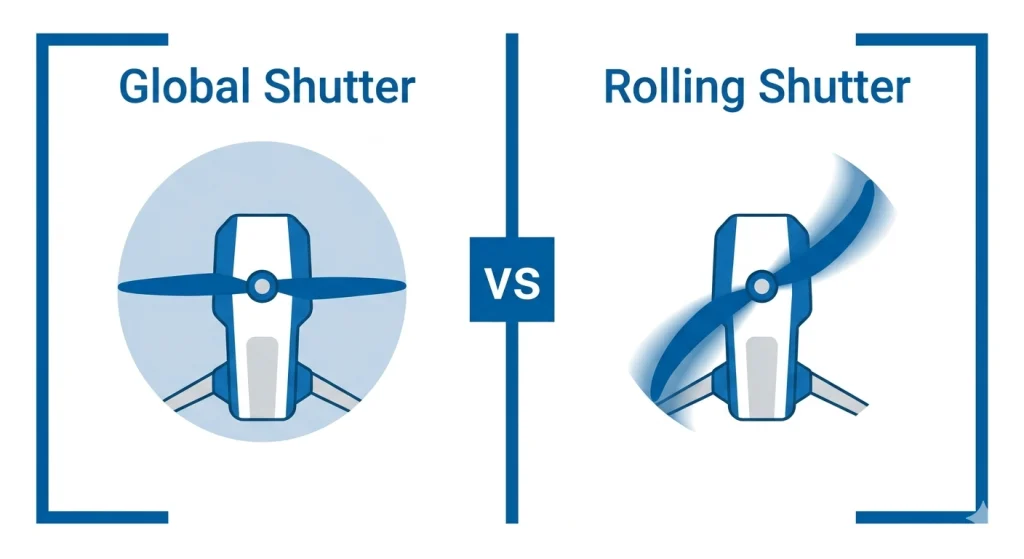
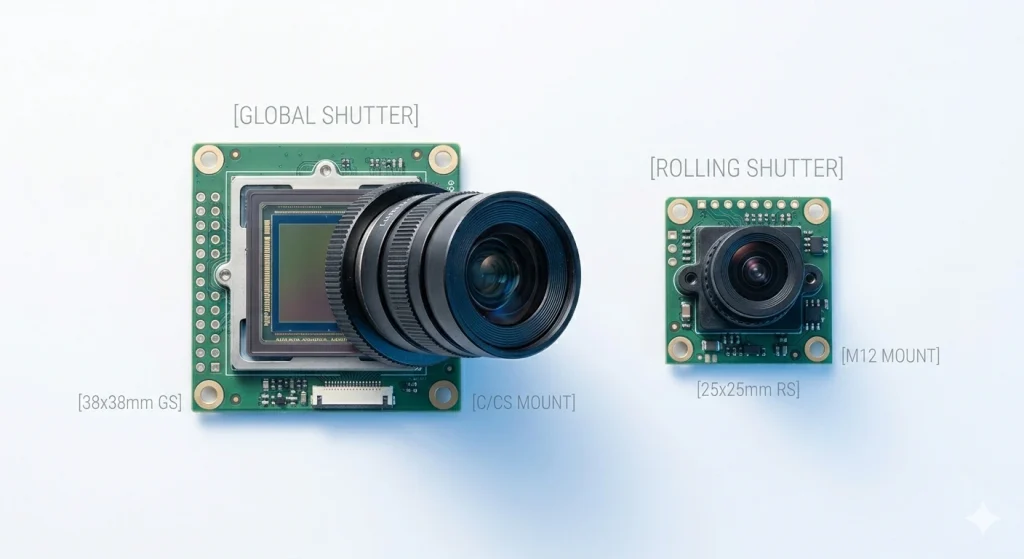
A global shutter camera module exposes every pixel simultaneously, producing distortion-free images of fast-moving objects — essential for machine vision, robotics, and any application with relative motion above ~0.5 m/s. A rolling shutter module exposes pixel rows sequentially, which is cheaper, offers higher resolution per dollar, and works fine for static or slow-moving scenes — but introduces "jello effect" skew on moving subjects. Choosing the wrong shutter type is one of the most common — and most expensive to fix late — camera module selection errors.
Key Takeaways
- Global shutter: all pixels expose and read simultaneously — zero motion skew, but larger pixels, lower resolution-per-dollar, and 30–80% higher sensor cost.
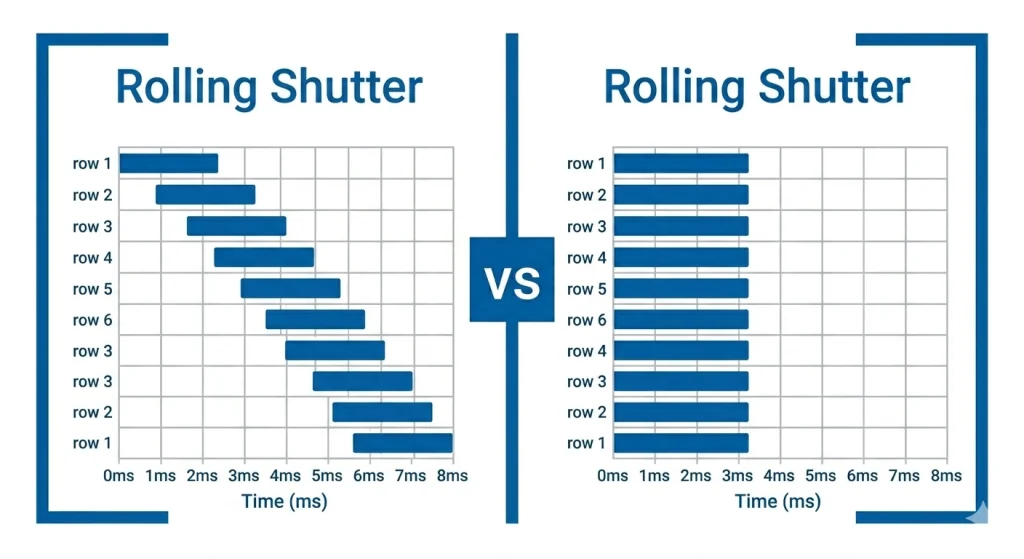
- Rolling shutter: pixel rows expose sequentially (10 µs–10 ms readout delay across the frame) — causes skew/wobble on objects moving relative to the camera.
- Rule of thumb: if your subject moves >0.5 m/s relative to the camera within the field of view, or you need hardware-triggered strobe sync, use global shutter.
- Global shutter is mandatory for conveyor inspection, barcode/QR on moving items, drone/UAV imaging, and AGV stereo depth — not optional.
- Smeiker supplies both global shutter and rolling shutter camera modules across USB and MIPI interfaces, with Sony Pregius and OnSemi sensor options.
How Global Shutter and Rolling Shutter Sensors Actually Work
Every CMOS image sensor must answer the same fundamental question for each frame: when does each pixel start collecting light, and when does it stop? The two architectures answer this question differently — and that difference determines whether moving objects appear sharp or distorted.
Rolling Shutter: Row-by-Row Exposure
A rolling shutter sensor exposes and reads out pixel rows sequentially, from top to bottom. As Teledyne Vision Solutions explains, while a rolling shutter reads out row-by-row when exposed, a global shutter reads out the entire sensor at once. For a sensor with 1080 rows reading out at a typical 10 µs per row, the total readout time spans approximately 10.8 ms — meaning the last row is captured 10.8 ms after the first row, even though both are part of the "same" frame.
During this 10.8 ms window, if the subject (or the camera) moves, each row captures the subject at a slightly different position. The result is geometric distortion: vertical lines lean, circles become ellipses, and fast-rotating objects (propellers, fan blades, spinning parts) appear bent or fragmented — the "jello effect" or "rolling shutter skew."
Global Shutter: Simultaneous Exposure
A global shutter sensor exposes all pixels — every row, simultaneously — for the same exposure window, then reads out the accumulated charge from the entire array at once (typically into a storage capacitor at each pixel before sequential readout of the stored values). Because every pixel "sees" the scene during the exact same time interval, there is zero temporal skew between rows. A spinning propeller captured with a global shutter sensor appears as a perfect circular blur (if exposure time is long) or perfectly sharp (if exposure time is short) — never bent or fragmented.
It's important to note — as e-con Systems clarifies — global shutter eliminates skew distortion, but does not by itself eliminate motion blur. If the exposure time is long relative to the object's speed, a global shutter image of a fast object will still show blur — just symmetric, undistorted blur, not skewed jello.
Why Global Shutter Sensors Cost More
Global shutter requires additional circuitry at each pixel — typically an extra storage node and transfer gate to hold the exposed charge until readout. This added circuitry consumes silicon area that would otherwise be photodiode (light-collecting) area, meaning global shutter pixels are either physically larger (for equivalent sensitivity) or less sensitive (for equivalent size) than rolling shutter pixels. The result: global shutter sensors at a given resolution typically have larger optical formats, require larger and more expensive lenses, and cost 30–80% more than an equivalent-resolution rolling shutter sensor.
How Rolling Shutter Artifacts Appear in Real Images — and Why They Break Computer Vision
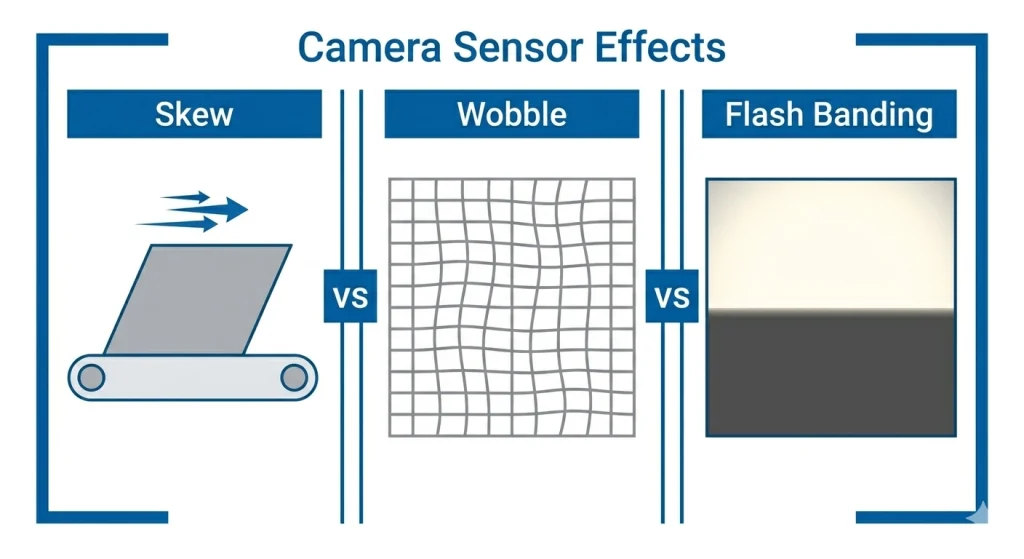
Rolling shutter skew is not just a cosmetic issue — it actively corrupts the data that computer vision algorithms depend on. Three artifact types are most relevant for industrial camera module applications:
- Skew (shear distortion): An object moving horizontally across the frame while rows are read top-to-bottom appears slanted — vertical edges become diagonal. For dimensional measurement in machine vision (e.g., measuring the width of a part on a conveyor), this introduces direct measurement error proportional to belt speed and sensor readout time.
- Wobble: If the camera itself vibrates during readout (common on drones, robotic arms, and vehicle-mounted cameras), different rows capture the scene from different camera positions, producing a wavy, non-rigid distortion that confuses feature-matching algorithms (SLAM, optical flow, stereo matching).
- Partial exposure / flash banding: If a strobe light fires for a duration shorter than the full frame readout time, only the rows being exposed during the flash pulse will capture it — producing a partially lit frame. This makes rolling shutter sensors largely incompatible with pulsed/strobed illumination systems commonly used in machine vision for consistent lighting.
The severity of skew scales with both object speed and sensor readout time. A sensor with a 5 ms full-frame readout time imaging an object moving at 1 m/s will show approximately 5 mm of positional skew across the frame — which may be negligible for a security camera but catastrophic for a 0.1 mm tolerance inspection system. As documented on Wikipedia's rolling shutter article, this effect is also responsible for the well-known "bent propeller" photographs commonly seen with rolling-shutter smartphone cameras.
Factory Perspective — Rolling Shutter Skew on a Bottling Line: "A beverage manufacturer's QC team contacted us about a fill-level inspection system that had been producing inconsistent results since the line speed was increased from 60 to 90 bottles per minute. They were using a 5MP rolling shutter USB camera module with a frame readout time of approximately 8 ms. At the new line speed, bottles moved roughly 0.45 m/s past the inspection point — and the resulting images showed a measurable 3.6 mm horizontal skew across the bottle's vertical axis. The fill-level algorithm, which measured liquid height relative to a fixed reference line on the bottle, was misreading the skewed bottle edge as a fill-level deviation, generating false rejects at a rate of roughly 4%. We swapped the sensor to a Sony IMX296 global shutter module (1.6MP, ~120 µs full-frame readout) at the same physical mounting position. The skew disappeared entirely, and false reject rate dropped to 0.1% — within the line's acceptable tolerance. The resolution reduction from 5MP to 1.6MP had no measurable impact on the fill-level measurement accuracy, since the inspection ROI only required about 400×300 pixels." — Smeiker Machine Vision Engineering Team
Global Shutter vs Rolling Shutter: Complete Specification Comparison
| Parameter | Global Shutter | Rolling Shutter |
|---|---|---|
| Exposure Method | All pixels simultaneously | Row-by-row sequential |
| Motion Artifacts | None (skew-free) | Skew, wobble, partial exposure |
| Strobe / Flash Compatibility | ✅ Full compatibility | ⚠️ Limited — requires long flash pulse |
| Pixel Size (typical) | 3.45 µm+ (larger) | 1.0–2.0 µm (smaller) |
| Resolution per $ (cost efficiency) | Lower | Higher |
| Low-Light Sensitivity | Lower per-pixel (larger pixel helps, but extra circuitry costs fill factor) | Higher (BSI rolling shutter sensors excel) |
| Sensor Cost (vs equivalent resolution) | +30% to +80% | Baseline |
| Typical Sensor Families | Sony Pregius (IMX2xx/IMX296), OnSemi AR0234/AR0820GS | Sony Starvis (IMX415/IMX678), OmniVision OVxxxx, most consumer sensors |
| Best For | Conveyor inspection, barcode/QR on moving items, AGV stereo, UAV, robotics | Face recognition (static subjects), smart kiosks, security cameras, surveillance |
Basler's comparison of Sony's IMX sensor generations notes that Sony's Pregius line uses global shutter optimized for industrial applications requiring precise motion capture, while the Starvis line uses rolling shutter and excels in low-light environments such as surveillance — a distinction that maps directly onto the application-driven selection framework below.
How to Decide: A Practical Framework
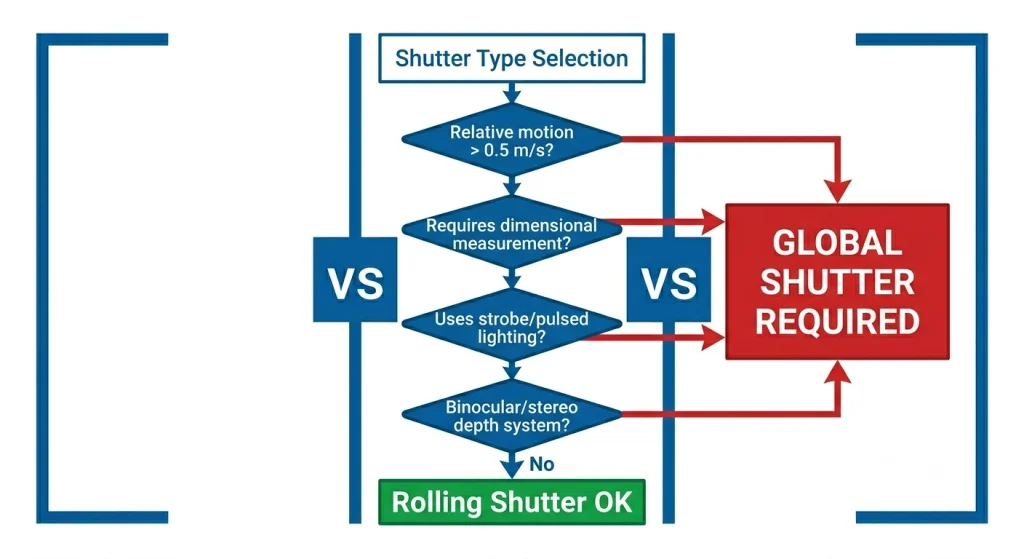
Use the following decision sequence to determine which shutter type your application requires. Each criterion is sufficient on its own to mandate global shutter — if any apply, global shutter is required regardless of the others.
- Is there relative motion between the camera and the subject above ~0.5 m/s? Conveyor belts, AGVs, drones, handheld scanners, and rotating machinery all qualify. If yes → global shutter required.
- Does your application require dimensional measurement or precise geometric analysis? Any system measuring size, position, angle, or alignment of a moving object needs skew-free images. If yes → global shutter required.
- Does your lighting system use a pulsed/strobed light source? Strobe lighting (common for high-speed inspection to "freeze" motion with light rather than shutter speed) requires global shutter for full-frame illumination capture. If yes → global shutter required.
- Is the application a binocular/stereo depth system? Rolling shutter introduces per-row timing differences between left and right sensors that corrupt disparity maps for moving scenes. Global shutter is standard for stereo vision in dynamic environments. If yes → global shutter strongly recommended.
- None of the above apply — is the subject largely static during capture? Face recognition terminals (subject pauses briefly), smart kiosks, access control, security cameras, and most indoor static-scene applications work well with rolling shutter — and benefit from its lower cost and better low-light performance.
For systems with mixed requirements — for example, a kiosk that occasionally needs to read a moving QR code on a phone screen — evaluate the worst-case motion scenario, not the average case. A 0.3 m/s phone-presentation motion at close range (15 cm) can still produce visible skew with an 8 ms readout rolling shutter sensor.
Project Case — Shutter Type Reconsideration Mid-Project: "An AGV manufacturer in Germany was specifying a binocular camera module for obstacle detection and initially requested a low-cost rolling shutter configuration (OmniVision OV4689, 4MP rolling shutter, ~4 ms readout) to keep the BOM under budget. During our technical review, we modeled their use case: the AGV travels at up to 1.5 m/s, and obstacle detection requires depth maps updated at 30 fps with sub-30mm accuracy at 3m. We calculated that with a 4 ms rolling shutter readout, an obstacle moving at 1.5 m/s relative to the AGV (e.g., a person walking across the AGV's path) would show approximately 6mm of inter-row skew between the left and right camera images — enough to introduce systematic disparity errors of 8–15mm at 3m range, eroding their safety margin. We proposed switching to the Sony IMX296 global shutter sensor (1.6MP, 120 µs readout) — a resolution decrease, but with zero skew. The customer ran both configurations side-by-side in their test facility: the global shutter configuration showed stable depth measurements for moving pedestrians, while the rolling shutter configuration showed measurable depth jitter correlating with pedestrian walking speed. They proceeded with the global shutter design at a $4/unit cost increase — accepted given the safety implications. Production volume: 600 units/year." — Smeiker ODM Engineering Team
Global Shutter and Rolling Shutter Sensor Options at Smeiker
Sensor selection should be driven by the resolution, frame rate, and interface requirements established by the decision framework above, paired with the appropriate sensor family:
Global Shutter Sensor Options
- Sony IMX296 (1.6MP, 1/2.9"): Pregius 2nd generation, 3.45 µm pixels, up to 61 fps at full resolution via USB3, ~120 µs full-frame readout. The most widely used global shutter sensor for machine vision, binocular stereo, and AGV applications at moderate resolution.
- Sony IMX265 (3.1MP, 1/1.8"): Pregius 2nd generation, 3.45 µm pixels, up to 56 fps via USB3. Higher resolution option for applications requiring finer detail — quality inspection of smaller parts, higher-resolution barcode reading.
- OnSemi AR0234 (2.3MP): Global shutter, color, up to 60 fps, widely used in robotics and drone applications for its balance of cost and performance.
Rolling Shutter Sensor Options
- Sony IMX415 (8MP): Starvis BSI rolling shutter, excellent low-light performance, up to 4K/60fps. Standard for face recognition, kiosk, and surveillance applications discussed in our face recognition camera module guide.
- Sony IMX678 (8MP): Starvis 2 BSI rolling shutter, 4K with improved low-light SNR over IMX415, suitable for non-cooperative surveillance-style face recognition.
- OmniVision OV9782 / OV2710: Cost-effective rolling shutter options for NIR-capable kiosk and access control modules.
Smeiker manufactures both global shutter camera modules and rolling shutter camera modules in USB and MIPI interfaces, with ODM customization of PCB form factor, lens, and ISP tuning. For applications combining global shutter with stereo depth, see our binocular camera module guide. For interface selection guidance once you've determined shutter type, review our DVP vs MIPI comparison.
Frequently Asked Questions
What is the difference between global shutter and rolling shutter camera modules?
A global shutter sensor exposes all pixels simultaneously, producing distortion-free images of moving objects. A rolling shutter sensor exposes pixel rows sequentially over a few milliseconds, which can cause skew, wobble, or partial exposure ("jello effect") when the subject or camera moves during capture.
Do I need a global shutter camera module for my application?
If your application involves relative motion above ~0.5 m/s between camera and subject, requires dimensional measurement of moving objects, uses pulsed/strobed lighting, or is a binocular/stereo depth system, global shutter is required. Static or slow-moving subject applications (face recognition, kiosks, security cameras) can use rolling shutter at lower cost.
Why are global shutter camera modules more expensive than rolling shutter?
Global shutter pixels require extra storage circuitry to hold exposed charge until readout, which consumes silicon area that would otherwise be light-collecting photodiode area. This makes global shutter sensors larger, less sensitive per unit area, and 30–80% more expensive than equivalent-resolution rolling shutter sensors.
Can global shutter sensors work in low light?
Global shutter sensors generally have lower per-pixel light sensitivity than equivalent rolling shutter sensors, because storage circuitry reduces fill factor. However, larger global shutter pixels (3.45 µm and above, like Sony Pregius) partially compensate. For applications requiring both motion-freeze and low-light performance, active illumination (NIR or visible strobe) is typically paired with global shutter sensors.
Does Smeiker supply global shutter camera modules?
Yes. Smeiker manufactures global shutter camera modules using Sony Pregius sensors (IMX296, IMX265) and OnSemi AR0234, available in USB and MIPI interfaces. Rolling shutter modules using Sony Starvis (IMX415, IMX678) and OmniVision sensors are also available. ODM customization of PCB form factor, lens, and ISP tuning from 500 units. Get a free quote with your application requirements.
Not Sure Which Shutter Type Your Application Needs?
Tell us about your application's motion speed, measurement requirements, and lighting setup. Smeiker's engineering team will recommend the right sensor and shutter type — and deliver samples within 4–8 weeks.
Get a Free Quote →