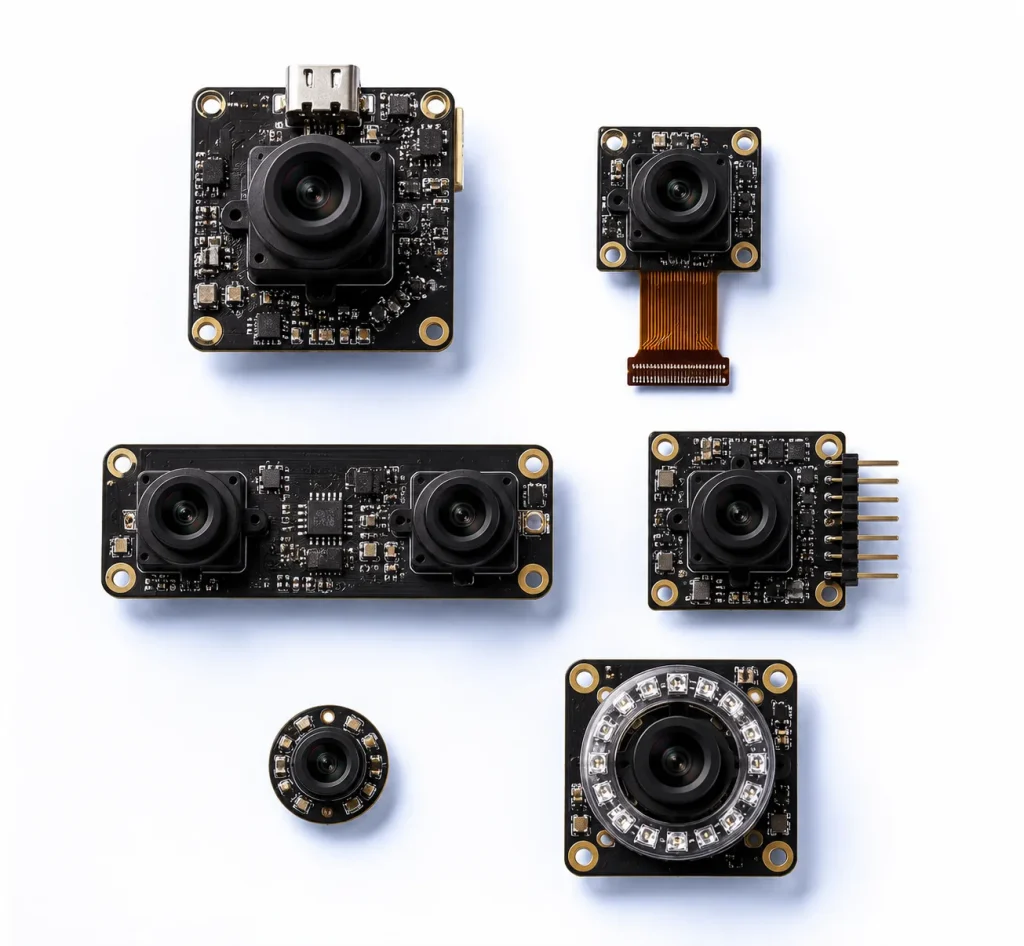
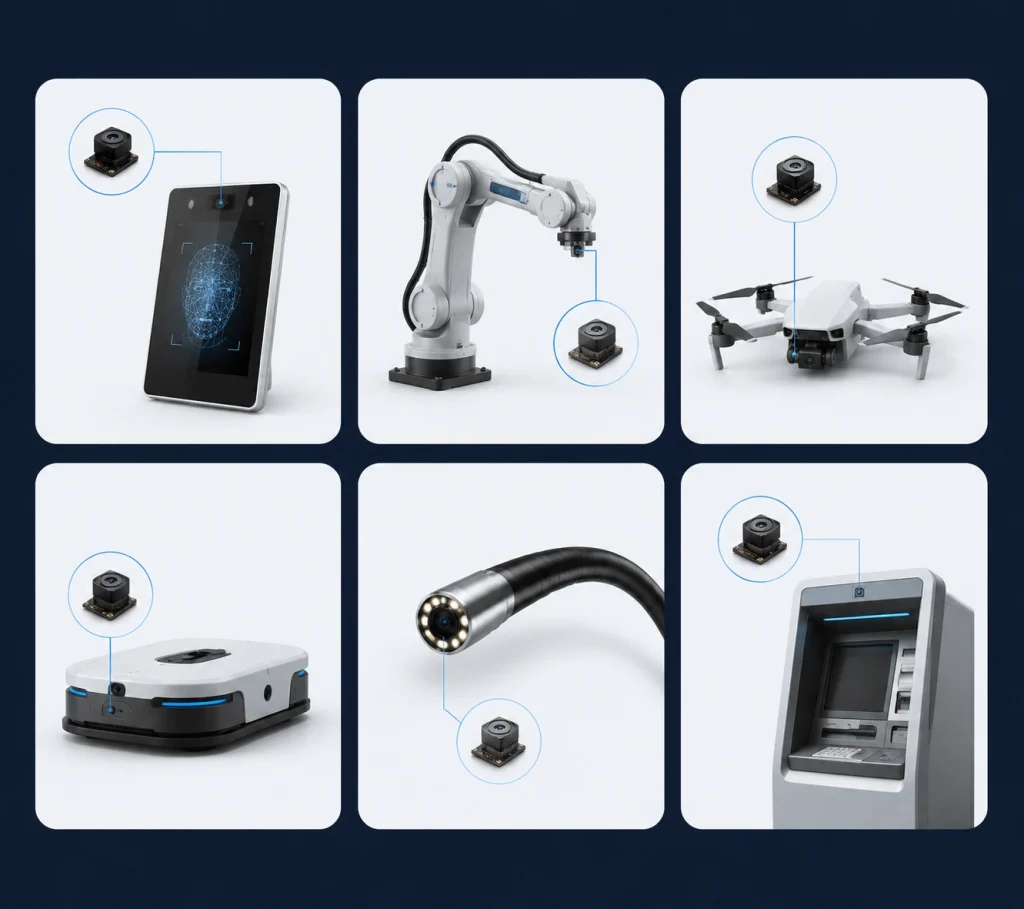
Camera module applications span face recognition kiosks, industrial machine vision, UAV payloads, AGV navigation, medical endoscopy, and smart retail — and each use case demands a different combination of sensor size, interface, shutter type, and form factor. Selecting the wrong module for your application is one of the most common and costly mistakes in embedded product development.
Key Takeaways
- Face recognition terminals require NIR illumination and ISP anti-spoofing support — not just resolution.
- Machine vision on high-speed lines demands a global shutter sensor to eliminate motion blur.
- UAV camera modules must balance weight (<15 g) with interface bandwidth (MIPI preferred over USB for vibration tolerance).
- AGV and mobile robots often need wide-FOV or binocular configurations for obstacle detection.
- OEM/ODM customization — lens, PCB size, connector, ISP tuning — is available from Smeiker from low MOQ.
Why Application Context Determines Camera Module Specs
A camera module is not a commodity component. Two modules with identical megapixel counts can perform completely differently in the field — because resolution is only one variable. Shutter type, sensor size, interface protocol, operating temperature, lens FOV, and ISP capabilities all interact with the physical and computational demands of the target environment.
Consider: a 2MP USB module that works perfectly for a kiosk check-in terminal will fail on a high-speed PCB inspection line because its rolling shutter introduces skew artifacts on fast-moving objects. A MIPI module tuned for indoor portrait capture will perform poorly in a UAV payload because its ISP pipeline is not optimized for high-altitude brightness variation and lens distortion correction.
The sections below map six high-volume industrial camera module applications to the spec requirements that actually matter — giving hardware engineers and product managers a decision-ready reference.
The scale of this challenge is significant: the global embedded vision camera module market reached USD 4.8 billion in 2024 and is projected to grow at a 12.2% CAGR through 2033, driven by industrial automation, AI integration, and smart device proliferation. Yet the majority of design-in failures reported by OEMs trace back not to budget or lead time — but to module specification mismatches at the application level.
Factory Perspective — ISP Tuning Mismatch: "We received a batch return from a client building access control terminals in Southeast Asia — their face recognition pass rate dropped below 70% under fluorescent office lighting. After analysis, the issue wasn't the algorithm. The camera module they had sourced was tuned for daylight outdoor exposure, with an auto-exposure curve that over-brightened at <200 lux. Swapping the ISP register table for an indoor profile and adding an 850 nm NIR LED array pushed their pass rate above 97%. We now run ISP verification specifically for lighting environment as part of our production QC for any customer ordering in access control applications. It's a 20-minute test that prevents returns that cost 10× as much to resolve in the field." — Smeiker Hardware Engineering Team
Use Case 1 — Face Recognition Terminals & Smart Kiosks
Face recognition is among the highest-volume camera module applications globally, deployed in access control systems, ATMs, hotel check-in kiosks, airline self-service terminals, and smart retail. The imaging challenge is not resolution — it is reliable capture under variable ambient lighting with low false-accept rates.
Key Requirements: Resolution, NIR, and Anti-Spoofing
- Resolution: 1080p (2MP) is the practical minimum. Higher resolution (5MP) improves facial landmark detection at greater working distances (>1.5 m) but increases processing load.
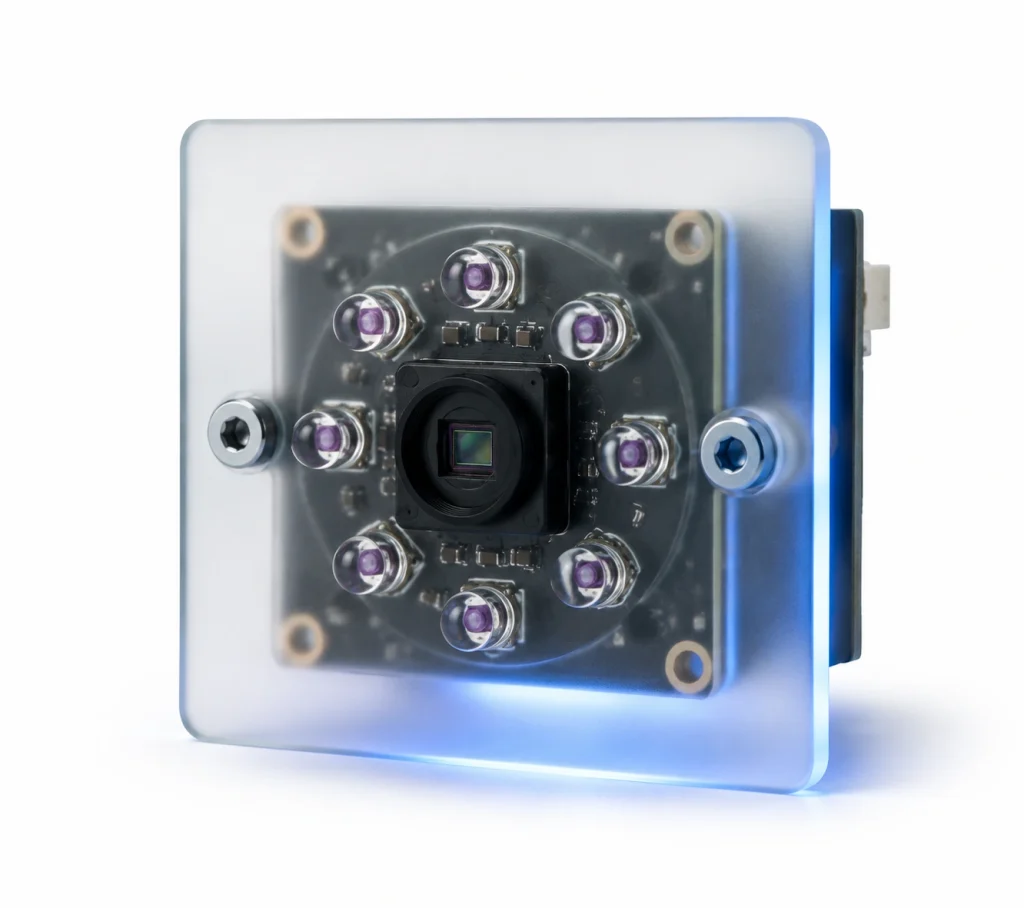
- NIR Capability: Most production-grade face recognition systems pair a visible-light RGB module with a near-infrared (850 nm or 940 nm) channel. The NIR channel enables anti-spoofing (detecting photo/screen attacks) and works in near-dark environments. Look for sensors with dual-exposure or NIR-transparent IRCF options.
- ISP Tuning: Indoor fluorescent and LED lighting creates flicker artifacts at 50/60 Hz. The ISP must support anti-flicker and low-light noise reduction (NR). Sensors such as the Sony IMX415 and OmniVision OV9782 are commonly specified for this application.
- Frame Rate: 30 fps is standard; some liveness detection algorithms require 60 fps for motion analysis.
Recommended Interface & Module Type
USB camera modules are predominant in this space because kiosk host boards (typically x86 or ARM SBC) offer USB 2.0/3.0 and support UVC without custom drivers — reducing integration time. MIPI modules are selected when the host SoC is a dedicated vision processor (e.g., Rockchip RK3588, NXP i.MX8) and system designers need lower latency and power consumption. Smeiker's USB camera modules include UVC-compliant options from 2MP to 4K suitable for kiosk and access control integration.
Use Case 2 — Industrial Machine Vision & Quality Inspection
Machine vision is one of the most demanding camera module applications. Production-line inspection cameras must capture high-contrast images of moving objects — PCBs, bottles, fasteners, textiles — at high frame rates with zero motion blur, and trigger synchronously with lighting strobe pulses. This use case is where module selection mistakes are most costly, because a wrong shutter type invalidates all downstream image processing.
Global Shutter vs Rolling Shutter for High-Speed Lines
Rolling shutter sensors expose pixel rows sequentially, introducing a "jello" skew effect on objects moving faster than ~0.5 m/s at typical inspection distances. Global shutter sensors expose all pixels simultaneously, completely eliminating motion artifacts. For any conveyor-based or robotic-arm inspection system, specify a global shutter module — sensors such as the Sony IMX265, IMX296, or OmniVision OG0VA1B are common choices.
Rolling shutter is acceptable in machine vision only for stationary inspection (e.g., a part is placed under a fixed camera and held still during capture).
Mounting, Trigger, and Lighting Sync Requirements
- Trigger Input: Industrial camera modules for machine vision should expose a hardware trigger pin, allowing the PLC or motion controller to synchronize frame capture to part arrival at the inspection station.
- Strobe Output: A flash trigger output pin synchronizes pulsed LED or laser lighting to the exact exposure window — critical for consistent illumination.
- Interface: MIPI CSI-2 for embedded vision processors; USB 3.0 for PC-based vision systems. GigE is used in larger industrial cameras but typically falls outside the "module" category.
- Temperature: Industrial environments may require modules rated for 0–70°C or −20–85°C (extended industrial). Verify sensor operating range and PCB conformal coating options.
Read our technical guide on USB, MIPI, and DVP interface comparison for full bandwidth and latency specs across interfaces used in machine vision systems.
Use Case 3 — UAV & Drone Imaging Payloads
Drones represent one of the fastest-growing industrial camera module applications — spanning agricultural survey, infrastructure inspection, search and rescue, and logistics. The three engineering constraints that dominate UAV camera module selection are weight, power draw, and vibration tolerance.
Weight, Power, and Vibration Constraints
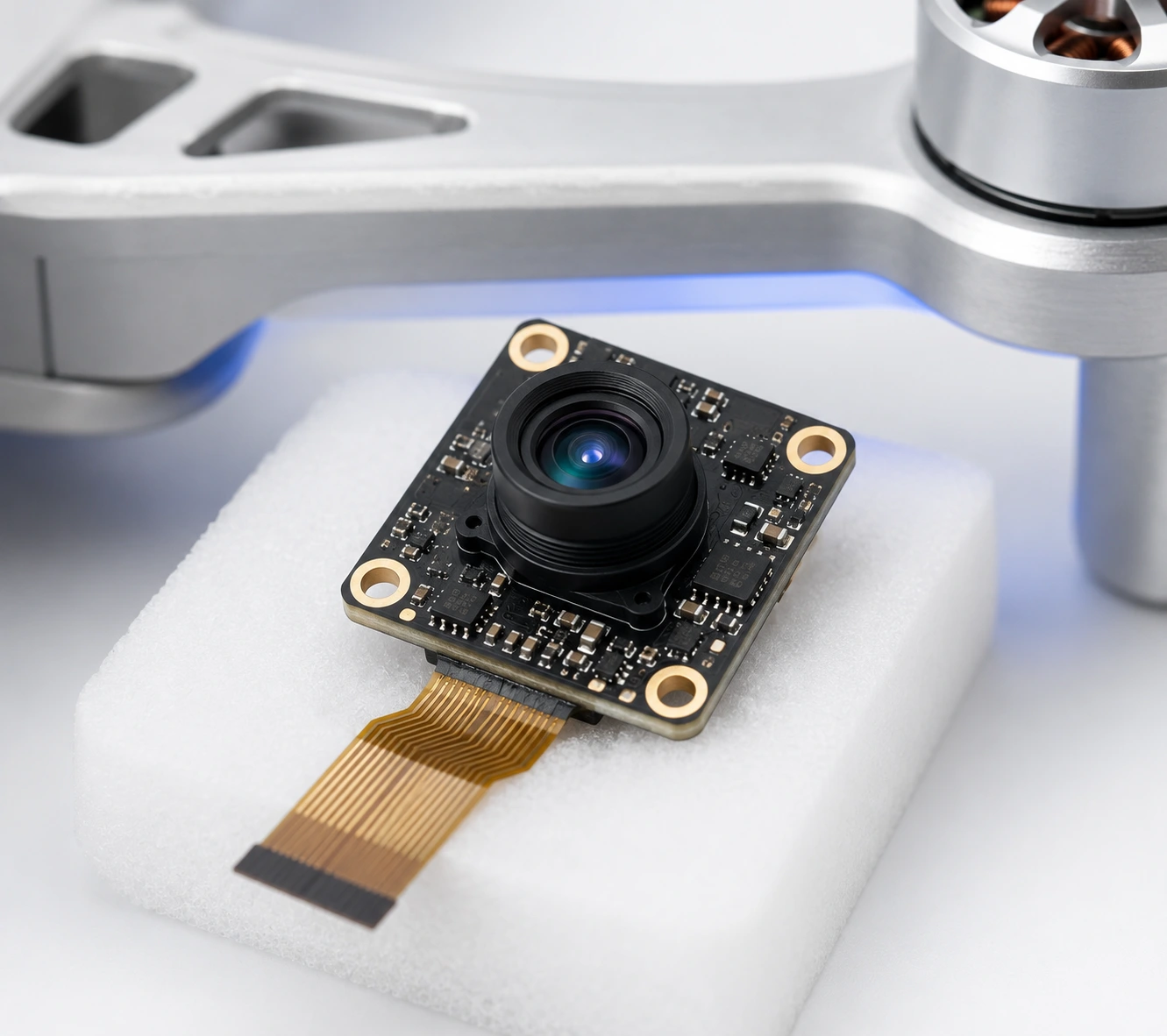
- Weight: Consumer and commercial drones have strict payload budgets. Camera module assemblies (PCB + sensor + lens) should target under 15 g for lightweight quadcopters; compact MIPI modules with M12 lenses are standard.
- Power: Modules operating from a 3.3 V or 5 V rail with under 500 mW total draw are preferred to preserve flight time.
- Vibration: Propeller vibration introduces micro-movements at 50–300 Hz during flight. Lens adhesive bonding and conformal-coated PCBs reduce field failures. Modules using FPC (flexible PCB) connectors are more vibration-tolerant than rigid board-to-board connectors.
MIPI vs USB for Drone Camera Modules
| Factor | MIPI CSI-2 | USB 3.0 |
|---|---|---|
| Latency | ~2 ms | ~10–30 ms |
| Power Draw | Lower (no USB controller) | Higher |
| Cable Length | ≤30 cm (standard FPC) | Up to 5 m (USB 3.0) |
| Driver Requirement | V4L2 / libcamera (custom) | UVC (driverless) |
| Vibration Tolerance | Higher (FPC flex) | Moderate (rigid plug) |
For drones with an ARM SoC compute board (e.g., NVIDIA Jetson Nano, Rockchip RK3588), MIPI is the preferred interface. USB modules are used when the drone carries a companion computer with a full USB stack and the designer needs cross-platform compatibility.
MIPI CSI-2 is maintained and updated by the MIPI Alliance — the latest specification is CSI-2 v4.2 (December 2025), supporting data rates up to several Gbps per lane and backward compatibility across all versions. Learn more about Smeiker's MIPI camera modules suitable for embedded drone payloads.
Use Case 4 — AGV & Mobile Robot Navigation
Automated guided vehicles (AGVs) and mobile robots in warehouse and factory environments rely on camera modules for lane detection, obstacle avoidance, barcode/QR scanning, and SLAM (simultaneous localization and mapping). This is a demanding camera module application because the imaging system must process continuous wide-field video in real time while the vehicle is in motion.
Wide-FOV and Stereo / Binocular Configurations
Single cameras with wide-angle lenses (100°–160° FOV) are used for basic obstacle detection and lane-following on flat surfaces. More sophisticated AGV navigation systems use binocular (stereo) camera modules — two calibrated sensors with a fixed baseline — to generate depth maps for 3D obstacle detection and precise distance measurement. Binocular configurations with 60–120 mm baselines are standard for AGV applications with 0.5–5 m obstacle detection ranges.
Interface and Latency Requirements
AGV perception loops require end-to-end latency under 50 ms to maintain safe stopping distances at typical speeds of 1–3 m/s. MIPI CSI-2 directly connected to an onboard edge AI processor (Rockchip RK3568, NVIDIA Jetson Orin NX) achieves 5–15 ms sensor-to-inference latency. USB 3.0 with UVC adds driver overhead (15–30 ms additional) but allows the perception compute unit to be a commercial x86 module without custom BSP work. DVP interfaces are used in cost-sensitive designs with lower-speed MCUs but are bandwidth-limited to 720p at 30 fps.
Use Case 5 — Medical Devices & Endoscopy Systems
Medical imaging is a specialized camera module application with unique constraints around miniaturization, sterilization compatibility, and regulatory pathway. Endoscopy capsule cameras, surgical scope tips, and patient monitoring cameras all embed camera modules — but the engineering requirements differ substantially from industrial or consumer applications.
Miniaturization, Biocompatibility, and Regulatory Notes
- Size: Capsule endoscopy modules must fit within a 10–11 mm diameter capsule. Chip-on-board (COB) packaging and bare-die sensors are used to achieve sub-5 mm optical assembly depths.
- Biocompatibility: PCB surface finish, lens barrel material, and adhesive compounds that contact body tissues or fluids must comply with ISO 10993 biocompatibility testing requirements — the international standard for biological evaluation of medical devices covering cytotoxicity, sensitization, and systemic toxicity.
- Sterilization: Reusable scope cameras must withstand autoclave sterilization (134°C steam) or EtO gas cycles — standard PCB FR4 and most sensor housings survive EtO but not steam autoclave without specialized potting.
- Regulatory: Medical device camera modules sold as components do not require independent FDA clearance, but device manufacturers bear 510(k) or PMA responsibility for the final system. Smeiker supplies modules with full traceability documentation and material declarations (RoHS, REACH) to support customer regulatory submissions.
Recommended Sensor and Interface
OmniVision's OV6948 (640×480, 1.4 mm die) is widely used in disposable endoscopy capsules. For higher-resolution surgical scope cameras, Sony IMX290 and IMX662 deliver 1080p at low light (F1.4 lens) with excellent color rendition under narrow-band endoscope illumination. MIPI CSI-2 is standard in tethered scopes; wireless capsule cameras use proprietary RF protocols. Contact Smeiker's ODM/OEM team to discuss miniaturized module designs for medical device applications.
Use Case 6 — Smart Retail, ATM & Self-Service Terminals
Self-service terminals — ATMs, vending machines, hotel check-in kiosks, restaurant ordering screens, and retail analytics cameras — represent a high-volume, long-lifecycle camera module application. Deployments run 24/7 for 5–10 years in temperature-variable retail and outdoor environments, making long-term component availability and environmental durability as important as imaging performance.
Environmental Conditions and Long-Term Availability
- Temperature: Outdoor ATMs in direct sunlight can exceed 60°C inside the enclosure; underground installations may see −10°C. Select modules with industrial-temperature-rated sensors and capacitors.
- Anti-Tamper Glass: Kiosk camera modules are typically behind polycarbonate or tempered glass, which reduces transmitted light by 10–20%. Compensate with a faster lens (F1.8 or lower) or higher-sensitivity sensor.
- Sensor EOL Risk: Consumer camera sensors follow mobile phone product cycles and are discontinued in 3–5 years. Specify sensors with published long-term availability commitments or work with a supplier who offers module redesign services when the original sensor reaches end-of-life. Smeiker maintains multi-generation USB camera modules with documented sensor migration paths.
Customization and OEM/ODM Path
Most self-service terminal manufacturers need a custom PCB size, specific connector type, or board-level integration (camera + microphone + LED) rather than a standard module. The OEM/ODM path begins with a sample evaluation of a standard module, followed by a customization specification covering PCB dimensions, connector pinout, ISP register configuration, lens selection, and labeling. Minimum order quantities for custom modules at Smeiker start from 500 units.
Project Case — Smart Retail Deployment: "A European retail analytics firm approached us needing a 1080p USB module that could fit inside a 22 mm diameter circular cutout in a retail shelf edge. Their standard shelf display had no room for a rectangular PCB. We designed a circular 22 mm PCB carrying an OmniVision OV2710 sensor with a 90° wide-angle M7 lens and a molded ABS lens ring for snap-in installation. The whole development cycle — from spec agreement to sample approval — took 11 weeks. The client deployed 4,200 units across three European countries in year one, using our modules for footfall heatmapping and dwell-time analytics. Two years later, when OV2710 approached its production sunset, we migrated the design to OV2735 with zero client-side hardware change, only a firmware ISP table update." — Smeiker ODM Project Management Team
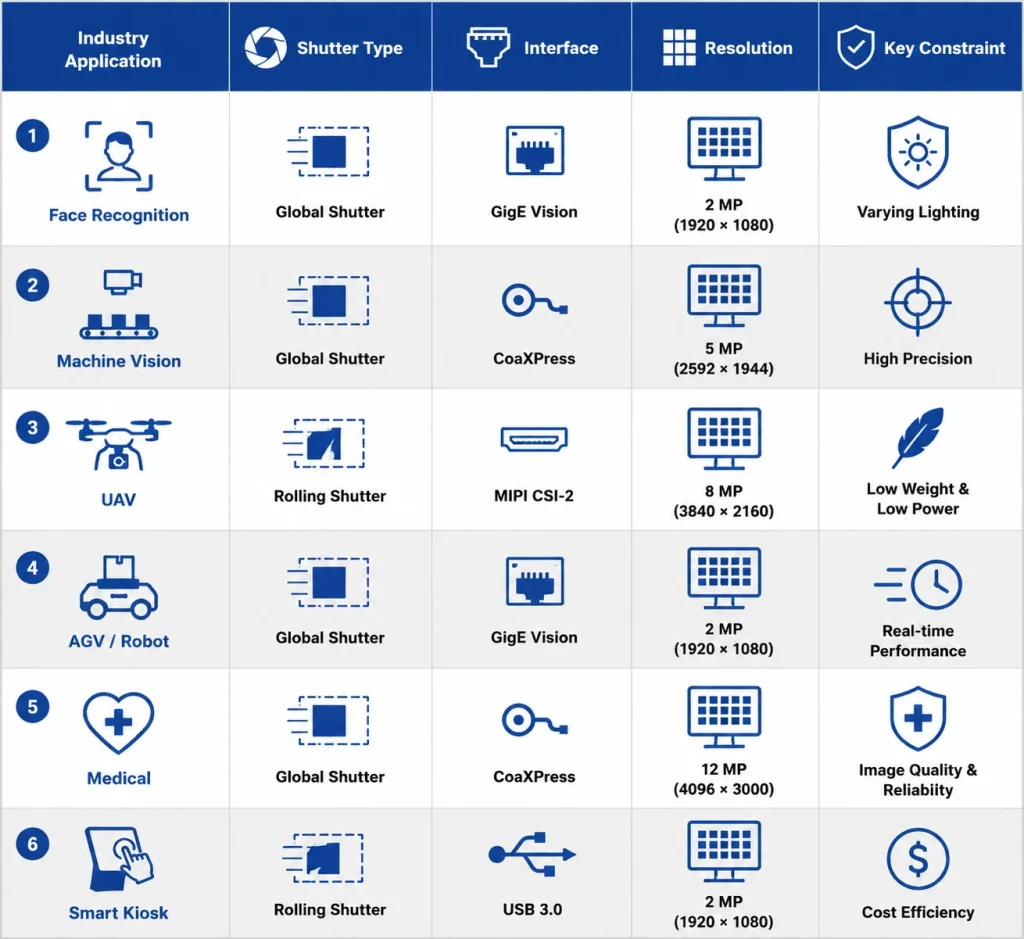
Spec Comparison Matrix: 6 Camera Module Applications
| Application | Min. Resolution | Shutter Type | Interface | Key Constraint |
|---|---|---|---|---|
| Face Recognition / Kiosk | 2MP (1080p) | Rolling (OK) | USB / MIPI | NIR + anti-flicker ISP |
| Machine Vision / Inspection | 2–5MP | Global (required) | MIPI / USB 3.0 | Hardware trigger + strobe sync |
| UAV / Drone | 2–12MP | Global preferred | MIPI preferred | Weight <15 g, FPC connector |
| AGV / Mobile Robot | 1–5MP | Rolling / Global | MIPI / USB 3.0 | Wide FOV / stereo depth |
| Medical / Endoscopy | VGA–2MP | Rolling (OK) | MIPI / proprietary | Miniaturization + ISO 10993 |
| Smart Retail / ATM | 1–4MP | Rolling (OK) | USB | Long-term availability + OEM form factor |
Frequently Asked Questions
What camera module is best for face recognition?
A 2MP or higher USB camera module with NIR sensitivity, anti-flicker ISP support, and an 850 nm NIR LED companion is the standard configuration. Sony IMX415 and OmniVision OV9782 are widely used sensors. The key is ISP tuning for indoor lighting — not just resolution.
Do I need a global shutter camera module for machine vision?
Yes, for any inspection of moving objects on a conveyor or robot arm. Rolling shutter introduces motion skew that invalidates dimensional measurements and defect detection at speeds above ~0.5 m/s. Global shutter sensors (Sony IMX265, IMX296, OmniVision OG0VA1B) expose all pixels simultaneously and eliminate this problem entirely.
Can a MIPI camera module be used in a drone?
Yes — MIPI CSI-2 is preferred for drone camera modules because it offers lower latency (~2 ms vs. 10–30 ms for USB), lower power draw, and better vibration tolerance with FPC connectors. The host SoC must have a MIPI CSI-2 receiver (e.g., Rockchip RK3588, NVIDIA Jetson Nano, NXP i.MX8).
What is a binocular camera module used for in robotics?
Binocular (stereo) camera modules use two calibrated sensors with a fixed baseline to generate depth maps, enabling 3D obstacle detection for AGVs and mobile robots. A 60–120 mm baseline is standard for 0.5–5 m detection range in warehouse environments.
Can Smeiker supply custom OEM camera modules for specific applications?
Yes. Smeiker provides full OEM/ODM customization: PCB dimensions, connector type, sensor selection, ISP register tuning, lens selection, and labeling. Sample development typically takes 8–12 weeks; production MOQ starts at 500 units. See our OEM/ODM camera module services page for details.
Need a Camera Module for Your Application?
Smeiker supplies USB, MIPI, DVP, CMOS, global shutter, binocular, and custom OEM camera modules. Tell us your application requirements and we'll recommend the right module — or design one.
Get a Free Quote