
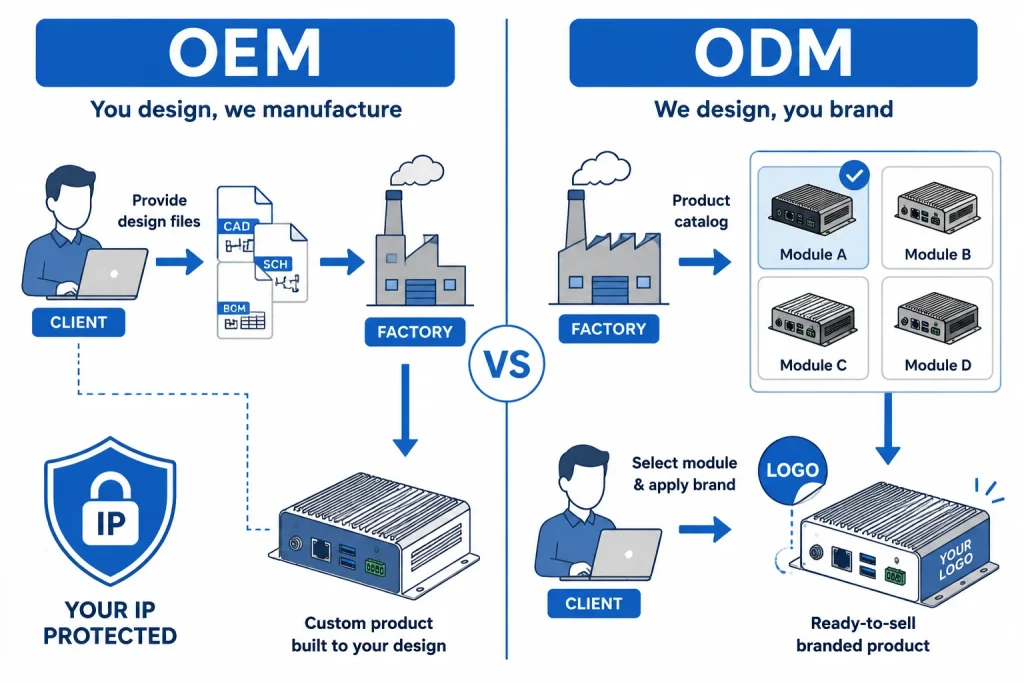
An OEM camera module is built to your design — you own the IP and the manufacturer executes production. An ODM camera module starts from the manufacturer's existing design, which you license and customize within defined parameters. Choosing between them determines your cost structure, development timeline, IP ownership, and long-term supply control for your product.
Key Takeaways
- OEM = client-owned design + manufacturer-executed production. Full IP control, higher NRE cost, longer lead time.
- ODM = manufacturer-owned design + client branding/minor customization. Faster to market, lower upfront cost, limited IP ownership.
- Most B2B hardware projects at volume <10,000 units/year benefit from ODM with targeted customizations (lens, PCB size, ISP tuning, connector) rather than full OEM.
- Supplier evaluation should prioritize ISO 9001 certification, in-house ISP tuning capability, and documented sensor migration policies — not just headline MOQ.
- Smeiker supports both paths from 500 units, with sample-to-production cycles of 8–12 weeks for ODM and 12–20 weeks for full OEM custom designs.
OEM vs ODM: The Core Distinction Explained
The terms OEM and ODM are used interchangeably in many supplier catalogs and trade show brochures — which creates genuine confusion for hardware engineers and product managers sourcing camera modules for the first time. The actual distinction is precise and consequential: it determines who owns the design, who controls the IP, and how much engineering investment you must front before production begins.
As outlined in Wevolver's technical guide for engineers, the core difference is: OEM is "client-owned design, manufacturer-executed production." ODM is "manufacturer-owned design, client-licensed customization."
What OEM Means for Camera Modules
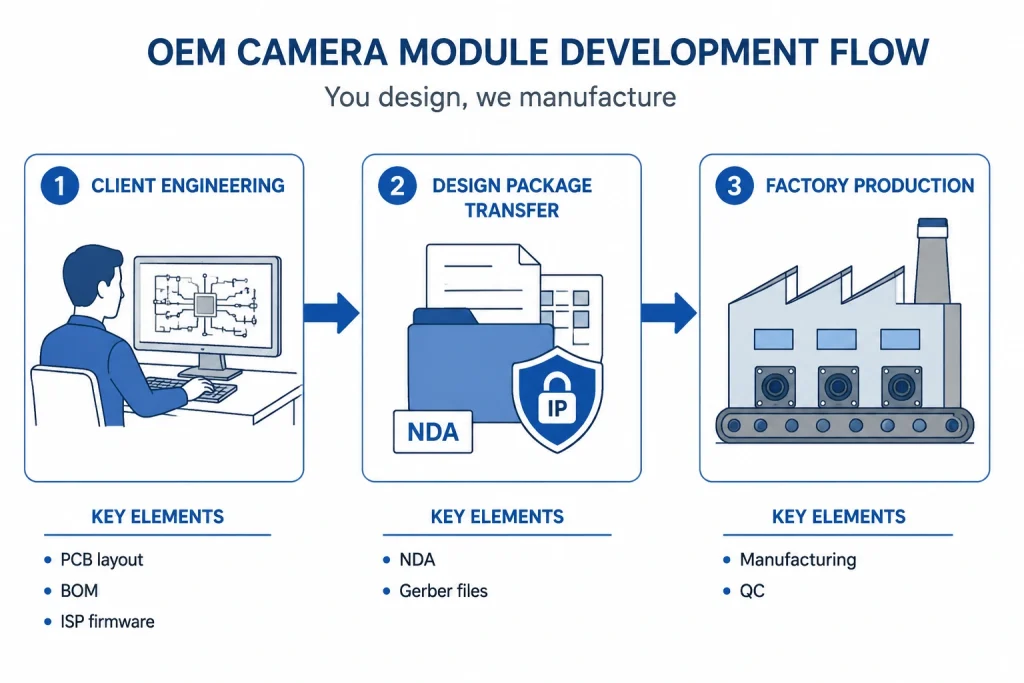
In a true OEM engagement, your company (the buyer) produces or commissions the hardware design: PCB schematic, sensor selection, lens specification, ISP register map, mechanical housing dimensions, and connector pinout. You hand these design files to the manufacturer, who procures components and executes production to your BOM and quality standards. You own the Gerber files, the firmware, the tooling — and your supplier cannot sell that design to any other customer.
OEM is the model used by companies like Apple (contracting Foxconn for iPhone production) and most Tier-1 automotive suppliers contracting electronics manufacturers for camera-based ADAS systems. It requires internal engineering capability or a design house engagement, plus NRE (non-recurring engineering) fees that typically range from $5,000 to $50,000+ for a camera module, depending on PCB complexity, lens tooling, and ISP customization depth.
What ODM Means for Camera Modules
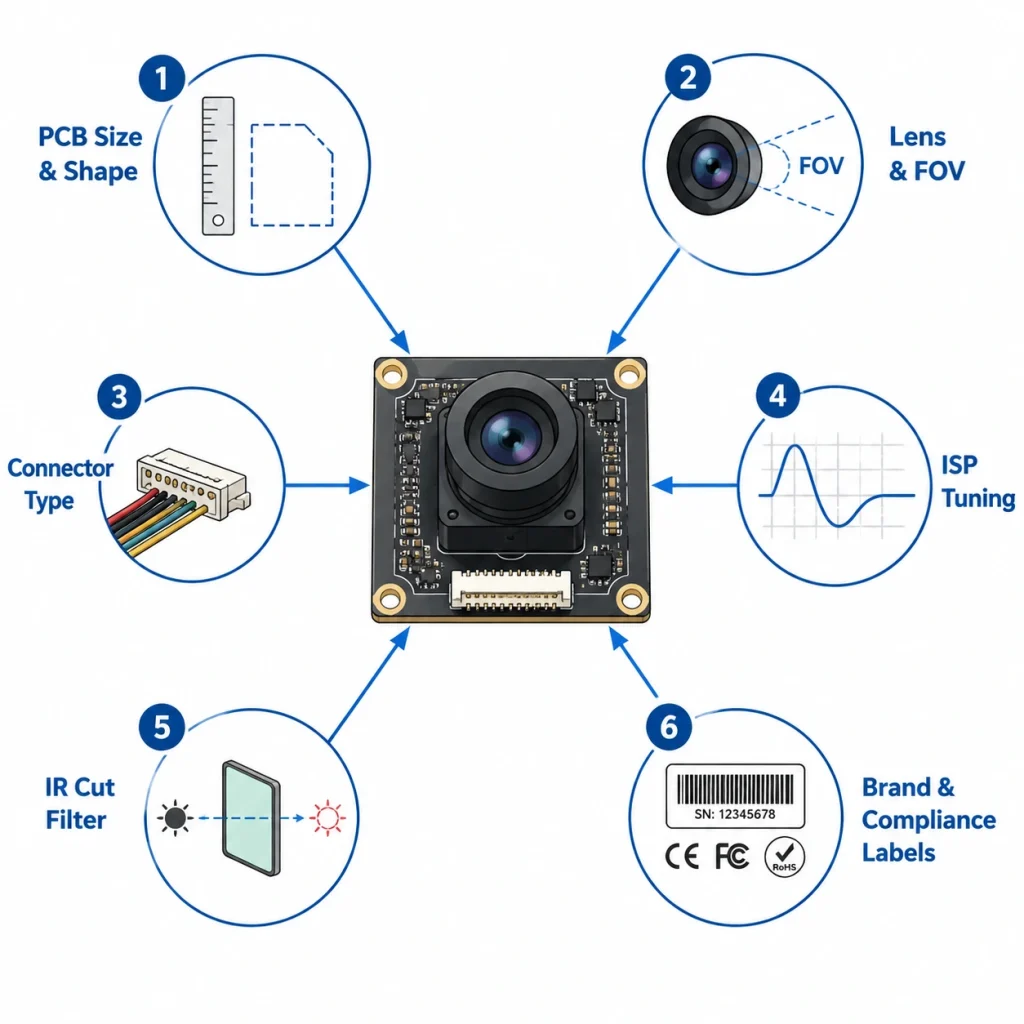
In an ODM arrangement, the manufacturer's engineering team has already designed, validated, and production-proven a camera module platform. You select a base module from their portfolio and specify a set of permitted modifications — which typically include PCB dimensions, connector type and pinout, lens FOV and mount type, IR cut filter options, ISP tuning profile (exposure curve, noise reduction, color matrix), and external labeling. The core sensor circuit, power management, and fundamental PCB architecture remain the manufacturer's IP.
ODM is commercially dominant in B2B camera module sourcing because it dramatically reduces development risk and time-to-market. The manufacturer has already resolved the hardest engineering challenges — sensor bring-up, power supply noise, clock routing, and ISP tuning — leaving you to focus on application-layer integration. Most camera module suppliers in Shenzhen and Dongguan, including Smeiker, operate primarily on an ODM model with a catalog of proven platforms available for customization. View Smeiker's USB camera module and MIPI camera module platforms available for ODM customization.
OEM vs ODM Camera Module: Side-by-Side Comparison
| Factor | OEM (Client-Designed) | ODM (Manufacturer-Designed) |
|---|---|---|
| Design Owner | Client | Manufacturer |
| IP Ownership | Client owns all files, tooling, firmware | Manufacturer retains core design IP |
| Customization Depth | Unlimited — every parameter client-defined | Defined menu: PCB size, lens, ISP, connector, label |
| NRE Cost | High ($5,000–$50,000+) | Low–Medium ($500–$5,000 for tooling changes) |
| Sample Lead Time | 12–20 weeks | 4–12 weeks |
| MOQ (Typical) | 1,000–10,000 units | 500–2,000 units |
| Engineering Risk | Higher — client bears design validation | Lower — manufacturer's platform already validated |
| Exclusivity | Full — design not sold to other customers | Partial — base platform may be shared; customizations may be exclusive |
| Best For | High-volume, regulated, or highly differentiated products | Faster time-to-market, cost efficiency, proven imaging platform |
| Smeiker MOQ | From 1,000 units | From 500 units |
When to Choose OEM for Your Camera Module Project
Full OEM is the right model when your imaging system is a core competitive differentiator that cannot be replicated from a shared platform, when regulatory requirements demand full supply chain traceability and design documentation, or when your production volume justifies the higher NRE investment through unit-cost reduction at scale.
You Own the Design — and the IP
IP ownership is the clearest reason to commit to full OEM. When you deliver Gerber files, a BOM, and an ISP firmware package to the manufacturer, those assets remain yours. The manufacturer signs an NDA and a manufacturing agreement that explicitly prohibits selling equivalent modules to your competitors. If you later switch manufacturers — for cost, capacity, or geographic reasons — you take all design files with you, and the new manufacturer can produce the same module from day one.
With ODM, the core platform IP stays with the supplier. If that supplier faces capacity issues, exits the market, or raises pricing, your design files cannot simply be transferred. You either accept their terms or invest in redesigning around a new platform — which is effectively the NRE cost you avoided at the start.
Applications That Demand Full OEM
- Automotive ADAS / in-cabin cameras: IATF 16949 and AEC-Q100 qualification requires full design traceability. No automotive Tier-1 can certify a system built on an undisclosed ODM platform.
- Regulated medical imaging: FDA 510(k) submissions require complete design documentation, including PCB schematics, component datasheets, and manufacturing process records. ODM platforms with withheld design files create regulatory gaps.
- Defense / government procurement: ITAR and export control regulations often require manufacturing in specified jurisdictions with full supply chain documentation — structurally incompatible with typical ODM arrangements.
- High-volume consumer products (>500k units/year): At this scale, per-unit cost reduction from a fully optimized BOM (selecting the exact sensor grade, eliminating unnecessary components) typically exceeds NRE amortization by year two.
Factory Perspective — OEM Design Validation: "We had a customer — a European industrial automation company — come to us with a full PCB design for a machine vision camera. They had done the sensor selection (Sony IMX264, global shutter, 5MP) and written a complete ISP configuration for their lighting environment, but they lacked a production partner with automated optical inspection (AOI) and ICT test fixtures for their board. We ran their design through our DFM review and flagged three issues: the decoupling capacitor placement near the MIPI lanes was creating impedance mismatches at 1.5 Gbps, the connector footprint didn't match our solder paste stencil thickness, and the lens holder thread spec used a non-standard pitch. We corrected those in one design revision cycle — about 18 days — ran EVT on 20 units, resolved one ISP register table issue with their engineering team over video call, and had DVT samples approved in six weeks. Mass production at 3,000 units per quarter launched without yield issues. The customer's IP stayed entirely with them; we signed a manufacturing exclusivity agreement for that product line." — Smeiker Production Engineering Team
When to Choose ODM for Your Camera Module Project
For the majority of B2B hardware products incorporating a camera module — smart kiosks, AGV systems, access control terminals, retail analytics cameras, IoT devices — ODM delivers faster time-to-market, lower development risk, and acceptable customization depth at a fraction of the OEM NRE cost. The manufacturer's proven platform becomes your engineering foundation, not your constraint.
Faster to Market, Lower Upfront Cost
An ODM supplier's platform has already passed the hardest milestones in camera module development: sensor bring-up, power supply design, MIPI/USB signal integrity verification, ISP base calibration, and thermal characterization. That validation work typically represents 800–1,500 engineering hours. By starting from a proven platform, your project's sample-to-approval cycle compresses from 16–24 weeks (full OEM) to 6–12 weeks — a critical advantage when your product has a market window.
ODM also reduces financial risk at the prototype stage. Rather than committing $15,000–$40,000 in NRE before you have a single working sample, ODM programs typically require a sample fee of $200–$1,000 and a tooling contribution (for custom lens rings, PCB profile cuts, or injection-molded parts) of $500–$3,000 — often credited back against production orders.
What ODM Customization Actually Includes
Many product managers assume ODM means accepting a generic module with just a logo change. In practice, a capable ODM supplier can customize across six dimensions:
- PCB size and shape: Custom cutouts, circular boards, elongated formats — any shape that fits your mechanical envelope, produced by adjusting the PCB panel design.
- Lens selection and FOV: M12 or M8 mount lenses across FOVs from 40° to 180°, with fixed or varifocal options, IR-coated or standard glass.
- Interface and connector: Switch from standard FPC to Molex PicoBlade, JST, or a specific board-to-board connector; change USB type from Type-A to Type-C; specify cable length.
- ISP register tuning: Custom auto-exposure curves for your specific lighting environment, noise reduction profiles for low-light or outdoor use, color matrix calibration for your application's white balance requirement.
- IR cut filter configuration: Fixed IR-cut (daylight only), fixed IR-pass (NIR only), or motorized IRCF for day/night switching.
- Labeling and compliance marking: CE, FCC, RoHS marks, customer brand name, serial number format, QR code on PCB silkscreen.
For most applications, this level of customization fully differentiates the final product without triggering the cost and timeline of full OEM. Explore Smeiker's ODM/OEM customization services and standard camera module platforms available for modification.
The 5-Stage OEM/ODM Camera Module Development Process
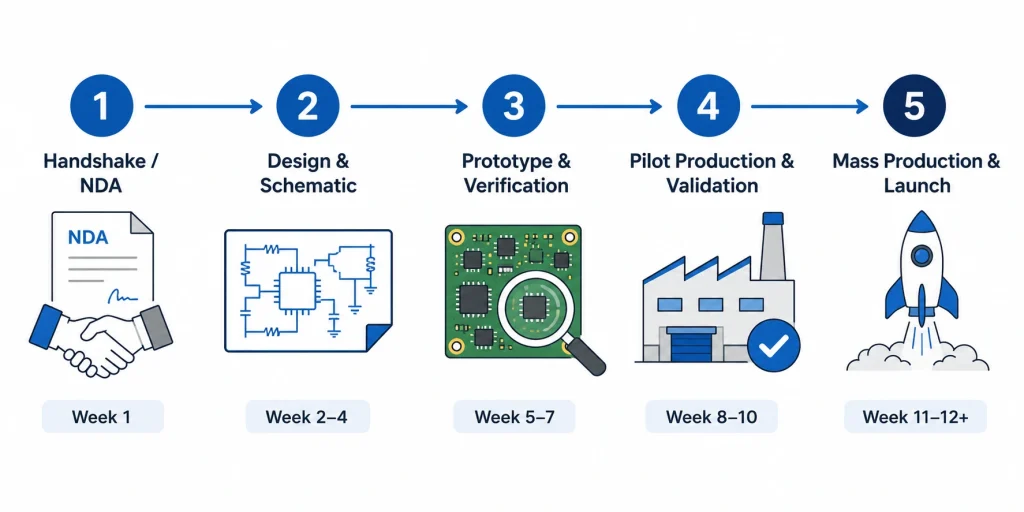
Whether you pursue OEM or ODM, the commercial development process follows five structured stages. Understanding these stages helps you set realistic internal schedules, allocate engineering resources, and know which decisions must be made at each gate before the next stage begins.
-
Stage 1 — Specification Definition & NDA (Week 1–2)
Both parties sign a mutual NDA before any technical discussion of designs or platforms. You document your requirements in a Product Requirement Specification (PRS): resolution, interface, operating temperature range, PCB envelope, connector, ISP requirements, certifications needed, target unit cost, and annual volume forecast. The manufacturer reviews the PRS and returns a feasibility assessment and a quotation covering NRE (if any), sample costs, and production unit pricing at your volume tier. This stage ends with a signed development agreement. -
Stage 2 — Module Selection or Design Review (Week 2–5)
For ODM: the manufacturer presents 1–3 platform options from their portfolio that best match your PRS. You evaluate reference samples, review the sensor datasheet, inspect the ISP tuning parameters, and select a base platform. For OEM: the manufacturer's DFM (Design for Manufacturing) team reviews your PCB Gerber files, BOM, and mechanical drawings, and returns a DFM report flagging any manufacturing-unfriendly features (minimum trace/space violations, unsupported component packages, solder paste issues). Design revisions are agreed upon at this stage. -
Stage 3 — Engineering Sample & Evaluation (Week 5–10)
The manufacturer produces 5–20 engineering samples (EVT — Engineering Validation Test units). You integrate these into your host system and run imaging tests under your application's actual lighting conditions. Any issues — ISP parameter mismatches, connector mechanical tolerances, lens FOV variation — are documented and fed back. The manufacturer issues a corrected sample batch (DVT — Design Validation Test) within 2–4 weeks. DVT approval is the gate to production. Do not skip DVT — this is the stage that prevents field failures. -
Stage 4 — Pilot Production & QC Verification (Week 10–14)
A pilot run of 100–500 units is produced under production tooling and processes — not hand-built engineering samples. You or a third-party inspector verify: dimensional conformance, electrical test pass rates, ISP parameter consistency across units, and cosmetic acceptance criteria. Acceptable Quality Level (AQL) sampling standards define the pass/fail threshold. Any yield issues discovered at pilot are corrected before mass production authorization (MPA) is signed. -
Stage 5 — Mass Production & Long-Term Supply Agreement (Week 14+)
Mass production begins against a purchase order. A long-term supply agreement should address: minimum annual purchase commitments, price adjustment mechanisms (typically annual, tied to component cost index), sensor EOL (end-of-life) notification obligations (12-month minimum notice), tooling ownership and storage, and NDA duration. For products with 5–10 year lifecycles, sensor EOL planning is one of the most underappreciated risk factors in the supply agreement — verify that your supplier has a documented sensor migration policy.
Ready to start the development process? Contact Smeiker's OEM/ODM team with your application requirements and annual volume estimate — we'll provide a platform recommendation and a preliminary quotation within 48 hours.
How to Evaluate a Camera Module OEM/ODM Supplier
The right supplier is not necessarily the one with the most megapixel options in their catalog or the lowest quoted MOQ. Camera module development involves 3–6 months of engineering collaboration before the first production purchase order — supplier capability and communication quality matter far more than headline price during this period. The following indicators separate capable suppliers from catalog resellers.
Technical Capability Indicators
- In-house ISP tuning: Ask whether ISP calibration (auto-exposure curve, noise reduction, color matrix, lens shading correction) is done internally or outsourced. Suppliers who rely on the sensor manufacturer's default register table cannot support application-specific tuning — which means your kiosk camera will be tuned for smartphone portraits, not indoor fluorescent access control environments.
- Cleanroom lens assembly: Camera module assembly requires a Class 1000 or better cleanroom for lens bonding to prevent dust contamination between the sensor and lens element. Request a facility photo or virtual tour. Dust-contaminated sensors are the leading cause of image quality complaints in field deployments.
- AOI and electrical test coverage: Automated optical inspection (AOI) on the SMT line catches solder bridging and component misplacement. Ask for the test coverage rate — a capable supplier should test 100% of boards electrically before lens installation.
- Sensor EOL management: Ask how the supplier handles sensor end-of-life. A mature supplier maintains a sensor migration roadmap and commits to 12-month advance notice with a pin-compatible replacement option ready. This is non-negotiable for products with 5+ year production lifetimes.
- Reference customers in your industry: A supplier claiming experience in medical camera modules but unable to provide a reference customer or a relevant case study is a risk. Specific case study scenarios (industry + application + volume range) are a minimum credibility bar.
Quality & Certification Red Flags
ISO 9001 certification is the baseline quality management standard for manufacturing suppliers. It verifies that the supplier has documented process controls, an independent QC function, non-conformance management procedures, and a system for corrective and preventive actions (CAPA). A supplier without ISO 9001 certification is not necessarily incapable, but you carry the full audit burden yourself — which is feasible for a one-time prototype but unsustainable for long-term production sourcing.
- Red flag: Supplier cannot provide a valid ISO 9001 certificate with an active accreditation body number. Ask to verify on the certifying body's registry.
- Red flag: Sample delivery is "hand-built by the engineering team" rather than produced on the SMT production line — hand-built samples do not validate the production process and hide yield problems.
- Red flag: Supplier quotes DDP (Delivered Duty Paid) pricing without a BOM or component-level cost breakdown. This prevents you from auditing material cost changes and makes price renegotiation impossible.
- Red flag: No documented sensor migration history. If the supplier has never managed a sensor EOL transition, your product is the test case.
Project Case — Supplier Qualification: "A product manager at a North American industrial IoT company contacted us after their previous camera module supplier — a small Shenzhen trading company — failed to deliver production-equivalent samples. The supplier had provided hand-built engineer samples that passed all image quality tests, but when production started, 34% of units failed the factory's automated vision test due to lens alignment drift. The root cause: the trading company was outsourcing assembly to a subcontractor without cleanroom conditions, and lens bonding was manual rather than AA (active alignment) process. We took over the program: re-qualified the sensor selection (OmniVision OV4689), ran AA lens bonding on our automated alignment station — achieving ±5 µm centration accuracy — and delivered 1,200 production units with a 0.8% cosmetic reject rate on first AQL lot. We also provided the customer with our ISO 9001 certificate, our AOI coverage report, and a production process audit package for their supplier qualification file. The customer's own QA team cleared us in three weeks rather than the six months they had budgeted for a new supplier onboard." — Smeiker Quality Engineering Team
Cost & Timeline Benchmarks for Camera Module OEM/ODM
| Cost / Timeline Item | ODM Range | OEM Range |
|---|---|---|
| NRE / Development Fee | $500–$5,000 | $5,000–$50,000+ |
| Sample Cost (EVT, 5–20 units) | $200–$1,000 | $1,000–$5,000 |
| Sample Lead Time | 4–8 weeks | 10–16 weeks |
| Mass Production Lead Time | 4–6 weeks | 6–10 weeks |
| Minimum Order Quantity | 500–2,000 units | 1,000–10,000 units |
| Total Time to First Production | 8–14 weeks | 16–26 weeks |
Frequently Asked Questions
What is the difference between OEM and ODM for camera modules?
OEM means you provide the design and the manufacturer produces to your spec — you own the IP. ODM means the manufacturer provides an existing, proven design that you license and customize within defined parameters. See the full comparison table above for a side-by-side breakdown of IP ownership, customization depth, NRE cost, and lead time.
What is the minimum order quantity (MOQ) for a custom camera module?
For ODM programs with minor customization (lens, connector, ISP tuning), Smeiker's MOQ starts at 500 units. For full OEM programs with custom PCB designs and tooling, MOQ is typically 1,000 units. Lower volumes are possible for platform evaluation orders before a custom program begins.
How long does an ODM camera module project take from inquiry to mass production?
A standard ODM program — from NDA signing through spec confirmation, sample production, EVT/DVT evaluation, and pilot production — typically takes 8–14 weeks before mass production authorization. Full OEM programs with new PCB design take 16–26 weeks. Both timelines depend on how quickly the client engineering team can review samples and close open items.
What certifications should a camera module OEM/ODM supplier have?
ISO 9001 is the baseline quality management certification — verify it with the issuing accreditation body. For camera modules going into CE-marked end products, the supplier should provide RoHS compliance documentation and can support CE/FCC pre-certification testing. For medical applications, ISO 13485 is relevant. Ask for certificates with valid accreditation numbers, not just certificate images.
Can I switch from ODM to OEM later if my product scales up?
Yes, and many mature product lines follow this path. You start with an ODM platform to validate the market and reach initial volume, then commission a full OEM design — often an evolved version of the ODM platform — when annual volume justifies the NRE investment and IP control becomes strategically important. The ODM phase gives you real production data (yield rates, field return analysis, ISP tuning history) that makes the subsequent OEM design significantly lower risk.
Start Your OEM/ODM Camera Module Project
Tell us your application, required specs, and annual volume. Smeiker will recommend an ODM platform or evaluate your OEM design — and return a preliminary quote within 48 hours.
Get a Free Quote →