
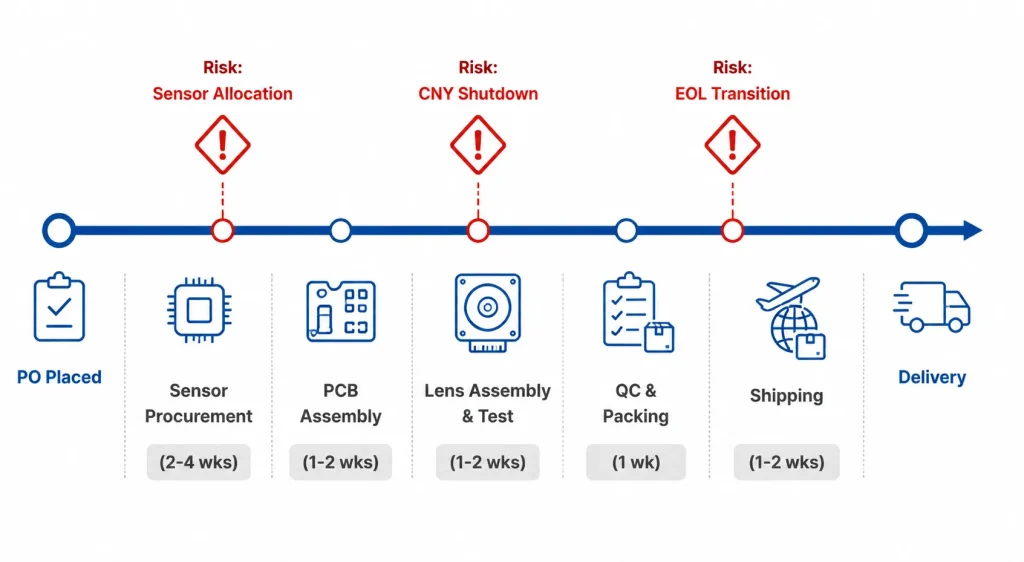
Short answer: Camera module lead time from purchase order to delivery runs 4–10 weeks for standard mass production replenishment, 6–14 weeks if a sensor or lens component is on allocation, and 16–28 weeks for a first production run following sample approval. The three supply-chain risks that most reliably turn a 6-week lead time into a 16-week crisis are: sensor shortages on key Sony/OmniVision SKUs, Chinese New Year production shutdowns, and sensor EOL (end-of-life) transitions where no pin-compatible replacement has been pre-qualified. Each of these is plannable and manageable — but only if you are not ordering for next month when the risk materialises.
Camera modules carry an unusual supply chain risk profile compared to most electronic components. The underlying CMOS image sensor — which represents 30–70% of unit cost and 100% of the uniqueness of the module — is manufactured at a small number of specialized foundries, dominated by Sony, Samsung, and OmniVision. When demand spikes (a major smartphone launch consuming Sony IMX sensor allocations) or supply contracts (a foundry node transition or geopolitical disruption), CMOS image sensors are among the component categories with the highest EOL sensitivity and allocation risk. Industrial and B2B buyers — who typically order in volumes of hundreds to low thousands per year — are the first to be de-prioritized when major smartphone OEMs consume sensor allocation at millions per month.
This guide maps the lead time structure of a camera module procurement cycle, identifies the specific risk events that extend lead times unpredictably, and gives product managers and procurement teams a practical planning framework for buffer stock, supply agreements, and EOL migration — the three tools that turn camera module supply chain risk from a reactive crisis into a manageable process. This is the final step in the 7-step camera module sourcing framework, and it is frequently the one that determines whether a well-designed, well-validated product can actually ship on schedule.
Key Takeaways
- Baseline replenishment lead time is 4–10 weeks for a production-approved module with no component allocation issues — treat anything beyond this as a supply event requiring investigation, not a planning assumption.
- Sensor allocation is the #1 lead time risk: when Sony or OmniVision tightens supply on a high-demand SKU, industrial buyers at low volumes face 12–20+ week lead times with no substitute ready.
- Safety stock of 8–12 weeks of consumption covers most supply disruption scenarios without requiring a full make-to-stock strategy.
- Sensor EOL notifications come with 12–24 months advance notice from major manufacturers — but only if your module supplier has a documented EOL monitoring and migration commitment in your supply agreement.
- A long-term supply agreement (LTA) with production capacity reservation and a sensor migration clause is the single most cost-effective supply chain risk mitigation tool for B2B camera module buyers.
Camera Module Lead Time Benchmarks by Stage
Camera module lead time has fundamentally different structures depending on which phase of the procurement cycle you are in. Conflating the "first sample" lead time with the "production replenishment" lead time is one of the most common planning errors, and it consistently results in either rushed sample evaluation or a false sense of security about production schedule flexibility.
| Procurement Stage | Typical Lead Time | Primary Dependency | Key Risk |
|---|---|---|---|
| EVT Samples (ODM) | 4–8 weeks | Sensor sample stock + ISP tuning | Sensor not in stock at supplier |
| DVT Samples | 3–6 weeks (from EVT approval) | ISP revisions + production-line sample build | ISP revision rounds consuming schedule |
| First Mass Production PO | 6–12 weeks (from MPA) | Sensor procurement lead time | Sensor on allocation; CNY timing |
| Replenishment PO (approved module) | 4–10 weeks | Sensor + lens component availability | Sensor allocation spike; customs delay |
| Replenishment (sensor on allocation) | 12–20+ weeks | Sensor availability from Sony/OV direct | No substitute pre-qualified; product line stoppage |
The 4–10 week baseline replenishment lead time assumes your sensor is available from distributor stock or from your module supplier's forward-purchased inventory. This assumption holds in normal market conditions but breaks down predictably in three scenarios — sensor allocation events, Chinese New Year production shutdowns, and EOL transitions — each of which is discussed below.
What Extends Camera Module Lead Times Beyond the Baseline
Risk 1 — Sensor Allocation & Shortage Events
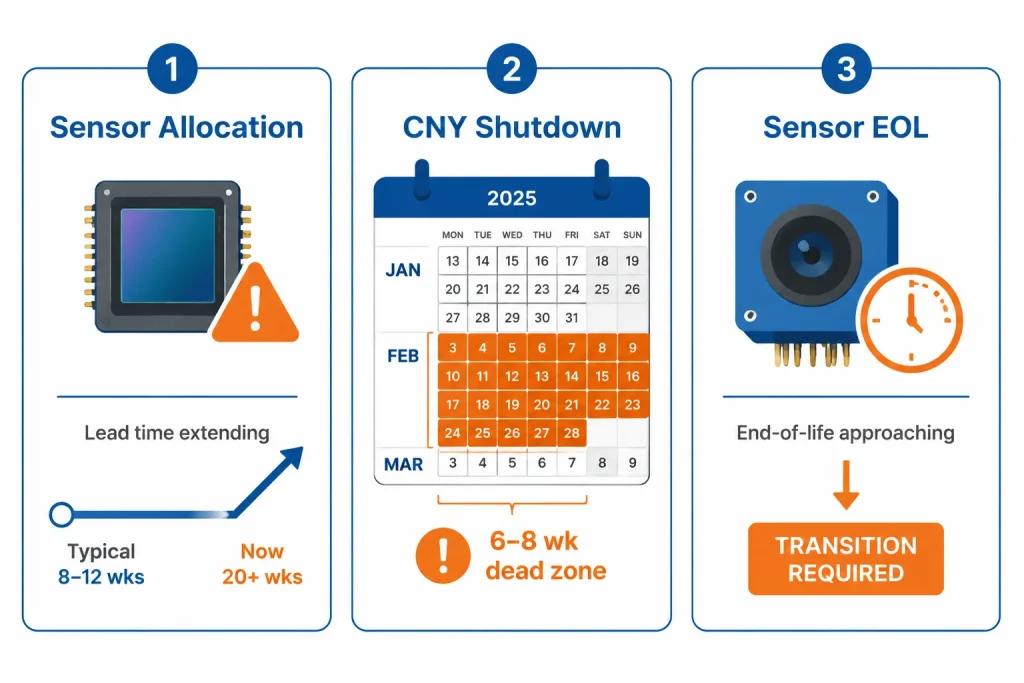
Sony and OmniVision collectively supply the image sensors for the vast majority of B2B camera modules in the market. Both companies prioritize their largest customers — tier-1 smartphone OEMs ordering tens of millions of sensors per quarter — when foundry capacity is constrained. Industry lead times for CMOS sensors extended from 8–12 weeks pre-2020 to over 52 weeks during the 2021–2022 semiconductor crisis, and while conditions normalized by 2024, the structural vulnerability — a small number of foundries serving sharply tiered customer priorities — remains.
Camera module lead time extends to 12–20+ weeks during an allocation event because the sensor is not a standardized component that can be quickly substituted — it is the defining part of the module's image quality, ISP configuration, and certification history. Switching sensors at production requires a new EVT-to-DVT cycle (4–12 weeks) on top of the procurement lead time. This is why forward purchasing agreements with your sensor-committed module supplier — not substitution after the fact — are the correct mitigation.
Risk 2 — Chinese New Year (CNY) Production Shutdown
The majority of camera module manufacturing is concentrated in the Pearl River Delta (Shenzhen, Dongguan, Guangzhou). Every year, factories shut down completely for 2–4 weeks surrounding Chinese New Year (late January to mid-February), followed by a 2–3 week ramp-back period as workers return and production lines restart. The effective dead zone for new orders placed during this period is 6–8 weeks, and orders placed in late November or early December must account for whether production will complete before CNY or restart after.
This is not a hidden risk — CNY dates are announced years in advance. Yet it is the leading cause of "unexpected" camera module delivery delays for buyers who don't track it explicitly. A PO placed on December 15 for a 6-week lead time module will not arrive in late January; it will arrive in March at the earliest. Plan orders accordingly, or carry buffer stock through the January–March window.
Risk 3 — Geopolitical and Tariff Disruptions
US-China trade tensions, export control changes, and tariff escalations have introduced a new layer of supply chain uncertainty for electronic components, including camera modules assembled in China. Since 2019, multiple rounds of US Section 301 tariffs have affected imported electronic components and finished goods, and the regulatory landscape continues to evolve. For buyers importing camera modules into the US from China, tariff classification (typically HTS 8525.80) and any applicable Section 301 exceptions should be verified with your customs broker before placing large production orders, since misclassification or an unexpected tariff change can add 15–25% to landed cost with little warning.
Factory Perspective — Turning an Allocation Event Into a Non-Event: "In Q2 2024, demand for Sony IMX415 — our highest-volume 8MP sensor used in face recognition and surveillance modules — tightened sharply as multiple major smartphone brands specified it for their front camera designs. Distributor availability dropped from 4–6 weeks to 16–18 weeks almost overnight. Customers who had signed long-term supply agreements with us and whose 12-week rolling forecasts were up to date were not affected — we had pre-purchased sensor inventory against those agreements specifically to cover exactly this scenario. Customers without agreements, placing spot orders, saw their camera module lead time extend from our standard 6 weeks to 14–16 weeks while we worked through our sensor procurement queue. The cost difference between those two outcomes: customers with agreements paid the agreed unit price and received on-time delivery. Spot customers paid 12–18% above standard unit price (sensor spot premium) and waited an additional 8–10 weeks. The supply agreement fee — essentially a small deposit on forward capacity — is structurally cheaper than the spot premium plus production delay cost in almost every scenario where demand exceeds supply." — Smeiker Supply Chain Management Team
Buffer Stock & Safety Stock: How Much to Hold
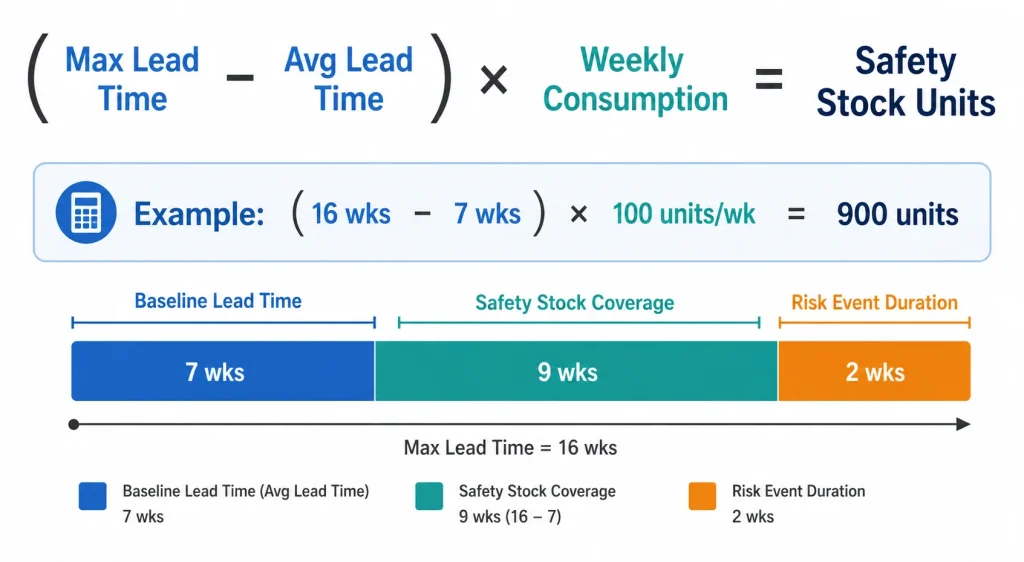
Safety stock is the buffer inventory held above expected consumption to absorb supply lead time variability without causing a stockout. For camera modules, where an extended lead time event can add 8–12 weeks without warning, the safety stock calculation is straightforward: multiply your average weekly consumption by the maximum expected lead time extension.
A practical safety stock formula for camera module procurement:
Safety Stock = (Max Lead Time − Avg Lead Time) × Average Weekly Consumption
Example: (16 weeks − 7 weeks) × 100 units/week = 900 units safety stock
For most B2B camera module programs with annual volumes between 500 and 10,000 units, an 8–12 week safety stock buffer covers the majority of lead time extension scenarios without requiring a capital-intensive build-to-stock strategy. The two situations where this buffer may be insufficient are CNY years where demand overlaps with CNY timing (plan for a 14-week max lead time in those cases) and sensor EOL transitions (where safety stock buys time for a migration, not a substitute).
Consignment Stock at the Supplier
An alternative to holding finished camera module stock yourself is a consignment stock arrangement, where your supplier holds pre-built or semi-built modules against your forecast, invoiced only on shipment. Consignment stock reduces your working capital requirement, eliminates your warehouse handling costs, and reduces the risk of modules becoming obsolete in your own inventory if a design change is needed. It is common in supply agreements at 3,000+ units/year and is worth negotiating into any long-term agreement alongside a rolling 12-week forecast commitment on your side.
Sensor EOL & Long-Term Supply Planning
CMOS image sensors follow the product life cycles of the smartphone and consumer electronics markets — typically 3–5 years from launch to EOL announcement, with a last-time-buy (LTB) window of 6–18 months after EOL notification. For an industrial or B2B product with a 5–10 year production lifetime, this means the sensor in your first production build will almost certainly be discontinued before your product reaches end-of-life — and you need a plan for that transition before it becomes a crisis.
What a Sensor EOL Notification Actually Gives You
- Advance notice: major sensor manufacturers (Sony, OmniVision) typically issue Product Change Notifications (PCNs) and EOL notices 12–24 months before the last shipment date. Some B-tier manufacturers give as little as 6 months. Your supply agreement should contractually require your module supplier to pass these notifications to you within 30 days of receipt.
- Last-time-buy window: EOL notices specify a last order date after which no further production runs will occur. Calculating a lifetime buy quantity — enough units to cover your estimated production needs until a migration can be completed — is often the right strategy for sensors without a direct pin-compatible replacement.
- Migration timeline: a sensor migration (replacing EOL sensor with a new sensor in an otherwise unchanged module) typically requires 4–8 weeks of EVT and DVT re-evaluation for the changed sensor, plus any ISP register table updates. If the module manufacturer has pre-qualified the replacement sensor on the same PCB platform, this can compress to 2–4 weeks of validation.
What to Include in a Long-Term Supply Agreement (LTA)
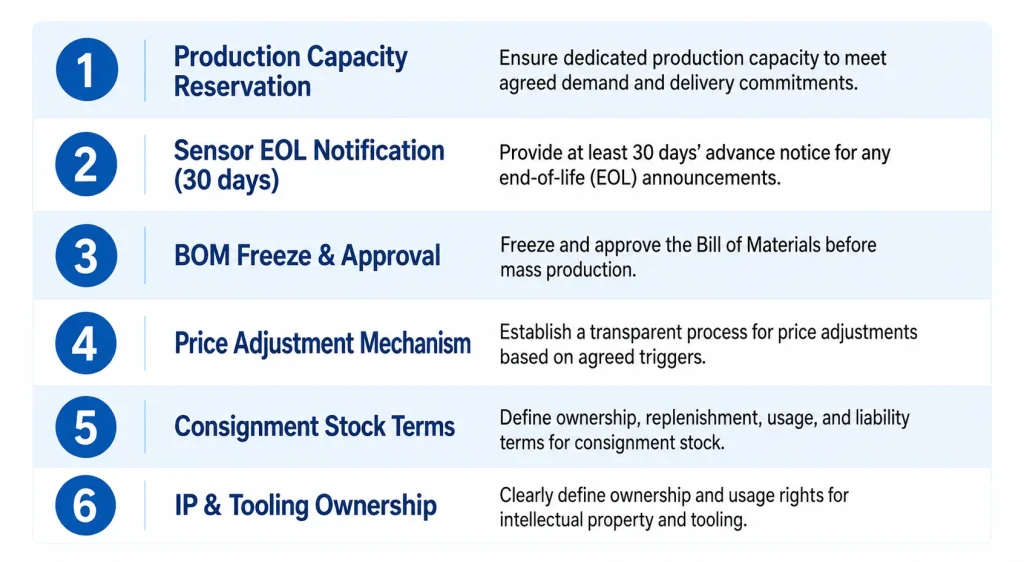
A Long-Term Supply Agreement (LTA) is the most effective single tool for stabilizing camera module supply chain predictability. Key clauses for a camera module LTA include:
- Production capacity reservation: the supplier commits to reserving a defined weekly production capacity for your product line against your rolling 12-week forecast.
- Sensor EOL notification: the supplier commits to forwarding any PCN or EOL notification for any component in your approved BOM within 30 days of receipt, with a proposed migration plan within 60 days.
- Approved BOM freeze: any component change — even "equivalent" substitutions — requires your written approval before production. This prevents silent component substitutions that change image quality without your knowledge.
- Price adjustment mechanism: typically annual, tied to a component cost index (often the spot price of the sensor), with a defined cap on year-over-year increases.
- Consignment stock terms: if applicable, defines the level of pre-built inventory the supplier maintains, the invoicing trigger (on shipment vs on build), and the ownership of held stock.
- IP and tooling ownership: confirms that custom PCB designs, tooling, and ISP firmware developed for your program remain your property and cannot be sold to other customers.
Smeiker's standard LTA framework covers all six clauses above and is available to review before any production commitment. Our supply chain management for industrial camera module customers includes quarterly sensor market status reviews, proactive PCN monitoring across all approved BOM components, and documented migration paths pre-validated for the most common sensor EOL scenarios. See our camera module certifications guide for how supply agreement terms interact with documentation continuity across a sensor migration.
Project Case — Managing a Sony Sensor EOL Migration With Zero Downtime: "A European access control terminal manufacturer had built their product around the Sony IMX219 sensor — a widely used 8MP rolling shutter module that had been specified at the product's launch. In late 2023, they received formal notice from us that IMX219 had received an EOL notification from Sony with a last-time-buy date 14 months out. Their annual volume was 2,400 units, with a product lifecycle of at least 3 more years. We presented two options: a lifetime buy of ~7,200 units (3 years at 2,400/year) at the current unit price, or a migration to OmniVision OV16A10 — a pin-compatible 16MP sensor on the same PCB footprint that required only ISP register table updates and a 3-week DVT re-validation. We pre-validated the OV16A10 on the customer's existing PCB before they made a decision — sent 10 DVT samples alongside their existing IMX219 units for direct comparison. Image quality from the OV16A10 was measurably better at the customer's 1080p operating resolution due to the smaller pixel binning overhead. They chose the migration over the lifetime buy, approved DVT within 4 weeks, and mass production transitioned without a single delivery gap. The customer's CE documentation was updated with the new BOM revision in parallel with the DVT, so their compliance file was current by the time production switched over. The total additional cost to the customer: 3 weeks of engineering time for parallel testing, and the DVT sample build fee." — Smeiker Supply Chain Engineering Team
Annual Supply Planning Calendar for Camera Module Buyers
Most camera module supply chain disruptions are not unpredictable — they are simply not planned for. The following calendar maps the recurring events that affect camera module lead time and procurement timing across a typical calendar year, using Pearl River Delta manufacturing as the baseline:
| Period | Supply Event | Planning Action |
|---|---|---|
| November – December | Pre-CNY production surge; smartphone brand pre-orders consuming sensor allocation; component prices tick up | Place Q1 PO by late November; confirm sensor availability with supplier |
| January – February | Chinese New Year shutdown (exact dates vary ±2 weeks); 2–4 weeks factory dark, 2–3 weeks ramp-back | Do not expect delivery for orders placed after Dec 20; hold 10–12 weeks safety stock entering January |
| March – April | Production ramp-back; first stable delivery window post-CNY; sensor market visibility improves | Confirm Q2 forecast and rolling 12-week order with supplier; review sensor market status |
| Q2 – Q3 (May – September) | Most stable supply period; normal lead times; smartphone brand mid-year model pre-orders may tighten specific sensors by Q3 | Best window for LTA negotiation and new sensor qualification; review PCN notifications |
| October (Golden Week) | National Day holiday — 1-week factory shutdown in China | Place orders requiring delivery by end-October by mid-September; short but predictable disruption |
Frequently Asked Questions
What is the typical camera module lead time for a standard production replenishment order?
Camera module lead time for a production-approved module with available sensor stock is typically 4–10 weeks from purchase order to delivery. This baseline extends to 12–20+ weeks if the sensor is on allocation, or if the order falls within the Chinese New Year production shutdown window (late January through mid-February). Always confirm sensor availability with your supplier before committing delivery promises to your own customers.
How much safety stock should I hold for camera modules?
A safety stock buffer of 8–12 weeks of consumption covers most supply disruption scenarios without excessive capital commitment. Calculate: (Maximum lead time in a disruption scenario − Average lead time) × Average weekly consumption. For programs going through a CNY window, plan for a 14-week maximum lead time scenario. For programs near a known sensor EOL, safety stock buys time for the migration but does not replace pre-qualifying a replacement sensor.
What happens when my camera module's sensor is discontinued?
Major sensor manufacturers provide EOL notification 12–24 months before the last shipment date, with a last-time-buy window. Your options are a lifetime buy (stock enough units to cover remaining product life) or a sensor migration (qualify a pin-compatible replacement sensor on your existing PCB). Migration typically takes 4–8 weeks of EVT/DVT re-evaluation. Your supply agreement should require your module supplier to notify you within 30 days of any PCN or EOL notice and propose a migration plan within 60 days.
How does a long-term supply agreement help with camera module lead times?
An LTA with production capacity reservation means your supplier holds sensor inventory and production slots against your rolling forecast, effectively converting a spot-market 12–20 week lead time into a committed 4–6 week delivery. The supplier's cost of carrying that inventory is offset by the purchase commitment in the agreement. At volumes of 2,000+ units/year, an LTA almost always costs less in total (inventory carrying + supplier fee) than the combined cost of expediting, spot pricing, and production delays in a shortage event.
What is Chinese New Year's impact on camera module deliveries?
Camera module manufacturing in the Pearl River Delta shuts down completely for 2–4 weeks surrounding Chinese New Year (typically late January to mid-February) followed by a 2–3 week production ramp-back. Orders placed after approximately December 20 that require production during this window will not ship until March. Plan your Q1 orders and inventory levels accordingly, or carry 10–12 weeks safety stock entering January.
Does Smeiker offer long-term supply agreements for camera modules?
Yes. Smeiker provides LTAs for camera module programs with annual volumes from 2,000 units, including production capacity reservation, sensor EOL monitoring and migration support, BOM freeze commitments, and consignment stock arrangements. Contact our supply chain team to review a standard LTA framework for your program.
Secure Your Camera Module Supply Chain
Share your program's annual volume and delivery schedule. Smeiker will recommend a supply agreement structure — with sensor allocation protection, EOL monitoring, and consignment stock terms — designed for your specific risk profile.
Discuss a Supply Agreement →