
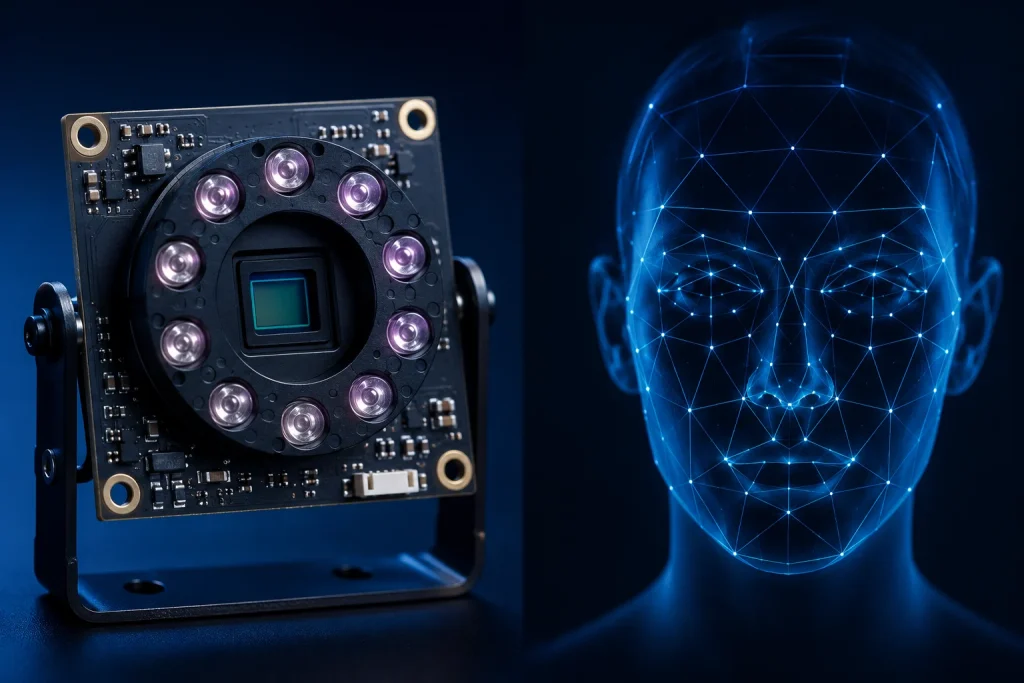
A camera module for face recognition requires more than adequate resolution — it needs NIR sensitivity for lighting-independent capture, anti-flicker ISP tuning for indoor fluorescent environments, and a liveness detection strategy (2D NIR, RGB-IR, or stereo depth) to resist spoofing attacks. Choosing the wrong module is the single most common reason face recognition systems fail accuracy benchmarks during product validation.
Key Takeaways
- Resolution minimum: 1080p (2MP) at the enrollment working distance; 5MP for gate-style terminals where face-to-camera distance exceeds 1.5 m.
- NIR is non-negotiable for 24/7 operation. 850 nm is standard for indoor access control; 940 nm for applications where a visible LED glow is unacceptable.
- Anti-flicker ISP (50/60 Hz power-line sync) is the most frequently overlooked spec — omitting it causes pass-rate drops under fluorescent or PWM-dimmed LED lighting.
- Liveness detection requires either a dedicated NIR channel, an RGB-IR sensor, or a binocular depth module — a single RGB camera cannot reliably detect spoofing attacks.
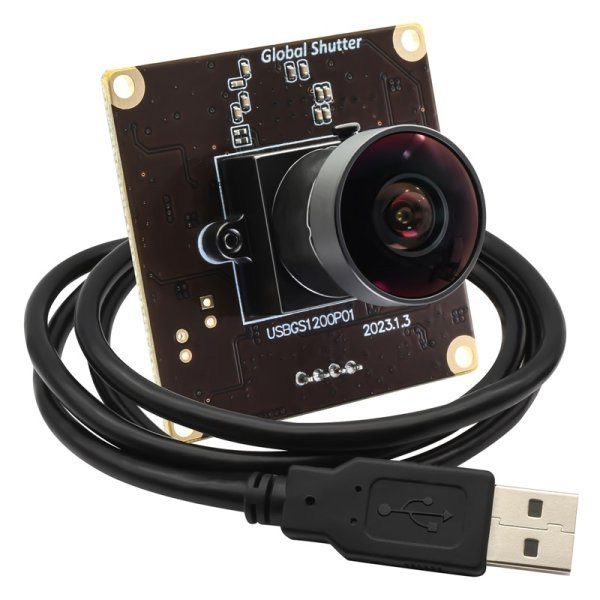
- Smeiker supplies USB and MIPI camera modules pre-tuned for face recognition environments, with NIR LED ring integration and ISP register customization from sample stage.
Why Camera Module Specs Directly Determine Face Recognition Pass Rate
Face recognition accuracy is typically benchmarked by two metrics: the False Match Rate (FMR) — the probability that an impostor is incorrectly accepted — and the False Non-Match Rate (FNMR) — the probability that a legitimate user is rejected. The NIST Face Recognition Vendor Test (FRVT), the world's largest independent face recognition benchmark, has consistently shown that image quality at the capture stage is a primary driver of FNMR — accounting for a higher proportion of real-world failures than algorithm limitations.
This means your camera module choice directly affects your system's accuracy metrics, even if you are using a top-ranked algorithm. Specifically, three hardware-level factors degrade image quality before the algorithm ever runs:
- Inadequate illumination control: Backlit subjects (e.g., user standing in front of a window) cause the ISP's auto-exposure to underexpose the face. Without HDR or active NIR fill lighting, facial features are lost in shadow — unrecoverable by software.
- Flicker artifacts: Indoor fluorescent and PWM-dimmed LED lighting cycles at 100–120 Hz (double the mains frequency). At mismatched shutter speeds, alternating dark bands appear across the face frame — raising FNMR by 5–20% in field deployments.
- Insufficient facial pixel count at working distance: At 1 m working distance, a 2MP 1/3" sensor delivers ~80–100 pixels across the inter-ocular distance (IOD). Below 60 pixels IOD, recognition accuracy drops sharply for most algorithms. At 2 m, a 2MP module falls below this threshold — requiring 5MP or optical zoom.
The sections below translate these hardware factors into a practical selection framework for access control, kiosk, hotel check-in, and smart attendance terminal applications. For a broader overview of camera module applications across industries, see our application guide.
Resolution & Working Distance: The Foundational Spec Pair
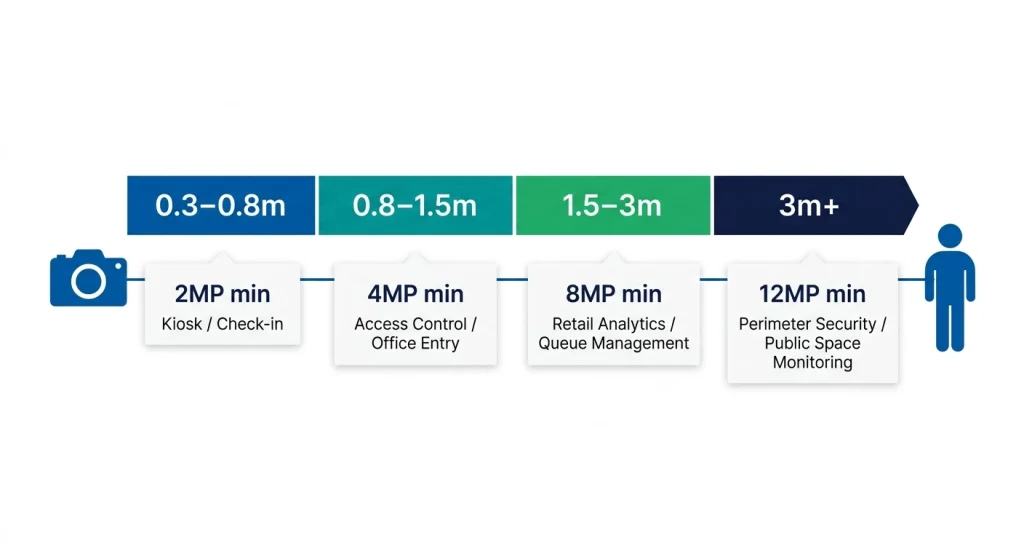
Resolution cannot be evaluated in isolation — it is only meaningful relative to the working distance (the face-to-camera distance at the enrollment and verification point) and the lens field of view. The critical derived metric is the inter-ocular pixel count: the number of pixels spanning the distance between the centers of the subject's eyes. Most leading face recognition algorithms require a minimum of 60–80 pixels IOD for reliable 1:1 verification; 100+ pixels IOD for 1:N identification in larger galleries.
| Working Distance | Minimum Resolution | Recommended Resolution | Typical Application |
|---|---|---|---|
| 0.3 – 0.8 m | 1MP (720p) | 2MP (1080p) | Door lock, desktop terminal, ATM |
| 0.8 – 1.5 m | 2MP (1080p) | 2MP–5MP | Kiosk, hotel check-in, access gate |
| 1.5 – 3 m | 5MP | 8MP–12MP | Turnstile, corridor gate, subway entrance |
| > 3 m | 12MP + optical zoom | PTZ camera or fixed telephoto | Security checkpoint, border control |
Lens FOV and Sensor Size Interaction
For a fixed resolution, a smaller sensor with a wider FOV delivers fewer pixels per face than a larger sensor with a narrower FOV at the same working distance. Most embedded face recognition terminals use a 1/3" to 1/2.8" sensor with a 70°–90° HFOV lens at 0.8–1.5 m working distance — this delivers adequate IOD pixel count for 2MP modules. Increasing the FOV beyond 100° for a "wider capture area" is a common design mistake: it reduces face pixel density and degrades FNMR unless resolution is increased proportionally.
Sensor size also affects low-light performance. A 1/2.8" sensor collects approximately 80% more light than a 1/3" sensor at the same pixel count, delivering better SNR under challenging indoor lighting. For 24/7 access control with active NIR illumination, the NIR photon flux typically dominates, reducing the sensor size impact — but for daytime RGB capture, sensor size still matters. Browse Smeiker's USB camera modules with sensor size options from 1/4" to 1/2" for kiosk and access control integration.
NIR Illumination: Why a Visible-Light-Only Camera Module Fails in Production
A camera module relying solely on visible-light RGB capture cannot meet the uptime requirements of a production face recognition system. The two failure modes are fundamental to the physics of visible light imaging, not software-correctable limitations:
- Low-light / total darkness: Indoor ambient light drops to near-zero in unlit corridors, underground parking, and during nighttime operation. At lux levels below 5, RGB sensor SNR collapses and face texture detail is lost entirely. Face recognition algorithms fail to extract usable embeddings.
- High-contrast and backlit conditions: A user standing in front of a bright window or exit door creates a 1000:1 or greater luminance ratio across the frame. Standard single-exposure ISP cannot retain face detail in shadow while exposing correctly for the background. Even HDR helps only partially.
Near-infrared (NIR) active illumination solves both problems. By flooding the face with 850 nm or 940 nm IR light — invisible to the human eye but well-detected by silicon CMOS sensors — the camera creates a controlled, lighting-independent illumination source. The result is consistent face images regardless of ambient visible light, at any time of day, in any lighting environment. As noted in e-con Systems' technical analysis of RGB-IR cameras for face recognition, NIR illumination also eliminates the demographic bias introduced by varying skin tone reflectance under visible light — a significant compliance concern for systems evaluated under NIST FRVT demographic equity standards.
NIR Wavelength: 850 nm vs 940 nm
The two dominant NIR wavelengths for face recognition are 850 nm and 940 nm. The choice has direct implications for LED drive power, camera sensitivity, working range, and user experience:
| Factor | 850 nm | 940 nm |
|---|---|---|
| CMOS Sensor Sensitivity | High — peak QE range for most silicon sensors | Lower — ~30–40% less effective than 850 nm |
| Visible Glow | Faint red glow visible to human eye | Completely invisible |
| LED Power Required | Lower (for same illumination distance) | Higher (to compensate lower sensor QE) |
| Working Range | Longer for same LED wattage | 30–40% shorter than 850 nm |
| Best For | Standard indoor access control, kiosks, ATMs | Luxury environments, covert operation, museums |
| Camera Compatibility | Virtually all NIR-capable CMOS sensors | Requires BSI sensor or dedicated NIR-enhanced sensor |
For the vast majority of face recognition terminal deployments — access control, hotel check-in, office attendance — 850 nm is the recommended default. It delivers the best balance of LED power efficiency, working range, and sensor compatibility. Use 940 nm only when the visible red glow of 850 nm LEDs is aesthetically unacceptable or a brand/design constraint.
Project Case — 940 nm Upgrade for Luxury Hotel: "A hospitality technology integrator in the Middle East specified our standard 850 nm NIR face recognition module for a five-star hotel's VIP suite access control system. During installation review, the hotel's interior design team flagged that the faint red LED glow was visible in the dark corridor and conflicted with the ambient lighting concept. We replaced the NIR LED ring from 850 nm to 940 nm Osram SFH 4716AS emitters, upgraded the ISP exposure baseline to compensate for the 35% QE reduction at 940 nm, and validated the system in a mock-up corridor at the factory under 2-lux ambient conditions — simulating the hotel's nighttime corridor lighting. Verification response time went from 280 ms to 310 ms (within acceptable range for the application). The completely invisible NIR illumination was approved by the design team in one review cycle. We produced 120 custom modules with the 940 nm LED ring and application-specific ISP register table within 10 weeks of the design change." — Smeiker ODM Project Management Team
Why ISP Tuning Matters More Than Megapixels for Face Recognition
Two camera modules with identical sensors and resolution can produce dramatically different face recognition pass rates — because the Image Signal Processor (ISP) determines how raw sensor data is converted into a usable image frame. For face recognition specifically, three ISP parameters have the greatest impact on FNMR:
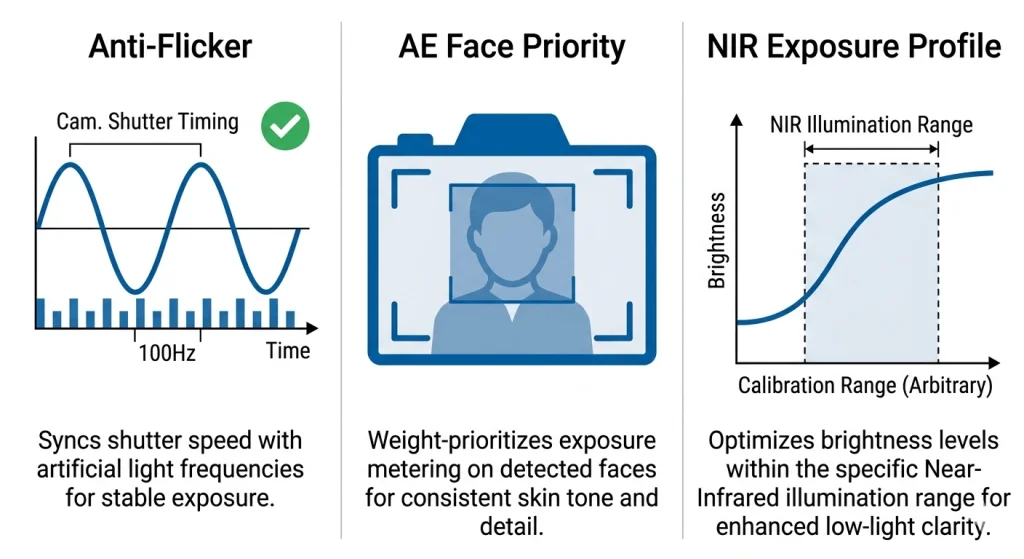
1. Anti-Flicker (Power-Line Frequency Sync)
Fluorescent tubes and many PWM-dimmed LED panels modulate their light output at 100 Hz (50 Hz mains × 2) in Europe and Asia, or 120 Hz (60 Hz mains × 2) in North America. When the camera's exposure time is not an exact integer multiple of the mains half-cycle, each captured frame sees a different phase of the lighting cycle — producing alternating bright/dark horizontal bands across the face. This artifact raises FNMR by 5–20% in field deployments and is not correctable in software post-capture.
The fix is a dedicated ISP anti-flicker register that constrains the auto-exposure algorithm to only select shutter speeds that are integer multiples of 1/100 s (for 50 Hz environments) or 1/120 s (for 60 Hz). For global deployments, the ISP must support auto power-line frequency detection or offer a field-configurable register — not a fixed factory setting. Smeiker configures anti-flicker registers as a standard step in all face recognition module ISP tuning packages, with both 50 Hz and 60 Hz profiles validated before sample delivery.
2. Auto-Exposure Curve Tuning for Face Priority
The default ISP auto-exposure curve in a consumer or general-purpose camera module is calibrated to expose correctly for the average luminance of the entire frame. In a face recognition terminal, the subject's face occupies 20–40% of the frame and may be 3–5 stops underexposed relative to a bright background. Face-priority exposure weighting shifts the metering zone to a central facial region — ensuring the face is correctly exposed even when the background is significantly brighter. This is implemented as a custom AE (auto-exposure) weight map in the ISP register table, not a feature that can be enabled via a standard V4L2 or UVC control.
3. Noise Reduction and Sharpening Profile
Face recognition algorithms operate on facial landmark coordinates derived from edge detection across the face. Over-aggressive noise reduction blurs fine facial texture — reducing landmark detection confidence. Under-aggressive NR leaves high-frequency sensor noise that the algorithm interprets as false edges. ISP tuning for face recognition requires a calibrated NR profile that preserves genuine facial texture at the expected illumination level (typically 200–800 lux for indoor NIR, 20–200 lux for ambient visible light). This is a 2–4 hour ISP calibration task per lighting scenario, typically performed against a test gallery of 50–100 reference face images.
Factory Perspective — ISP Exposure Mismatch in Field: "A Southeast Asian access control integrator returned a batch of 200 face recognition terminals reporting that pass rates had dropped from 96% in the lab to below 70% at installation sites. The terminals were deployed across office buildings in Thailand and Indonesia. Our analysis showed the root cause was a combination of two ISP issues: the 50 Hz anti-flicker register had not been set — their host application was defaulting to 60 Hz, causing banding under the 50 Hz fluorescent ceiling lights used in all five office buildings. Additionally, the auto-exposure weight map was set to full-frame averaging, so the ISP was overexposing for the white office walls visible behind users, severely underexposing the face region. We issued an updated ISP register table addressing both issues — anti-flicker set to auto-detect with a 50 Hz default, and AE weight concentrated in the central 40% × 60% of the frame. After the firmware update was pushed to all 200 terminals, pass rates recovered to 94.5%. The customer reported no further field failures in the subsequent six-month deployment period." — Smeiker ISP Engineering Team
Liveness Detection: Three Camera-Level Approaches to Anti-Spoofing
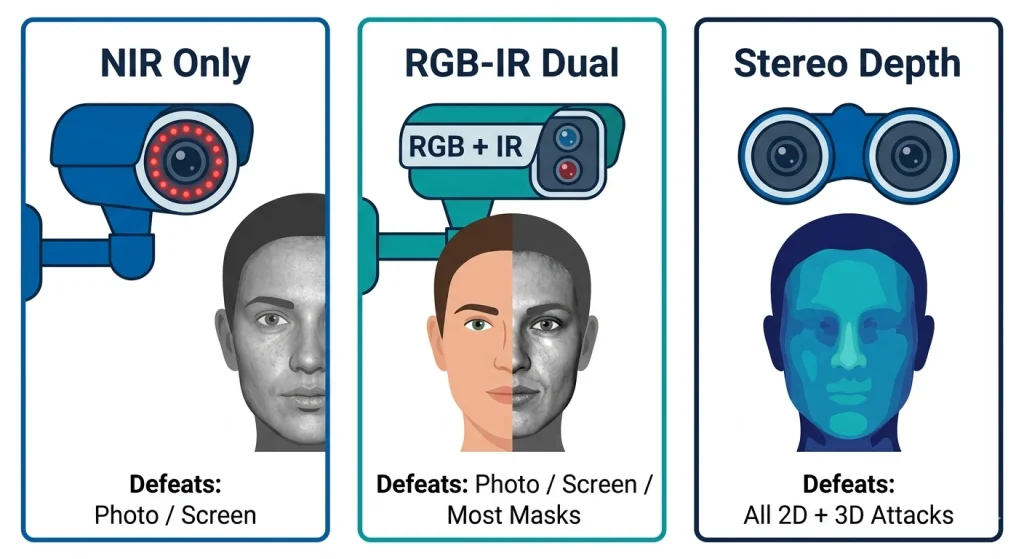
Facial recognition systems are vulnerable to presentation attacks — where an impostor holds up a printed photo, replays a video on a screen, or presents a 3D mask to defeat the algorithm. Liveness detection (also called Presentation Attack Detection, PAD) is the hardware and software layer that distinguishes a real, live face from a spoofing artifact. There are three camera-hardware-level approaches, each with different cost, complexity, and detection capability:
Approach 1 — Dedicated NIR Channel (2D NIR Liveness)
A single NIR camera captures near-infrared images under 850/940 nm illumination. Human skin has distinctive NIR reflectance properties: it absorbs strongly at some wavelengths and reflects at others, creating texture gradients invisible to printed paper or LCD screens. A photo or screen replay appears uniformly flat under NIR illumination. The algorithm detects liveness by analyzing NIR texture variance. This is the lowest-cost approach and is sufficient for most commercial access control applications. Required hardware: NIR-sensitive CMOS sensor + 850/940 nm LED ring + no visible-light RGB channel required (though RGB is typically included for HR logging and audit images).
Approach 2 — RGB-IR Dual-Channel (Simultaneous Visible + NIR)
An RGB-IR sensor integrates both visible-wavelength pixels and NIR-sensitive pixels in the same Color Filter Array, capturing a combined RGB+IR frame that the ISP separates into a visible color image and an NIR-only image in a single exposure. This enables simultaneous visible-light face recognition (for high-accuracy identification) and NIR-based liveness detection without the cost or form factor penalty of a dual-sensor assembly. Sensors with RGB-IR CFA support include models from OmniVision and onsemi. The ISP must separate the two streams — a non-trivial processing step that requires a dedicated algorithm to subtract IR contamination from the RGB channels. This approach delivers stronger anti-spoofing against 3D mask attacks compared to NIR-only systems.
Approach 3 — Binocular / Stereo Depth (3D Liveness)
A binocular camera module generates a depth map of the face at capture time. A flat printed photo produces a nearly uniform depth map (near-zero disparity variance); a real face has characteristic depth structure — nose tip 15–25 mm closer than the ear planes. The algorithm detects liveness by comparing the depth variance against a real-face model. This is the most robust approach against all 2D attacks (photos, screens) and most 3D mask attacks (flat silicone masks without accurate facial geometry). The hardware cost is higher (two sensors + baseline calibration) and compute requirements increase significantly. Use when security requirements demand resistance to 3D mask attacks.
| Approach | Defeats Photo/Screen | Defeats 3D Mask | Relative Cost | Best For |
|---|---|---|---|---|
| NIR Only | ✅ Yes | ⚠️ Partially | Low | Office access, attendance, kiosk |
| RGB-IR Dual | ✅ Yes | ✅ Most masks | Medium | Hotel check-in, ATM, smart retail |
| Stereo Depth | ✅ Yes | ✅ Yes (geometry check) | High | High-security gates, border control, financial terminals |
Recommended Sensors & Interface for Face Recognition Camera Modules
Sensor and interface selection should follow directly from the application tier defined by working distance, liveness method, and host platform. The following recommendations cover the most common production scenarios.
Recommended Sensors by Tier
- Entry tier (0.3–0.8 m, NIR only, cost-sensitive): OmniVision OV9782 — 1MP, 1/4" BSI, 60 fps at 720p, strong NIR QE at 850/940 nm, low power draw (under 200 mW). Ideal for smart door locks, desktop attendance terminals, and low-cost kiosks.
- Standard tier (0.8–1.5 m, NIR or RGB-IR, mainstream access control): Sony IMX415 — 8MP, 1/2.8" BSI, 4K/60fps or 1080p/120fps, excellent SNR, wide dynamic range. Most widely deployed sensor in commercial face recognition terminals. OmniVision OV5647 or OV2710 are cost-alternative options at 5MP and 2MP respectively.
- High-resolution tier (1.5–3 m, turnstile / gate, high gallery size): Sony IMX678 — 8MP, 1/1.8" BSI, 4K, STARVIS 2 low-light, global shutter option. Suitable for non-cooperative surveillance-style face recognition where subjects do not pause at an enrollment point.
- RGB-IR tier: OmniVision OV7251 (NIR-dedicated channel) paired with a visible-light sensor for dual-sensor assemblies; or OmniVision sensors with integrated RGBIR CFA for single-sensor RGB-IR implementations.
USB vs MIPI Interface for Face Recognition Systems
Interface choice is driven by the host platform:
- USB (UVC): Dominant choice for kiosk and terminal designs built on x86 embedded boards (Intel NUC, Celeron-based all-in-ones) or ARM SBCs with a full Linux OS. UVC compliance means no custom driver, reducing integration time by 3–5 weeks. Supports up to 4K at USB 3.0. Smeiker's USB face recognition camera modules include pre-configured ISP tables for indoor NIR environments.
- MIPI CSI-2: Preferred for dedicated face recognition SoC platforms (Rockchip RV1126, RK3568, NXP i.MX8M) where the ISP pipeline runs on the SoC itself rather than in the module. Lower latency (~2 ms vs. 10–30 ms USB), lower power, no USB controller overhead. Required for designs with <300 ms end-to-end authentication latency. Review our interface comparison guide for detailed USB vs. MIPI latency and bandwidth specs.
For face recognition module customization — NIR LED ring integration, ISP register tuning, sensor selection, and PCB form factor — contact Smeiker's ODM/OEM engineering team with your application spec.
Frequently Asked Questions
What resolution camera module do I need for face recognition?
At 0.3–0.8 m working distance, 1MP (720p) is the minimum; 2MP (1080p) is recommended. At 0.8–1.5 m (typical kiosk or access gate), 2MP–5MP. At 1.5–3 m (turnstile, corridor gate), 5MP–8MP minimum. The key metric is inter-ocular pixel count — most algorithms require 60–80+ pixels between the eyes for reliable verification.
Why does my face recognition pass rate drop under fluorescent lighting?
Fluorescent and PWM-dimmed LED lights cycle at 100 Hz (50 Hz mains) or 120 Hz (60 Hz mains). If the camera's ISP anti-flicker register is not set to match the local power-line frequency, each frame sees a different phase of the lighting cycle, producing horizontal banding across the face image. This raises FNMR by 5–20% and is not correctable in post-processing. The fix is configuring the ISP anti-flicker register to the correct regional mains frequency.
What is the difference between 850 nm and 940 nm NIR for face recognition?
850 nm has higher CMOS sensor sensitivity, longer working range for the same LED power, and is the standard choice for most indoor face recognition applications. It emits a faint red glow visible in dark environments. 940 nm is completely invisible, making it preferred for aesthetically sensitive installations — but requires 30–40% more LED power to achieve equivalent illumination range, and needs sensors with higher NIR QE (ideally BSI technology).
Can a single RGB camera module detect liveness / anti-spoofing?
A single RGB camera can implement software-based 2D liveness (blink detection, challenge-response motion) but is fundamentally limited against high-quality printed photos and video replay attacks. Hardware-level liveness detection — NIR texture analysis, RGB-IR dual channel, or stereo depth — provides significantly more reliable protection against presentation attacks and is recommended for any access control application with genuine security requirements.
Does Smeiker supply camera modules pre-tuned for face recognition?
Yes. Smeiker supplies USB and MIPI camera modules with ISP configuration pre-tuned for face recognition environments: anti-flicker register set to your regional mains frequency, face-priority AE weight map, NIR exposure profile for 850 nm or 940 nm, and noise reduction calibrated for 200–800 lux indoor NIR operation. NIR LED ring integration is available as an ODM option. Contact us with your working distance, liveness detection tier, and host platform.
Need a Camera Module Configured for Face Recognition?
Tell us your working distance, liveness detection requirement, host platform, and annual volume. Smeiker will recommend a pre-tuned module — or configure one from our ODM platform — and deliver samples within 6 weeks.
Get a Free Quote →