
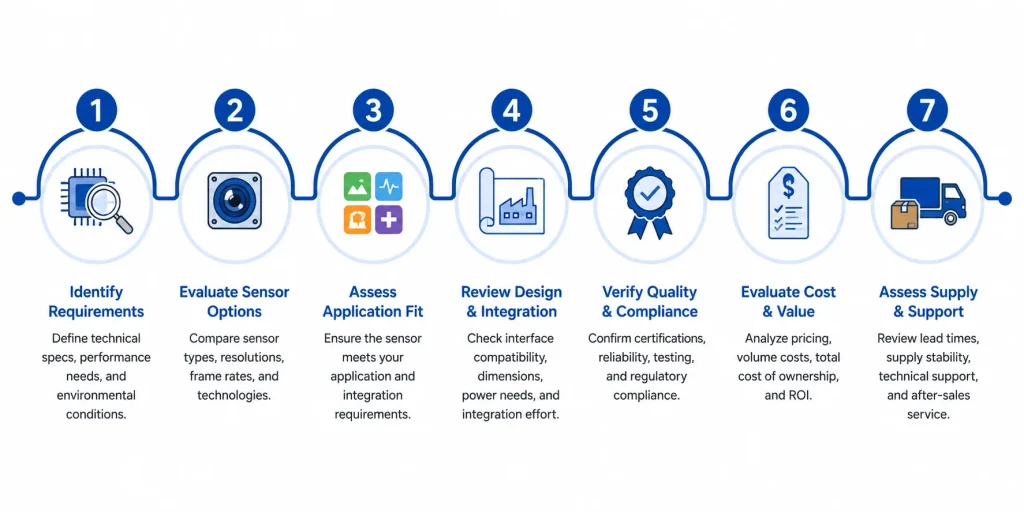
Choosing the right camera module manufacturer determines your product's image quality, certification timeline, unit cost, and long-term supply stability — and the decision involves far more than comparing megapixel numbers on a datasheet. This guide walks hardware engineers, product managers, and procurement teams through 7 sequential steps: understanding specifications, selecting sensor/shutter/interface, matching modules to your application, choosing OEM vs ODM, verifying certifications, evaluating pricing and samples, and planning long-term supply. Each step links to an in-depth technical guide — bookmark this page as your sourcing map.
Key Takeaways
- The global camera module market is valued at roughly $41.5 billion in 2025, growing steadily — meaning more manufacturers, more noise, and a wider quality gap between suppliers than ever.
- Specification clarity comes first. Resolution, shutter type, and interface (USB/MIPI/DVP) determine which sensors and platforms are even compatible with your project.
- Application context changes the spec sheet. A face recognition kiosk, an AGV, and a binocular depth system each need fundamentally different modules.
- OEM vs ODM determines your IP ownership, NRE cost, and time-to-market — get this decision wrong and you pay for it twice.
- Certifications (CE, FCC, RoHS) at the module level support — but don't replace — your finished product's compliance documentation.
- Pricing, samples, and lead times are where most supplier relationships succeed or fail — this guide shows what to check before placing a PO.
How to Use This Camera Module Sourcing Guide
Each of the 7 steps below links to a dedicated technical article covering that topic in depth. If you already know which step applies to your current decision, jump straight there using the list below — otherwise, work through all 7 in order for a complete sourcing framework.
- Step 1: Camera Module Fundamentals & Specifications
- Step 2: Sensor, Shutter Type & Interface Selection
- Step 3: Match Modules to Your Application
- Step 4: OEM vs ODM Manufacturing
- Step 5: Certifications & Compliance
- Step 6: Pricing, Samples & Quality Control
- Step 7: Lead Times & Long-Term Supply
- Camera Module Supplier Evaluation Checklist
- FAQ
Step 1 — Camera Module Fundamentals & Specifications
Before contacting any camera module manufacturer, you need a working vocabulary for the parameters that actually drive cost, compatibility, and performance: sensor size and resolution, pixel size, shutter type, interface, lens mount and field of view, operating temperature range, and power consumption. A camera module specification sheet packs all of these into a one-page table — but each parameter interacts with the others, so reading it in isolation leads to mismatched expectations.
The global camera module market — valued at approximately $41.55 billion in 2025 and projected to reach $51.38 billion by 2030 — spans everything from sub-$2 consumer modules to multi-hundred-dollar global shutter industrial sensors. That price range exists because "camera module" describes a category, not a product; your specification determines where in that range you land.
Our foundational guide, What Is a Camera Module? Types, Interfaces & How to Choose, walks through every core parameter with plain-language definitions and decision criteria — start there if any term above is unfamiliar before moving to Step 2.
Step 2 — Sensor, Shutter Type & Interface Selection
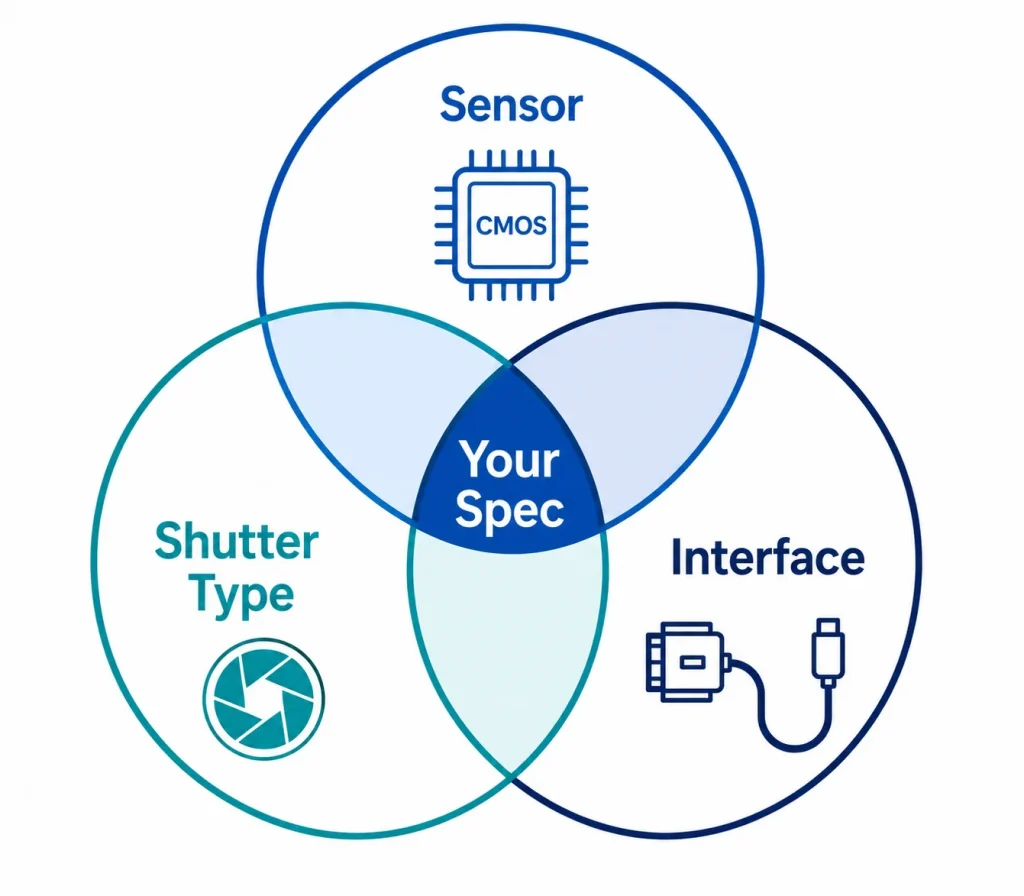
Three interlocking decisions form the technical core of any camera module specification: which CMOS image sensor to use, whether it needs a global or rolling shutter, and which interface connects it to your host platform. Get any one of these wrong and the other two often have to change too.
- Sensor selection: resolution, pixel size, low-light sensitivity, and sensor family (Sony Starvis vs Pregius, OmniVision, etc.) determine image quality and cost. See our CMOS sensor selection guide for a parameter-by-parameter walkthrough.
- Shutter type: rolling shutter is cheaper and better in low light; global shutter is mandatory for any application with relative motion above ~0.5 m/s. Our global shutter vs rolling shutter guide gives a decision framework.
- Interface: USB is driverless and host-flexible; MIPI CSI-2 is lower-latency and standard on ARM SoCs; DVP is simplest for MCU-based designs but bandwidth-limited. Compare all three in our USB vs MIPI vs DVP comparison and the deeper DVP vs MIPI technical breakdown.
Factory Perspective — Translating "I Need a Good Camera" Into a Spec: "The single most common message we receive from new OEM customers is some version of: 'we need a good quality camera module for our product.' That sentence alone is unspecifiable — it could describe a $1.20 OV2640 DVP module or a $45 global shutter MIPI module, a 30x difference in unit cost. Our standard intake process now starts with five questions before any quote: what host platform/SoC, what working distance and lighting environment, is there relative motion in the scene, what's the target unit cost at your volume, and what's your annual quantity. These five answers alone usually narrow the field from 'any of 200 modules in our catalog' to '3 specific candidates.' Customers who arrive having already read through resolution, shutter type, and interface basics — even at a high level — typically reach a confirmed sample order 2-3 weeks faster than those who start from 'we need a good camera,' because we skip 1-2 rounds of clarifying questions entirely." — Smeiker Pre-Sales Engineering Team
Step 3 — Match Modules to Your Application
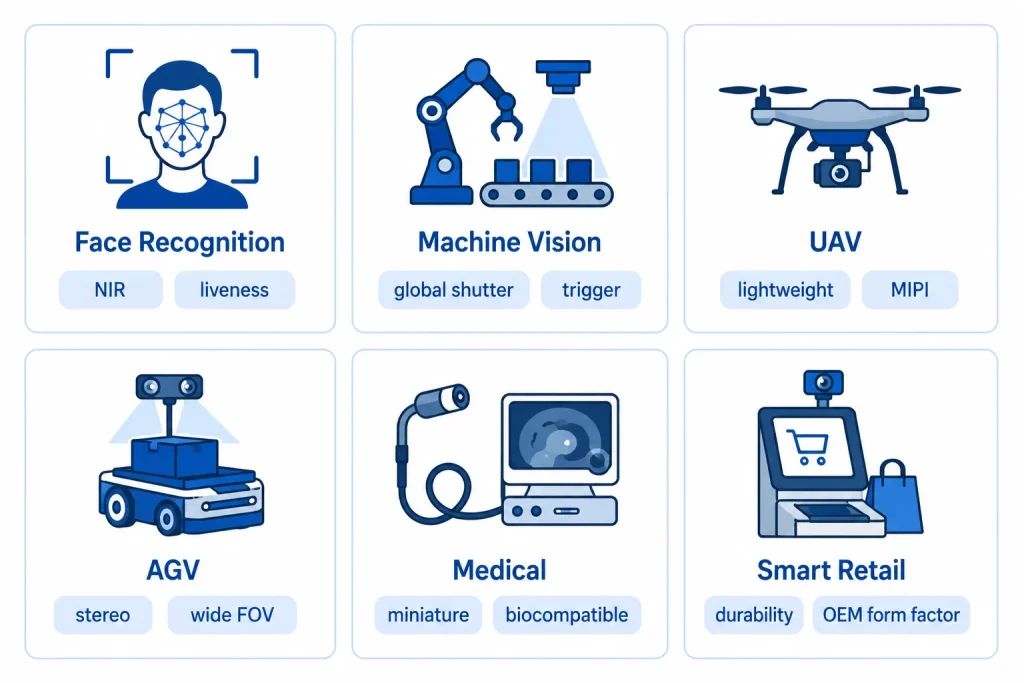
The same sensor and interface decisions from Step 2 get weighted very differently depending on what you're building. A face recognition kiosk, an AGV navigation system, and a UAV payload share almost no specification priorities despite all being "camera modules."
- General application mapping: our camera module applications guide covers 6 industry use cases — face recognition, machine vision, UAV, AGV, medical, and smart retail — with the spec priorities for each.
- 3D / depth sensing: if your application needs obstacle detection, bin picking, or liveness detection, our binocular camera module guide explains baseline selection and stereo calibration.
- Face recognition specifically: NIR wavelength, ISP anti-flicker tuning, and liveness detection method are covered in depth in our face recognition camera module guide.
If your application doesn't map cleanly to one of these, the underlying principle still holds: identify your working distance, lighting environment, and whether the camera or subject moves — those three answers determine 80% of your spec sheet regardless of industry.
Step 4 — OEM vs ODM Manufacturing
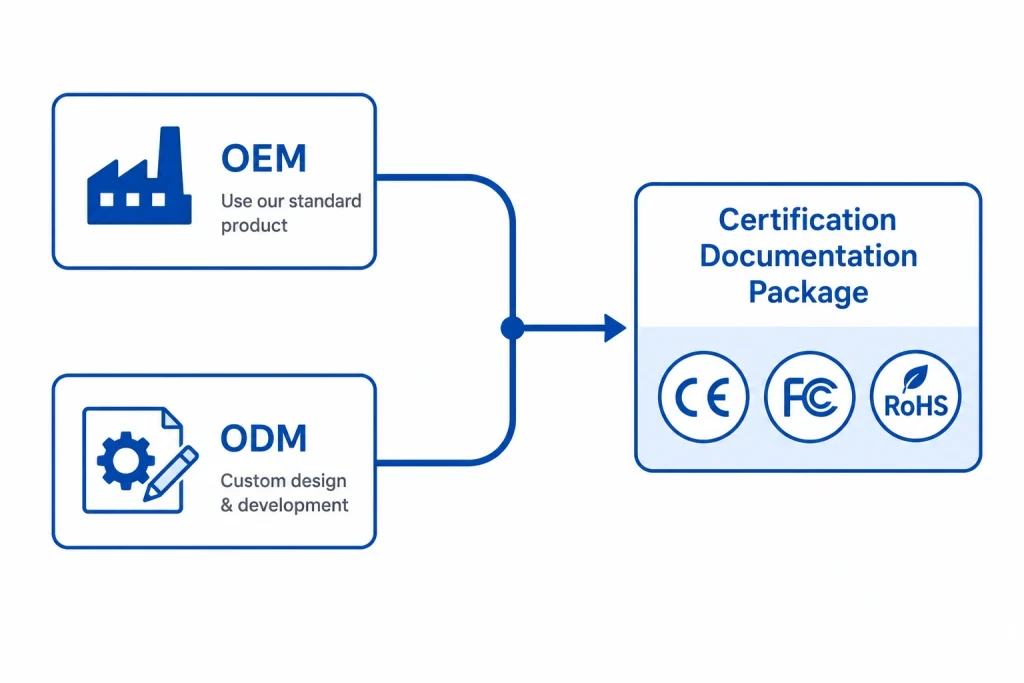
Once your specification is defined, the next decision is how your camera module manufacturer will produce it: a fully custom OEM design that you own, or an ODM platform from the manufacturer's existing portfolio that you customize within defined parameters. This decision affects your NRE cost, IP ownership, sample lead time, and minimum order quantity (MOQ) — often by an order of magnitude.
For the large majority of B2B hardware products — kiosks, AGVs, access control terminals, IoT devices — an ODM camera module manufacturer with a strong existing platform delivers 80-90% of the differentiation of full OEM at a fraction of the cost and timeline. Full OEM becomes necessary for regulated industries (automotive, medical) or very high volumes where per-unit BOM optimization pays back the NRE. Our OEM vs ODM camera module guide covers the full 5-stage development process, cost benchmarks, and supplier evaluation criteria for either path.
Where Camera Module Manufacturers Are Located
Most ODM and custom camera module manufacturers are concentrated in the Pearl River Delta region of Guangdong, China — Shenzhen, Dongguan, and Guangzhou form a dense industrial cluster of sensor distributors, lens manufacturers, PCB fabs, and assembly houses, enabling fast prototyping and short supply chains for components. A China-based custom camera module manufacturer in this cluster typically offers shorter sample lead times and lower NRE than manufacturers in regions with less vertically-integrated supply chains, though Taiwan, South Korea, and Southeast Asia each have their own specialization niches worth considering for specific sensor technologies or labor-cost profiles.
Step 5 — Certifications & Compliance
Camera module certifications — CE, FCC, and RoHS — don't certify your finished product, but the documentation your manufacturer provides directly supports (or undermines) your own certification timeline. A supplier who cannot produce a real RoHS material declaration or FCC Part 15B reference test data when asked is a significant schedule risk discovered far too late if you wait until your own product enters testing.
Our camera module certifications guide covers exactly what CE marking, FCC Part 15B, and the 2024 RoHS Category 9 exemption changes mean for industrial camera modules, plus a verification checklist for evaluating any supplier's compliance claims before you commit to a design.
Step 6 — Pricing, Samples & Quality Control
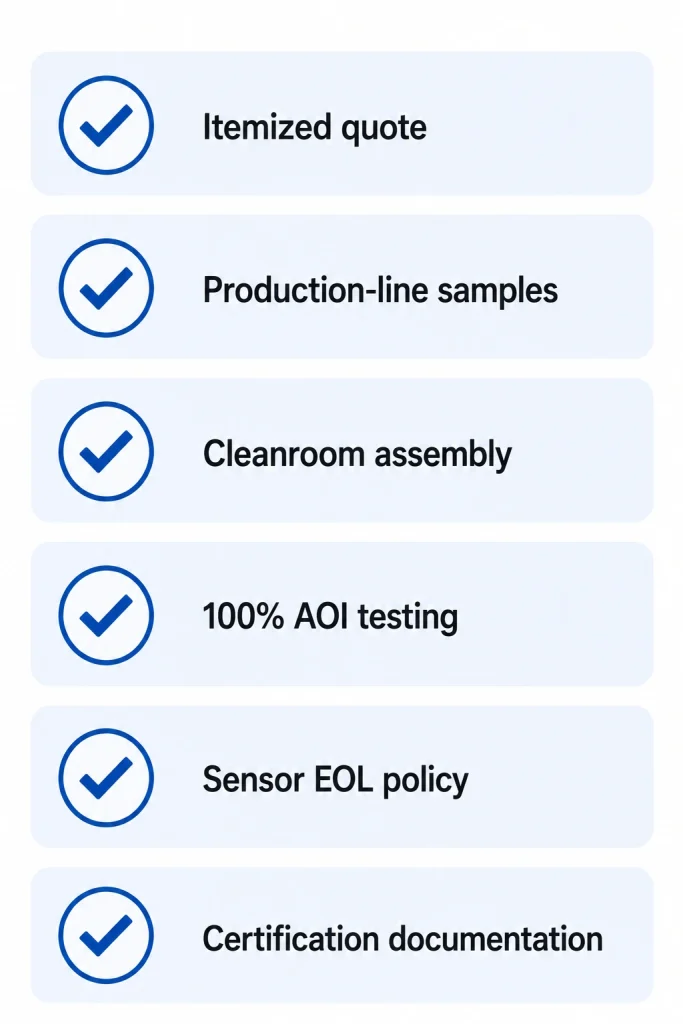
Camera module pricing varies dramatically based on sensor choice, shutter type, MOQ, and customization depth — the same nominal "2MP USB camera module" can range from under $5 to over $40 depending on these factors. Request an itemized quote (sensor, PCB, lens, assembly, NRE if applicable) rather than a single bundled number; this is the only way to compare quotes from different camera module manufacturers on equal terms and to understand which line items scale with volume versus which are fixed.
Camera module sample evaluation should never be skipped, even for "standard" off-the-shelf modules — verify the sample was produced on the actual production line (not hand-built by engineering), test under your real lighting and mounting conditions, and confirm ISP tuning matches your environment before approving for mass production. Camera module quality control practices worth verifying with any manufacturer include: cleanroom lens assembly (Class 1000 or better), 100% AOI/electrical test coverage before lens installation, and AQL-based sampling inspection at pilot production. Our OEM vs ODM guide covers the EVT/DVT sample evaluation stages and typical cost/timeline benchmarks for both ODM and full OEM programs.
Step 7 — Lead Times & Long-Term Supply
Camera module lead time has two very different phases: sample lead time (4-12 weeks depending on ODM vs OEM) and mass production lead time (4-10 weeks per PO once tooling and processes are validated). For products with multi-year production lifecycles, the more important question is what happens when your sensor reaches end-of-life — does your manufacturer have a documented sensor migration policy with advance notice, or will an EOL notice from the sensor vendor become an unplanned redesign project on your side?
A long-term supply agreement should address minimum annual commitments, price adjustment mechanisms, tooling ownership, and — critically — sensor EOL notification with a pin-compatible replacement path. These terms are covered as part of the 5-stage development process in our OEM vs ODM camera module guide, and certification documentation continuity across a sensor migration is covered in our certifications guide.
Camera Module Supplier Evaluation Checklist
Use this checklist to compare camera module manufacturers across the dimensions that actually predict a successful long-term relationship — not just unit price.
| Evaluation Area | What to Ask For | Red Flag |
|---|---|---|
| Technical Capability | In-house ISP tuning, reference designs for your platform | Relies entirely on sensor default ISP settings |
| Manufacturing Model | Clear OEM vs ODM terms, IP ownership in writing | Ambiguous about who owns design files |
| Certifications | RoHS material declaration, FCC reference test data, ISO 9001 | One-page "certificate" with no test data |
| Pricing | Itemized BOM-level quote | Single bundled price, no breakdown |
| Samples | Production-line EVT/DVT samples | Hand-built "engineering" samples only |
| Quality Control | Cleanroom assembly, 100% AOI, AQL pilot inspection | No documented QC process |
| Long-Term Supply | Documented sensor EOL/migration policy | No EOL history or plan |
Why Smeiker Is the Camera Module Manufacturer Behind This Guide
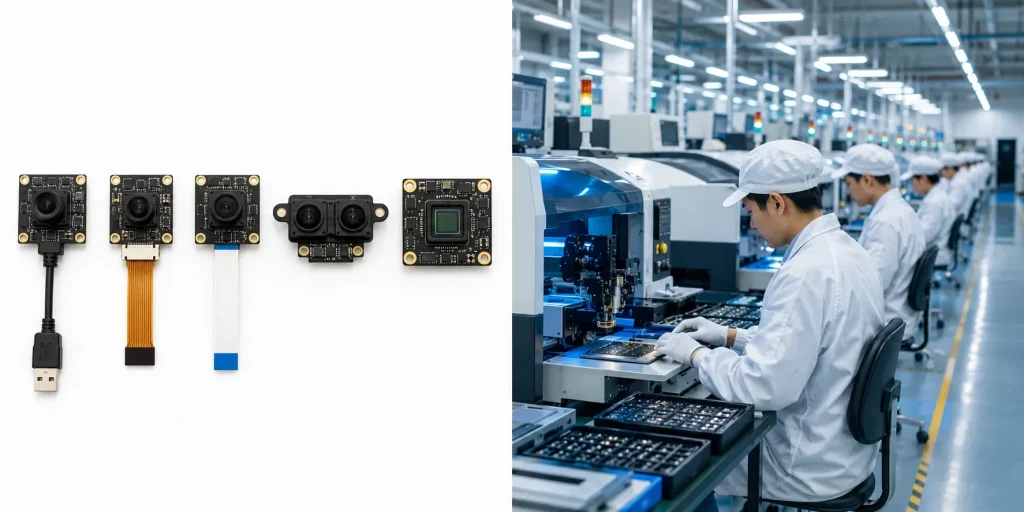
Smeiker Technology designs and manufactures USB, MIPI, DVP, global shutter, and binocular camera modules for industrial OEM/ODM integration, with in-house ISP tuning, cleanroom lens assembly, 100% AOI electrical testing, and ISO 9001-certified production. Every module ships with the certification documentation package described in Step 5 — RoHS material declarations, FCC reference test data, and Supplier Declarations of Conformity — as standard, not on request.
Project Case — A Complete Sourcing Journey: "A smart kiosk manufacturer in the Netherlands came to us at the very beginning of their sourcing process — they had a product concept (a hotel self-check-in terminal with face recognition) but no camera specification at all. We walked through the same framework as this guide: Step 1-2 established that their use case needed a 2MP USB module with NIR capability and anti-flicker ISP tuning for European 50Hz lighting; Step 3 confirmed face recognition with RGB-IR liveness detection as the application fit; Step 4 led to an ODM path using our existing OV9782-based platform with a custom PCB cutout for their kiosk's circular camera housing; Step 5 required full RoHS and CE EMC reference documentation for their EU certification; Step 6 involved two rounds of sample evaluation — the first sample's NIR LED ring needed repositioning for their housing's glass thickness; Step 7 established a 3-year supply agreement with sensor migration commitments. From first inquiry to confirmed production order: 11 weeks. The customer's product passed CE certification on the first submission, with our EMC reference data cited directly in their technical file. They have since ordered four additional production runs totaling 6,000 units, with zero quality-related returns." — Smeiker OEM/ODM Program Management Team
Whatever stage of this 7-step process you're at, contact Smeiker's engineering team — we can usually tell you within 48 hours whether an existing ODM platform fits your spec or whether a custom design is needed.
Frequently Asked Questions
How do I choose a camera module manufacturer?
Work through the 7 steps in this guide: define your specification (sensor, shutter, interface), match it to your application, decide OEM vs ODM, verify certifications, evaluate pricing and samples on equal terms, and confirm a long-term supply plan. A manufacturer who can speak fluently to all 7 areas — not just price — is significantly lower risk for a multi-year product.
What's the difference between a camera module supplier and a camera module manufacturer?
A "supplier" may be a trading company that resells another factory's modules without manufacturing capability of its own — this can still work for standard catalog modules, but limits customization and quality control visibility. A manufacturer operates its own production line (SMT, lens assembly, testing) and can offer ODM/OEM customization, in-house ISP tuning, and direct quality control — generally the better choice for any product beyond a one-off prototype.
How much does it cost to get custom camera module samples?
For ODM customization (lens, connector, ISP tuning, PCB form factor), sample fees typically range from $200-$1,000 with 4-8 week lead times. Full OEM custom designs run $1,000-$5,000 for samples with 10-16 week lead times, plus NRE of $5,000-$50,000+ depending on complexity. See our OEM vs ODM guide for full cost benchmarks.
What is the minimum order quantity (MOQ) for custom camera modules?
ODM customization typically starts at 500 units MOQ; full OEM custom PCB designs typically require 1,000+ units. Some manufacturers offer lower "evaluation" quantities (50-100 units) at a price premium to validate a platform before committing to the full MOQ.
Do I need different camera modules for different regions (EU vs US)?
The hardware is often identical, but ISP tuning may need region-specific anti-flicker settings (50Hz vs 60Hz), and certification documentation differs (CE/RoHS for EU, FCC for US). A capable manufacturer maintains both ISP profiles for the same hardware SKU and can provide region-appropriate compliance documentation without a hardware change.
Can Smeiker help if I don't know my specification yet?
Yes — this is the most common starting point. Describe your application, host platform (if known), and target volume, and our pre-sales engineering team will work through Steps 1-3 of this guide with you to arrive at a candidate specification before any quote is issued. Contact us to start.
Ready to Start Sourcing Your Camera Module?
Whether you're at Step 1 (no spec yet) or Step 7 (planning long-term supply), Smeiker's engineering team can help. Tell us about your application, host platform, and volume — we'll respond within 48 hours.
Get a Free Quote →